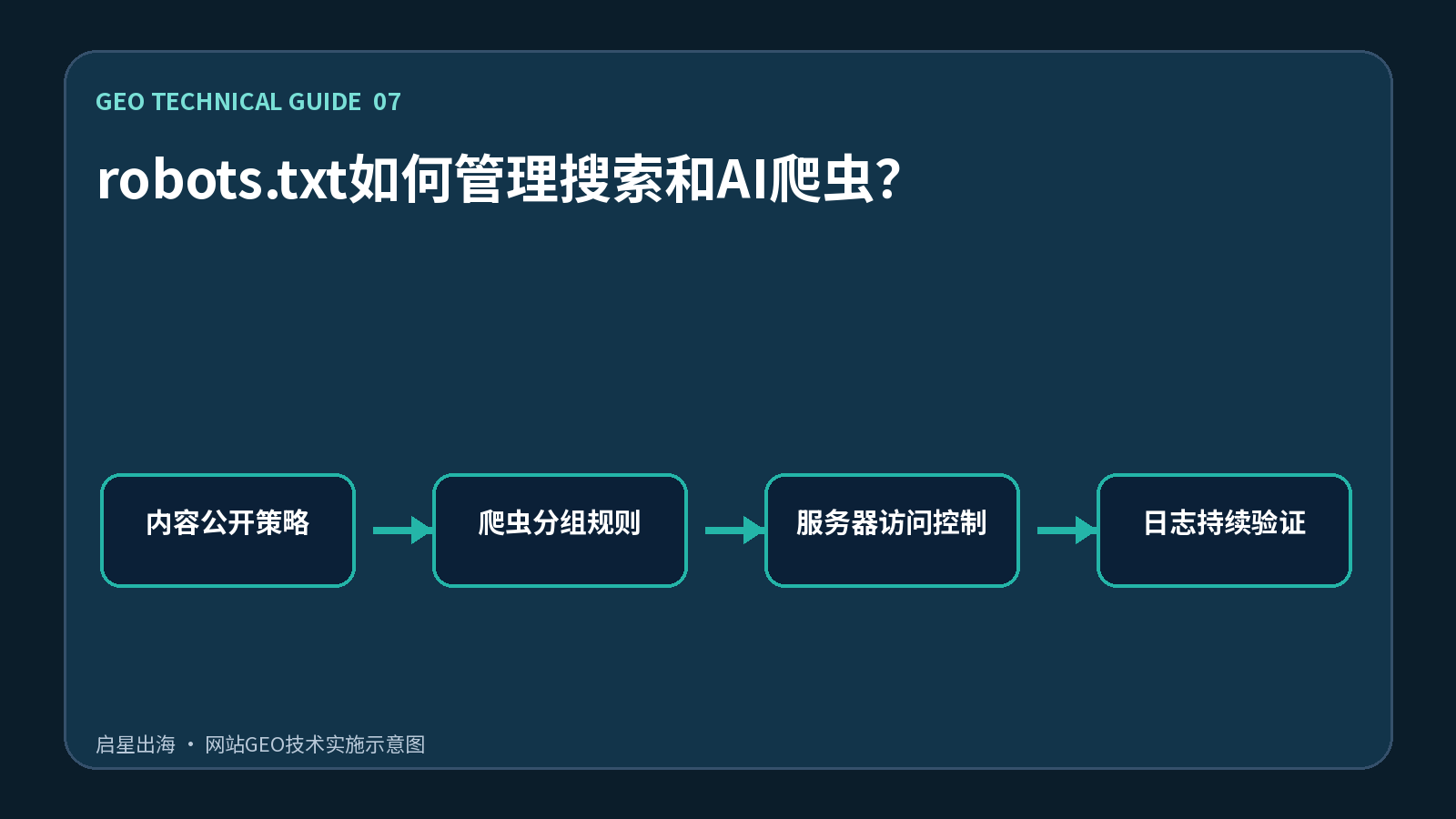
Robots.txt is a tool for capturing control files, not privacy protection, or for ensuring that pages are not indexed. The GEO project needs to consider both traditional and user-triggered reptiles, AIS reptiles, training reptiles, and user-triggered grabs, but it cannot be confused with all User-agents. Enterprises should allow or limit each other according to their content-public strategy, and ensure that Sitemap, the public page and the necessary resources are not missealed.
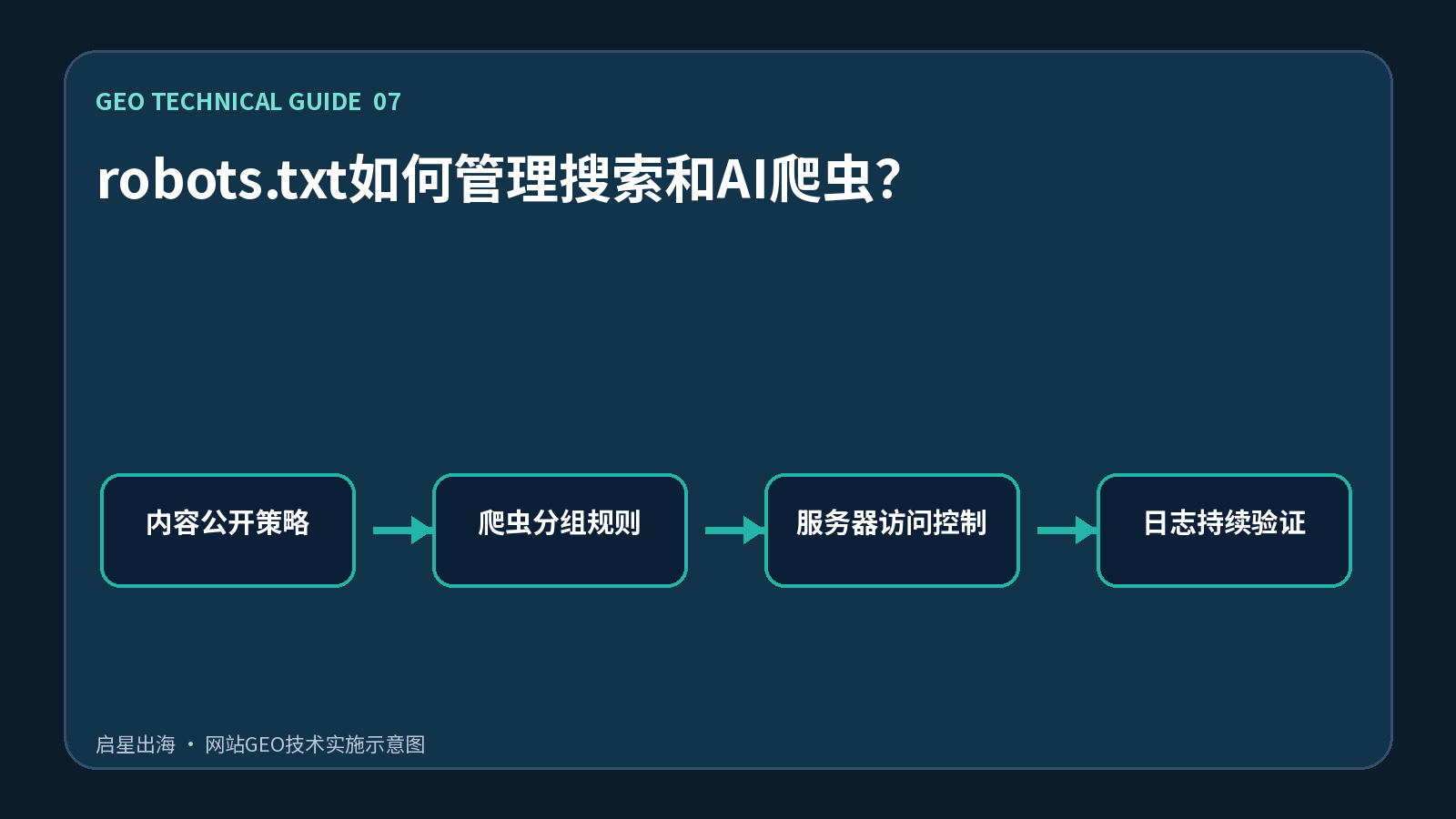
The reptiles will read permitted and banned paths in accordance with the User-agent matching rules. Different platforms may provide independent robotic names and descriptions of uses, so search applications and model training for the same company can also be two control items. Disallow prevents the capture of content, but external links may still lead to the discovery of URLs; if an index is needed to stop, it is usually allowed to read noindex, or to use authentication and access controls.
Lists public content, backstage, installation directories, logs, search result pages, parameter pages and download files, and defines which can be retrieved. Robots.txt maintains the least clear and clear rules, uses absolute Sitemap addresses and addresses for identified robot name configurations. Do not copy the list of ultra-long reptiles from unknown sources. Test whether key URLs are allowed by the target rules, then check whether CDNs, WAFs and speed limits intercept legitimate robots. Robots.txt changes should enter version management and record changes.
Monitors the access path, status code and frequency of access in the server log. The rules should be amended to observe whether the target reptile has stopped or resumed access and to check the capture and index reports of platforms such as Google Seach Console.
Common errors include the fact that Disallow's entire site has forgotten to recover, the blocking of CSS and JavaScript has led to page rendering anomalies, the use of robots.txt to hide client information and to overwhelm one another in different rules. No sensitive data should rely on robots.txt for protection, because the document is publicly visible and true access restrictions must be fulfilled by authentication and server privileges.
When you land on the ground, you will have to include the same release checklist for content disclosure strategy, reptile grouping rules, server access controls, logbook continuous validation, identifying the content manager, technical officer and date of review. Any change must be accompanied by a review of the visible content of the page, HTML source code, structured data, internal links and site maps, so as to avoid that the front desk has been updated and machine reading layers still have old values. GEO is not a one-time plugin, and does not guarantee that any platform will be quoted; it is a set of content and technical works that continuously improves the accessibility, validation, attribution and citation of information.