
This issue is appropriate to be judged on the three levels of “input, execution, evidence”. The first rule is that a request for review should indicate a focus on safety, compatibility, performance or operational rules.
From a preservation point of view, automatic review without a clear focus may give rise to a broad view. A temporary circumvention may make one operation a success, but the next member cannot understand the true configuration.
What can be confirmed from the official document is not the secret to the guaranteed result, but the conditions for running it. The Codex code review can start with local differences or Pull Request, but the automatic discovery should still be confirmed by the duplicate evidence, test and manual judgement.
The card lists the objects, permissions, input, and acceptance, and then executes: After the warehouse is activated, call Codex in the PR and add a short command to the attention.
Do not replace quality with code line numbers or chat lengths. It is necessary to check whether the comments point to actual differences and can be repeated, and then to judge whether the method is worth going into a long-term norm.
The website version should not reproduce only the records of the dialogue. Clear definitions, lists of operations, erroneous branches, official sources and related inner chains should be added, and pictures should be used to describe the actual theme using an accurate ALT.
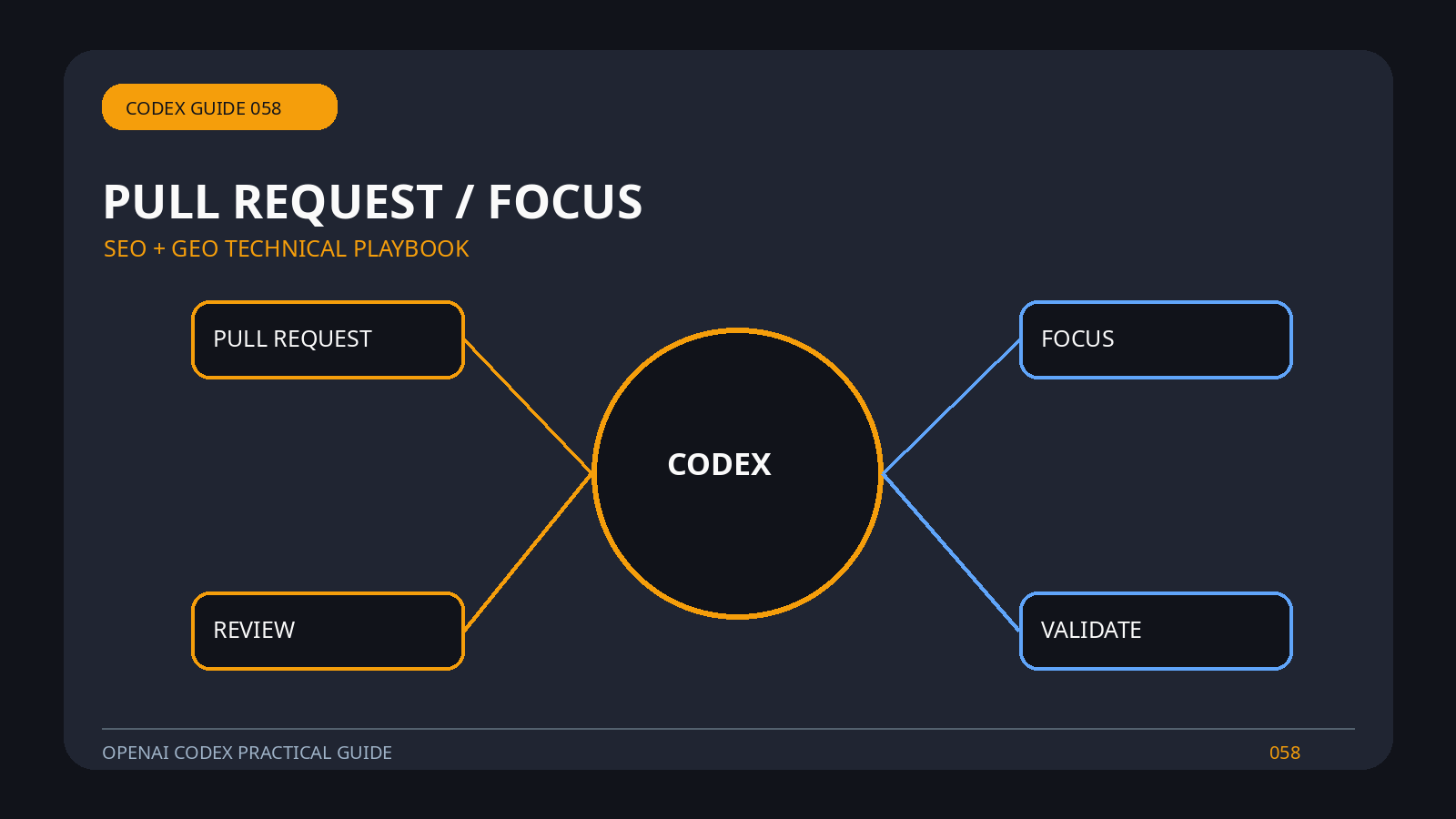
In order to enable the Codex GitHub review to be reproduced by another member, the mission record contains at least four check points: PULL REQUEST, FOCUS, REVIEW, VALIDATE. These English labels can also be used for branch, log or board search.
Two questions need to be answered at the same time: whether to “check that the comments point to actual differences and can be repeated” and whether there is “a noise added to the noise when all automatic comments are considered to be a direct barrier.” The former decides whether to continue and the latter decides whether to suspend, roll back or supplement the authorization.
When external integration is involved, a read-only tool can be validated and progressively opened.
It is also necessary to open the generated file, format and quantity before the final delivery.
For non-technical users, the delivery notes should be separated from “modified” “executed inspection” “unvalidated matters” and avoid considering the technical log as the final result.
In the event that “all automatic comments are directly regarded as blocking items will add to the noise”, the original logs and differences should be maintained, with a controlled return to the state before discussions continue.



