
A common SEO accident is that the operator has done "optimal" and the content page can be opened, but the search performance has deteriorated. Putting it on the anomaly "How to adjust the page by clicking too deep" is the common root cause of the loss of speed and user access to important content pages if multiple hits are required.
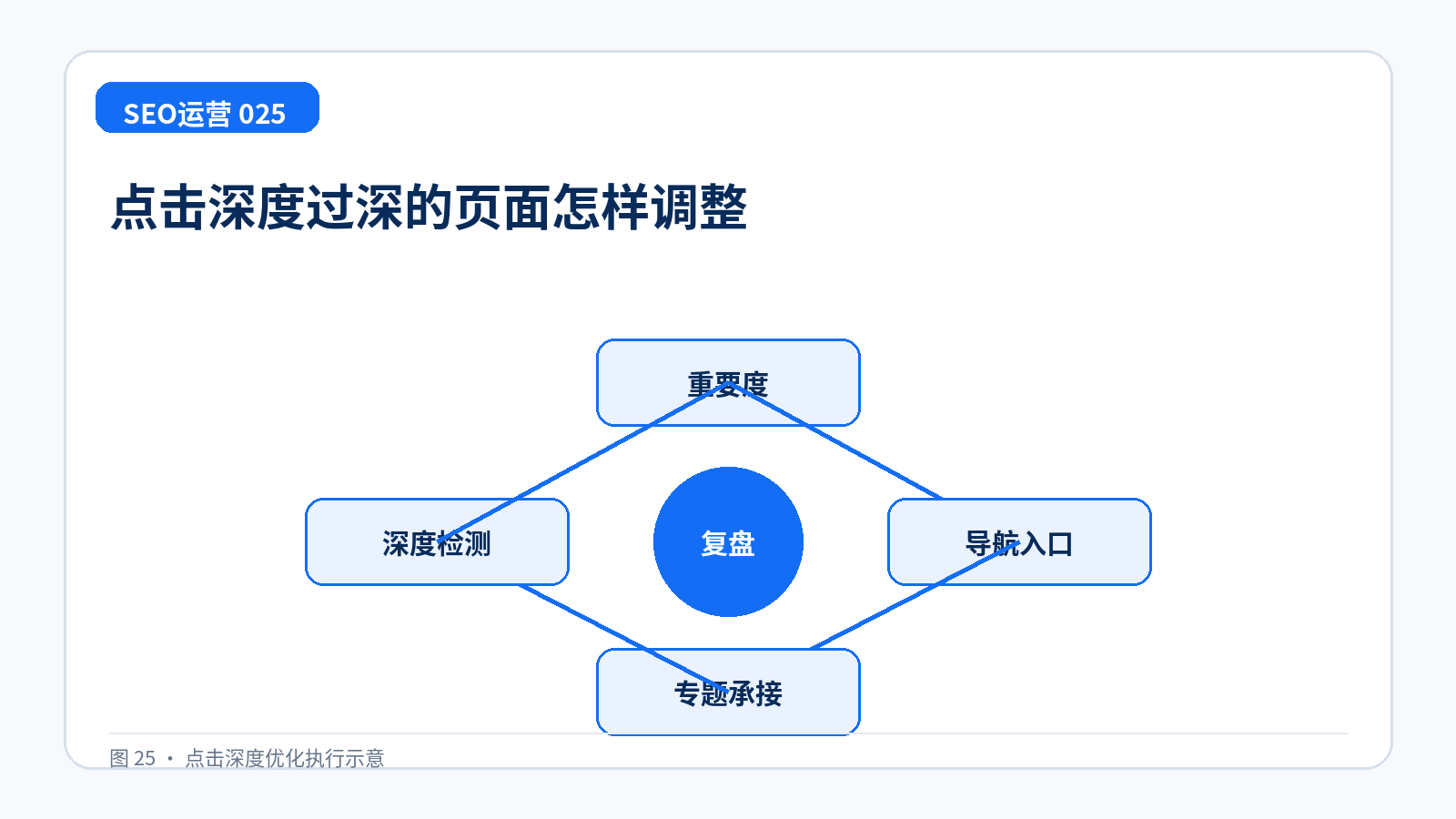
Retrieve back to principle: Click depth should match business importance, up-to-date frequency and user path, rather than all content pages on the front page. Compare the content pages seen by browsers, captured HTML, server status and in-site links, often for reasons more quickly than repeated changes in keywords.
The restoration programme is to place the core classification in the main navigation, use the theme page to carry long end-to-end content, add relevant content modules and eliminate routes that can only be reached by site maps. Prioritize the restoration of high flow, high transformation and significant external chain URLs, and then process long end-to-end pages; each batch maintains a change registration and roll-back version.
If you see changes only on a single day, do not rush to declare success because retake, index update and demand fluctuations take different time.
The follow-up disk must be written to make it clear that stacking navigation in order to bring depth down to one level would damage the information structure and the movement-end experience. Translating the cause of the accident into automatic validation and manual sampling before release is more reliable than relying on someone to remember lessons.
At the maintenance level, “click depth optimization” can be added to the quarterly spot check: randomly select old and new content pages, checking that configurations, text, links, and data are still consistent with current operations. Search rules and product information will change, and the correct content pages will need to be clearly updated.
In order to prevent the conclusion from remaining in the report, it is recommended that the criticality and depth test be issued as the acceptance item and that the anomaly be judged by whom and how long it should be repaired. This way, the new content page follows the same standard, and the old content page can be detected in time after the template changes.