The "internal link anchor text should be written in more detail" can be seen as a decision-making anomaly, rather than as a separate task for the writing or development department. The target mission should be described naturally, avoiding a mechanical repetition of precise keywords throughout the site.
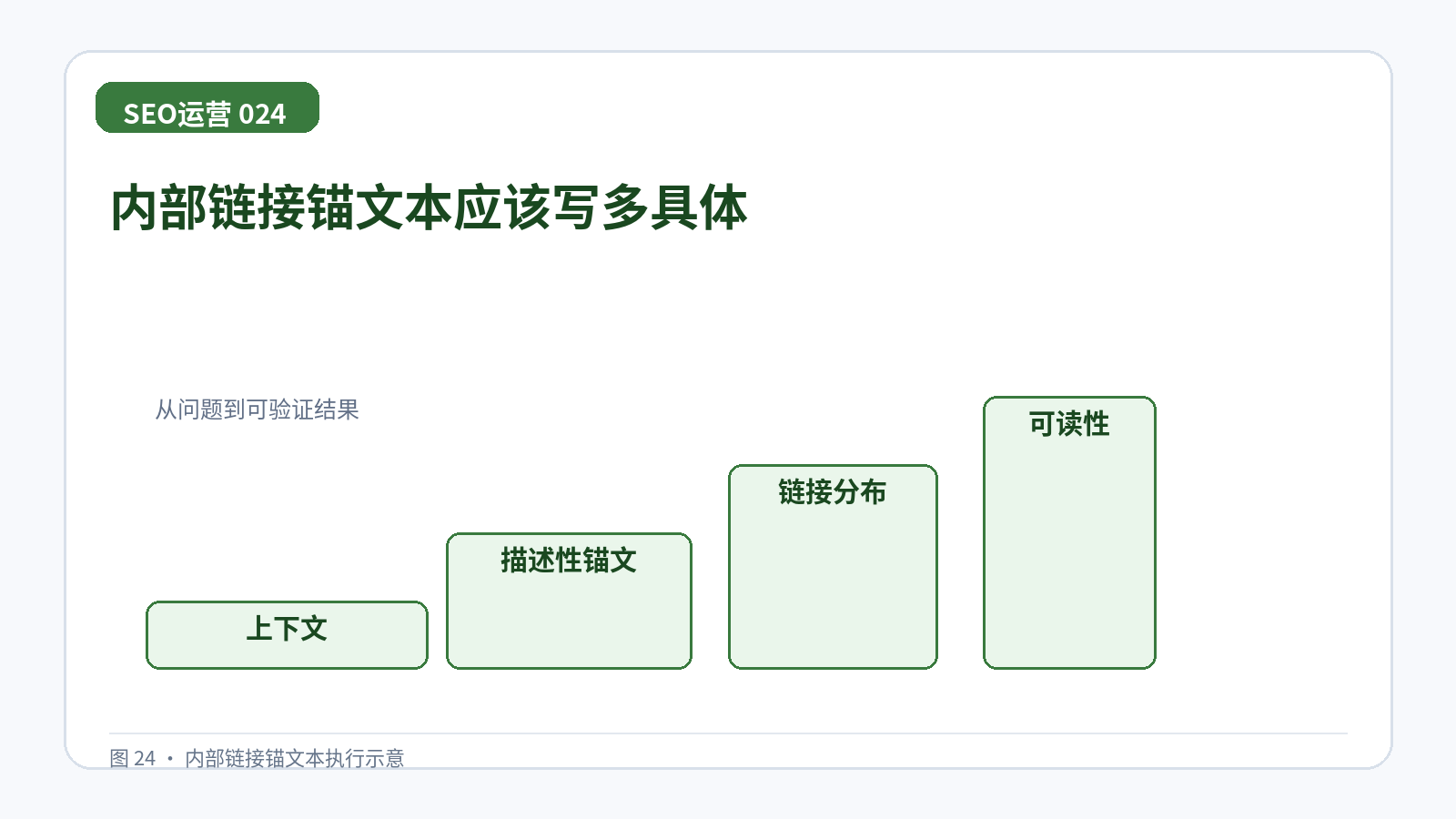
If there is a stable performance at present, it is not recommended to redo it immediately in pursuit of the form; first, it is confirmed that the anchor text indicates the target page content to the user and to the retrieval system, which is more informative than “click here.” Small-scale adjustments are usually easier to keep a valid signal and to judge which elements actually work.
This can be done by using short and clear text in the relevant paragraphs, and by providing a reasonable link to the key pages from different contexts, without imposing a link for each keyword. The landing list also includes unaltered entries, such as URLs, main contents or transformation paths, to reduce multiple variables.
If the core indicator deteriorates and the technical verification is abnormal, the expansion should be suspended according to preset rules; if the data are stable, the approach will be extended to similar content pages.
Overprecise and moored text can reduce readability and may present manipulation marks. The final delivery should therefore not only be a content page, but should also include a map, test results and a successor maintainer, ensuring that three months later there is still an understanding of why this set-up exists.
User feedback is also included in the SEO judgement. The search data indicates whether the content page was found, but does not fully explain whether the answer is clear; this can be supplemented by an anomaly in the passenger service, the form content and the sales register, which optimizes the internal link anchor text back to real demand.
At the maintenance level, “internal link anchor text” can be added to the quarterly spot check: randomly selects old and new content pages, checking that configurations, text, links, and data are still consistent with current operations. Search rules and product information will change, and the correct content pages will need to be clearly updated.