
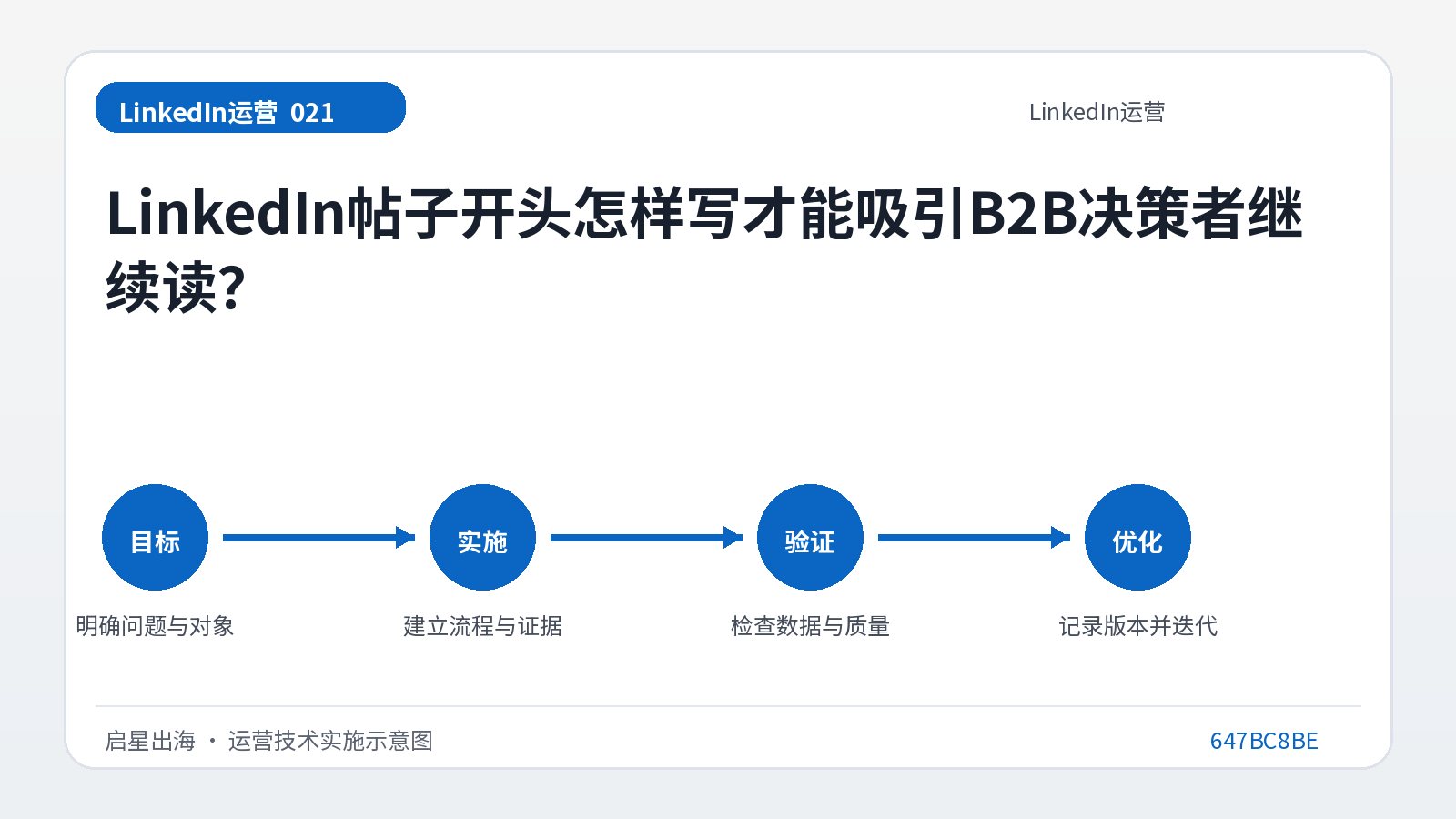
When encountering this situation, first separate the "no effect".Is it insufficient coverage, inaccurate interaction, loss after clicking, poor form quality, or sales not being taken on in a timely manner?The most likely reason is to open with a company introduction, greeting, or vague trend, without presenting the decision-maker's current risks and benefits.
Different breakpoints correspond to different solutions: for coverage issues, look at themes and distribution, for interest issues, look at hooks and scenarios, for trust issues, look at cases and proofs, for action issues, look at pages and CTA, and for quality issues, look at filtering conditions.The core of LinkedIn B2B content is not to show how good the company is, but to help target decision-makers understand the problem, compare options, reduce risks, and remember trusted professional sources.Not all breakpoints can be solved with increased budget.
It is recommended to first give counter-intuitive conclusions, specific scenarios or quantifiable problems, and then explain the applicable objects and reading benefits. Then extract the questions from the sales dialogue, establish topic selection according to the recognition, comparison, verification and action stages, and use opinions, methods, evidence, cases and CTA to complete the content closed loop.Check upstream and downstream.When establishing a control group, keep the country, time, and customer type as consistent as possible, otherwise cost changes may simply be differences in market conditions.
In terms of data, you can also view target role exposure, stay and expansion, saving, effective comments, data access, attention and content-assisted business opportunities.It’s more important to judge leads with expansion rates, dwells, and target comments, and have sales flag invalid reasons such as retail, job search, wrong region, no company, demand mismatch, or duplicate leads.Reason classification can guide optimization better than a sentence of "inaccuracy".
The conclusions of the review must be transformed into the next round of actions: what to keep, what to delete, what to test, who will complete it, and when to check.In this way, content operations will transform from scattered operations into customer acquisition assets that can be continuously accumulated.
When implementing this question, you can first use a small group of real target accounts to verify it: first give counter-intuitive conclusions, specific scenarios or quantifiable problems, and then explain the applicable objects and reading benefits.After execution, don't just judge by feeling, but use the expansion rate, stay and target comments to judge the beginning; at the same time, save the customer identity, version, date and subsequent sales results to avoid mistaking accidental replies for replicable methods.



