
The answer lies in the customer’s perspective.The customer will not automatically inquire because the company continues to publish or pay. He will only act when the content is relevant to the current task, the evidence is credible, and the next step is clear.Most of the current resistance is that formatting is regarded as a traffic technique, and there is no selection based on content complexity and customer reading tasks.
First check whether the customer can answer within ten seconds: who do you serve, what problem do you solve, why do you believe it, and what can you get after contacting you.The core of LinkedIn B2B content is not to show how good the company is, but to help target decision-makers understand the problem, compare options, reduce risks, and remember trusted professional sources.If these answers are scattered or contradictory, any traffic will be lost in the acceptance phase.
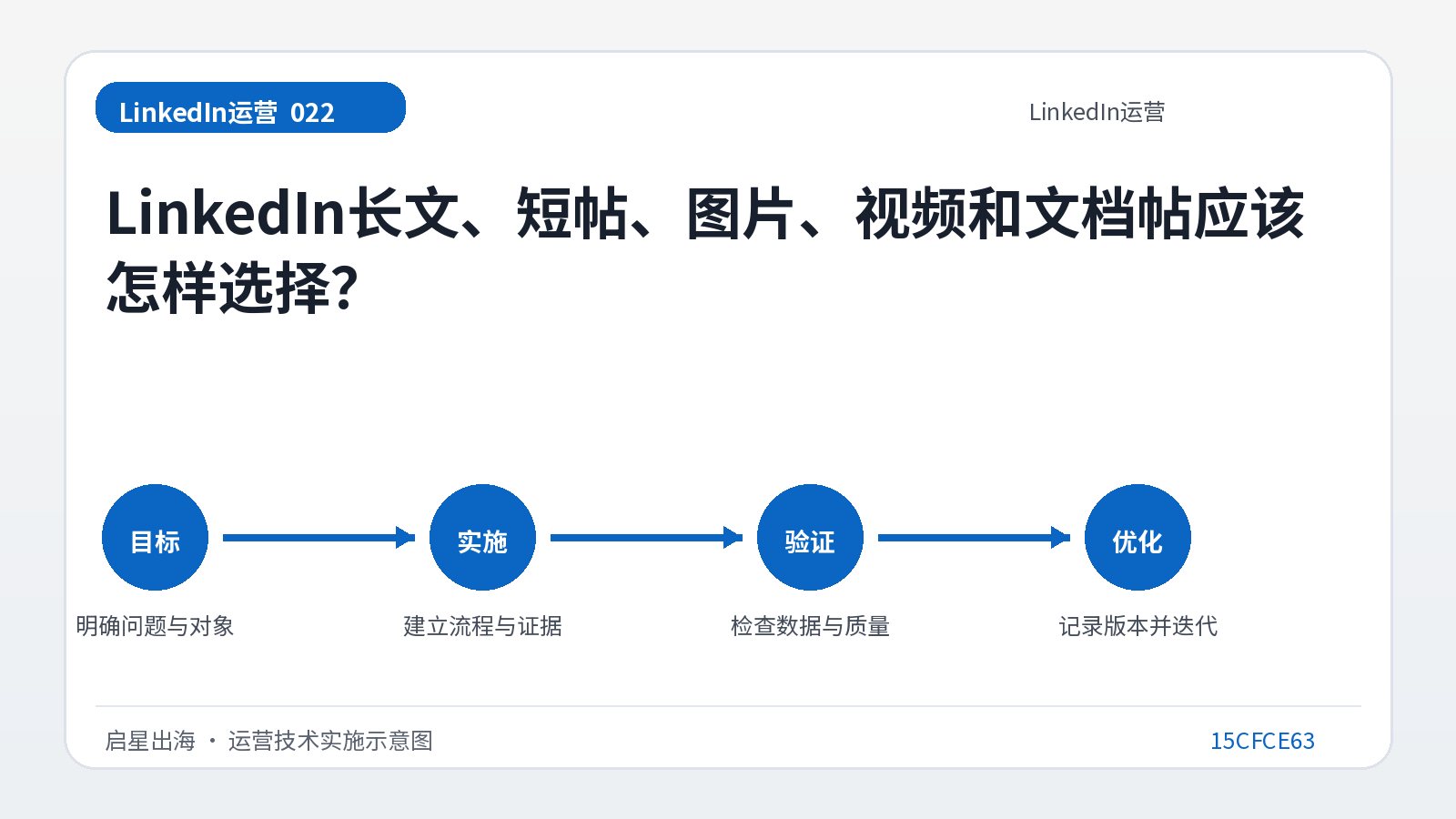
The implementation suggestions are short posts to express a single point of view, documents to provide steps and comparisons, videos to prove the process, and long articles to carry systematic methods.Then extract questions from the sales dialogue, establish topic selection according to the stages of cognition, comparison, verification and action, and use opinions, methods, evidence, cases and CTA to complete the content closed loop.Connect content, homepage or landing page, form and sales response.Set a unique source tag for each entry to prevent customers from being able to know which content comes from after entering the private message.
When evaluating, compare the effective reading, saving and subsequent access of each format, and simultaneously observe the target role exposure, stay and expansion, saving, effective comments, data access, attention and content-assisted business opportunities.If the number of customers is small but the questions are specific, the information is complete, and the company matches, it should be regarded as a positive signal; if the number is large but only the lowest price is asked or there is no business identity, pre-screening should continue to be strengthened.
Don’t pursue optimization all at once.Solve the biggest loss points first, and then deal with the next layer after stabilization.Content operations based on customer understanding of costs, sales follow-up efficiency and final business opportunities are more in line with the real cycle of foreign trade B2B.
When this question is implemented, you can first use a small group of real target accounts to verify: short posts express a single point of view, documents provide steps and comparisons, videos provide process proof, and long articles carry system methods.After execution, don’t just judge based on your feelings, but compare the effective reading, saving and subsequent access of each format; at the same time, save the customer identity, version, date and subsequent sales results to avoid mistaking accidental replies for replicable methods.



