
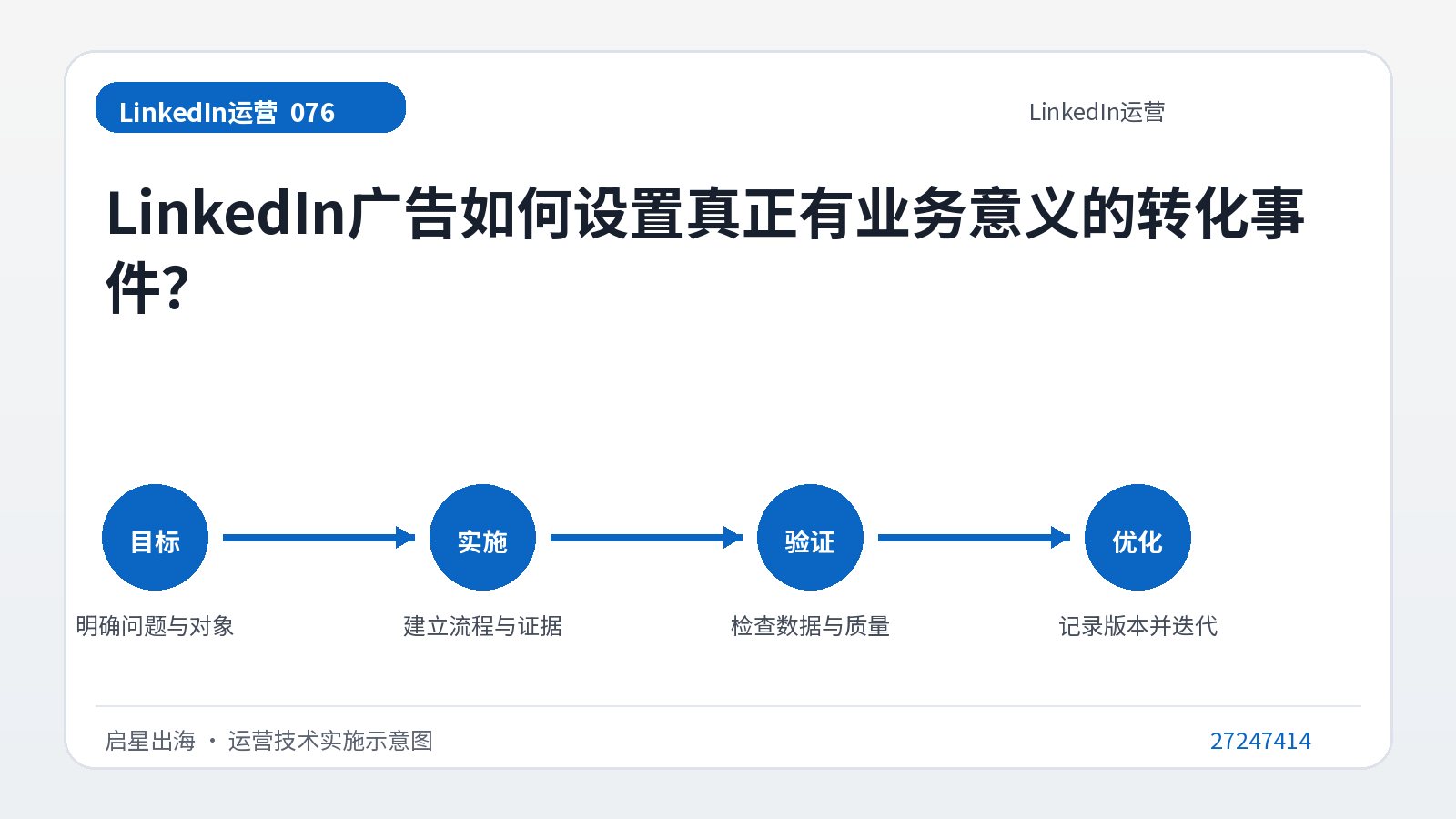
When encountering this situation, first separate the "no effect".Is it insufficient coverage, inaccurate interaction, loss after clicking, poor form quality, or sales not being taken on in a timely manner?The most likely reason is that any page visit or button click is regarded as the final conversion, and the optimization signal is too far away from the sales result.
Different breakpoints correspond to different solutions: for coverage issues, look at themes and distribution, for interest issues, look at hooks and scenarios, for trust issues, look at cases and proofs, for action issues, look at pages and CTA, and for quality issues, look at filtering conditions.LinkedIn advertising must first clarify funnel goals, data sources and sales definitions; if tracking and undertaking are incomplete, the platform cost will not be able to prove the business value no matter how beautiful it is.Not all breakpoints can be solved with increased budget.
It is recommended to first establish hierarchical events and clear definitions according to content download, form submission, appointment, effective leads and business opportunities, and then confirm the advertising account and homepage permissions, Campaign Group and naming, marketing goals, conversion events, Insight Tag, UTM, landing page or form, CRM and sales response in order.Check upstream and downstream.When establishing a control group, keep the country, time, and customer type as consistent as possible, otherwise cost changes may simply be differences in market conditions.
In terms of data, you can also view delivery status, clicks, landing page behavior, form completion, effective lead rate, sales acceptance rate, opportunity cost and attribution completeness.What's more important is to compare the correlation of different levels of events with CRM results and let sales flag invalid reasons, such as retail, job search, wrong region, no company, demand mismatch or duplicate leads.Reason classification can guide optimization better than a sentence of "inaccuracy".
The conclusions of the review must be transformed into the next round of actions: what to keep, what to delete, what to test, who will complete it, and when to check.In this way, the advertising foundation will change from scattered operations to customer acquisition assets that can be continuously accumulated.
When implementing this question, you can first use a small group of real target accounts to verify: establish hierarchical events and clear definitions based on content downloads, form submissions, appointments, effective leads and business opportunities.After execution, do not just judge based on your feelings, but compare the correlation between different levels of events and CRM results; at the same time, save the customer identity, version, date and subsequent sales results to avoid mistaking accidental replies for replicable methods.



