
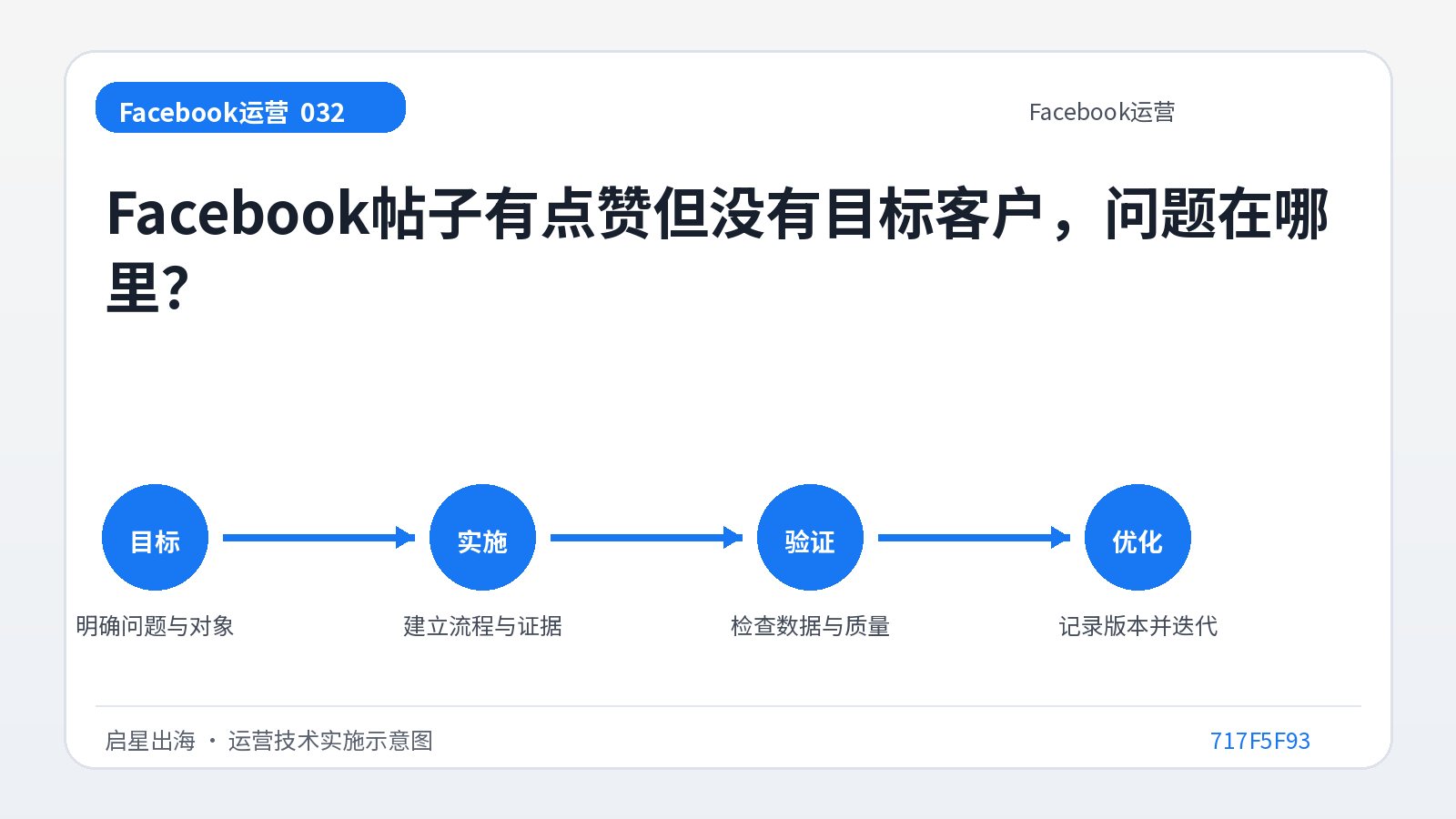
Facebook posts have likes but no target customers, what’s the problem?
POST

Facebook posts have likes but no target customers, what’s the problem?

Qixing Global analyzes Facebook posts that have likes but no target customers, the common causes of the problem, the troubleshooting sequence, implementation methods and core indicators, helping individual SOHOs, internal to external factories and foreign trade teams to improve Facebook's natural customer acquisition and effective inquiry quality.The main problem is often that interactions may come from peers, employees, low-interest areas, or general interest groups, and quantity does not represent business value.

Facebook posts have likes but no target customers, what’s the problem?

Let’s start with the conclusion: Interactions may come from peers, employees, low-interest areas, or general interest groups. The quantity cannot represent commercial value. This is usually the core problem behind “There are likes on Facebook posts but no target customers, what is the problem?”Continuing to increase publication volume or budget will not automatically solve it, but may lead to more data in the wrong direction.

Draw the actual link first.Customers may be lost at every step from the first time they see the content to visiting the homepage or landing page, initiating a conversation, submitting information, becoming a valid lead, and entering into a quote.Natural distribution relies on content relevance, relationships and real interactions. B2B accounts need to proactively enter discussions in the industry where customers are located, rather than waiting after publishing.Therefore, it is necessary to put the target customer interaction proportion, comment quality, group contribution, homepage visits, private message conversations and the number of repeated interactions in the same table, instead of just looking at the number that is easiest to increase.

In terms of execution, make minimal changes first: check the identities and countries of the interactors on a sample basis, and realign the content language, case scenarios, and distribution groups with the target customers.Determine the target group and interaction entrance before publishing, promptly respond to comments, participate in groups, contact high-intent interactors, and convert valuable discussions into follow-up content after publishing.Keep the original version before adjusting, set a complete observation period, and mark the country, customer type and content or advertising version.In this way, when the results change, you can know which action has the impact.

The sales end must simultaneously verify the lead's company, role, application, specification or quantity, purchase time and next step.This question recommends establishing the target customer interaction ratio instead of just recording the total interaction.If there are a lot of interactions or forms but a conversation with complete information cannot be formed, it means that the front end is still attracting the wrong people and low cost cannot be regarded as success.

During review, the conclusions are divided into four categories: retention, optimization, stop, and amplification.Interactive distribution is only worth replicating to more countries or products if it simultaneously reduces customer understanding costs, increases effective dialogue, and generates trackable business opportunities.


Related content

The organic reach of Facebook posts is getting lower and lower. How should I check?

Qixing Global analyzes the common reasons why the natural reach of Facebook posts is getting lower and lower, how to troubleshoot, the troubleshooting order, implementation methods and core indicators, helping individual SOHOs, internal to external factories and foreign trade teams to improve Facebook's natural customer acquisition and effective inquiry quality.The main problem is often that the decline in reach may come from topic selection fatigue, audience mismatch, weak material, insufficient interaction or changes in publishing rhythm. It cannot just be.

Read more →

After posting a Facebook post, should company employees focus on likes and comments?

Qixing Global analyzes the common reasons why corporate employees should like and comment after publishing a Facebook post, as well as the order of investigation, implementation methods and core indicators, and helps individual SOHOs, internal to external factories and foreign trade teams improve the quality of natural Facebook customer acquisition and effective inquiries.The main issue is often that real employee engagement provides early interaction, but copying the same comments or mechanically focused operations can appear unnatural.

Read more →

Someone in the Facebook comment section only asks about the price. How should I reply?

Qixing Global analyzes the common reasons why someone in the Facebook comment area only asks about price, how to respond, the troubleshooting sequence, implementation methods and core indicators, helping individual SOHOs, internal to external factories and foreign trade teams to improve Facebook's natural customer acquisition and effective inquiry quality.The main problem is often that publicly directly quoting a single price may ignore specifications, quantities, trade terms and destinations, and can also cause the conversation to stop at a comparison prematurely.

Read more →

