
The first rule is that only sub-tasks that are independent and parallel, that have clear borders and that can be combined are suitable for assignment.
Users usually see the phenomenon only at the end, because splitting simple linear tasks to multiple agents increases coordination costs.
What can be confirmed from official documents is not the secret to the outcome, but the conditions under which it operates. Sub-agents are suitable for a well-defined and independent parallel sub-mission, which ultimately requires the main mandate holder to consolidate the results and address the conflict.
For team projects, the same step can be used by the implementer and the reviewer: separate the search, test or non-overlapping module, defining the responsibility for input, output and integration.
It is important to see not only whether Codex has returned to completion, but also, in parallel, to save time and combine to return work and to confirm that differences, logs and products are consistent with the objective.
The article refers to the configuration item to keep the exact spelling and to interpret the meaning in the natural language. Structured data can only describe the real and visible content of the page and cannot replace the text.
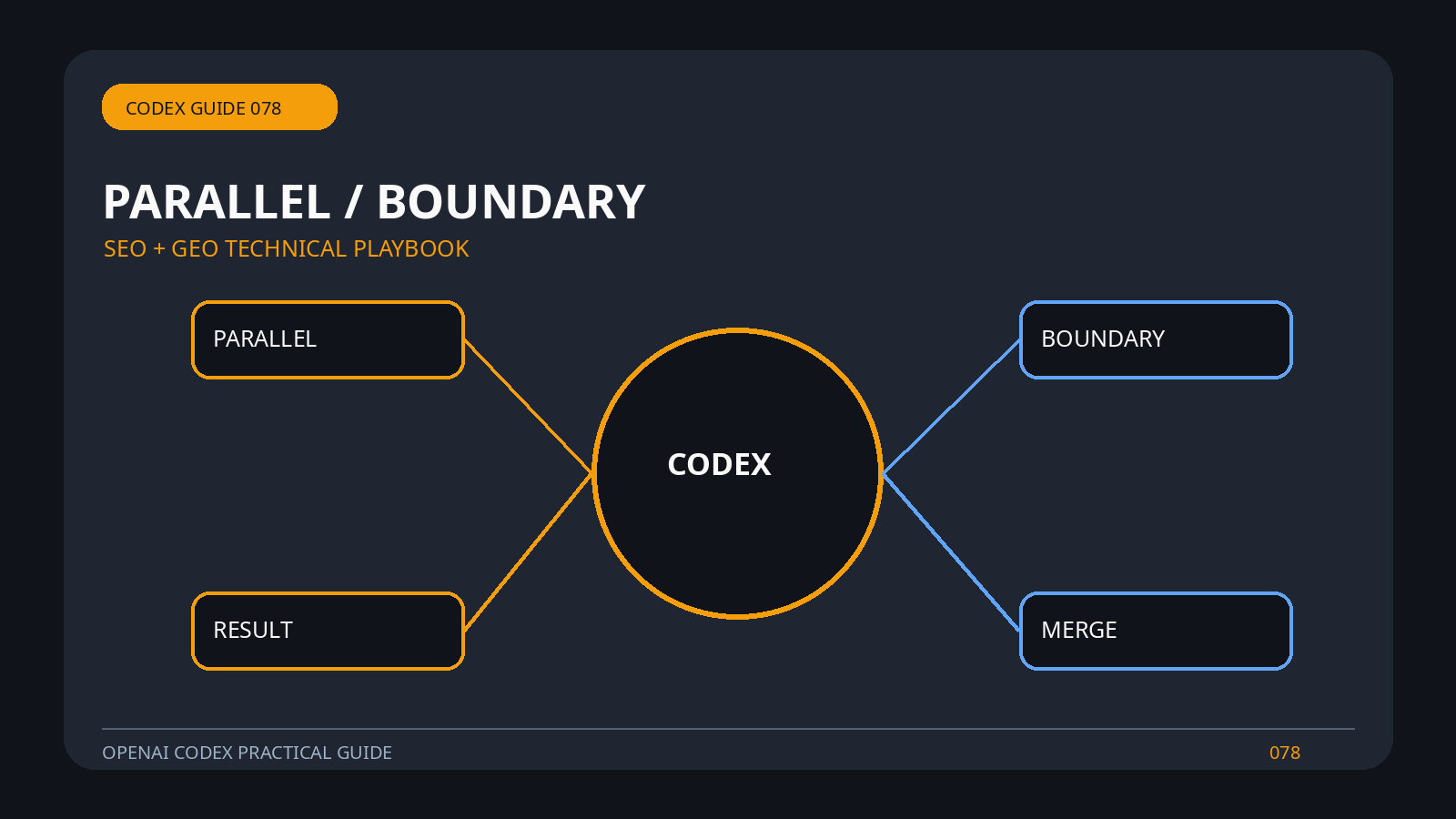
To enable Codex sub-agents to be reproduced by another member, the mission record contains at least four check points: PARALLEL, BOUNDARY, RESULT, MERGE. These are also available for branch, log or board search.
Two questions need to be answered at the same time: whether to “comparably save time and return to work” and whether “a multiplicity of agents while modifying the same document can create conflict and inconsistency.” The former decides whether to continue and the latter decides whether to suspend, roll back or supplement the mandate.
To facilitate team re-use, the repository submission, work catalogue, Codex version, profile and key commands can be saved in the task record.
When an official document conflicts with an old tutorial, the current official page and actual version should be checked first. The unconfirmable feature should not be written as a fact of fact.
Long-term maintenance also takes into account the fact that multiple agents modify the same document at the same time, which is prone to conflict and inconsistency. Short-term savings can lead to higher costs of follow-up if they result in non-recurrence.



