
Distinguishing between functionality can be used and delivery is reliable first. The function is capable of executing an order, and does not mean that the result is safe; Hook should be quick, determinable, visible and avoid hidden destructive actions.
Users usually see the phenomenon only at the end, because hooks can automatically verify or record, or may have side effects in each event.
OpenAI Docs provides the current boundary for this topic. Hook operates auto-actions on a given event. The design takes into account the time of execution, failure strategy, observability and side effects.
Do not extend the full permissions once in practice. First, limit event, time and failure processing to the controlled range for format checking, strategy validation or notification, and then add tools or access after the need is confirmed.
The number of triggers, time-consuming, exit code and impact on the main task should be recorded.
Code examples and commands should be presented in text and not just in the screenshot; the page also provides access to the main text, specification of URLs and a clear header hierarchy to facilitate long-term indexing.
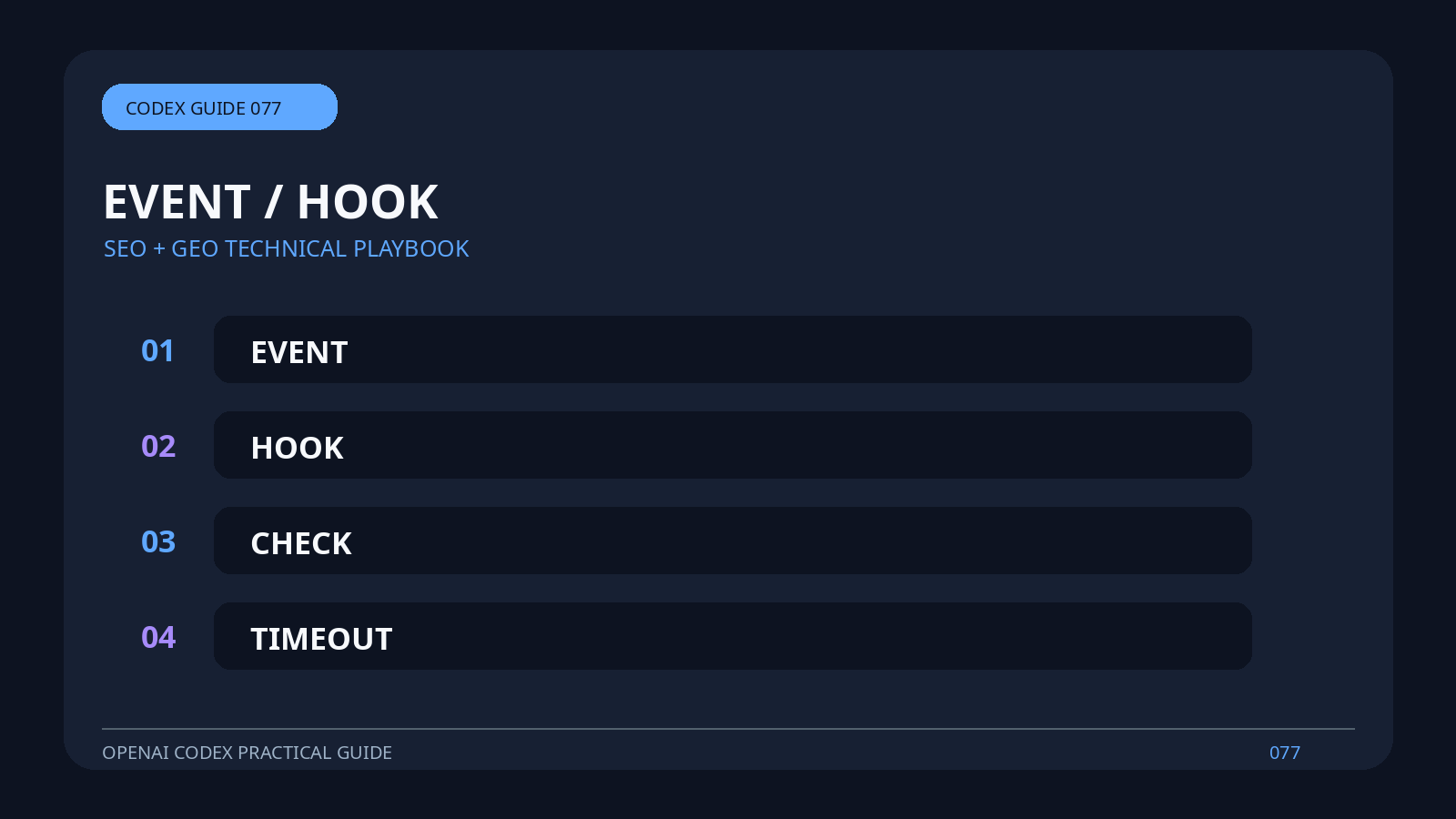
In order to enable Codex Hook to be reproduced by another member, the mission record contains at least four check points: EVENT, HOOK, CHECK, TIMEOUT.
Two questions need to be answered at the same time: whether “the number of triggers, time-consuming, exit codes and the impact on the main mission are recorded” and whether “the operation of long deployments or the modification of a large number of documents by hooks makes it difficult to control the task.” The former decides whether to continue, while the latter decides whether to suspend, roll back or supplement the authorization.
For long assignments, the phasing summary should refer to actual documents and tests rather than simply describe the work done. The evidence can be reviewed more valuable than the percentage of progress.
To facilitate team re-use, the repository submission, work catalogue, Codex version, profile and key commands can be saved in the task record.
Do not equate automation success with operational correctness. The execution of long deployments or modification of large quantities of documents in hooks makes task control difficult, so the ultimate responsibility remains with those who know the project.



