Distinguishing between functional reliability and reliability of delivery does not mean that the result is safe; external side effects must recognize the objective, content, authority and revocability.
The check first recognizes that sending messages, deploying, paying and modifying remote data will affect objects outside the field. This is not an addition to the process, but rather a reduction in the number of variables, the number of invalid re-tests and large-scale changes.
The functions covered by this topic may be updated and the official page should be given priority.
Write this in a taskcard that is clearer. The card lists the object, permission, input and acceptance, and then executes it: Mr. previews or drafts, interprets the recipient and the environment, and is not executed until authorized.
The problem needs to be corrected to confirm that no side effects have been introduced. This is done by preserving operational results, object identification and rollback information, and by checking for anomalies in adjacent modules or external systems.
Since Codex will keep up-to-date, the article should separate the principle of stability from the details of the version, show the update time and regularly check the lapse orders, interfaces and links.
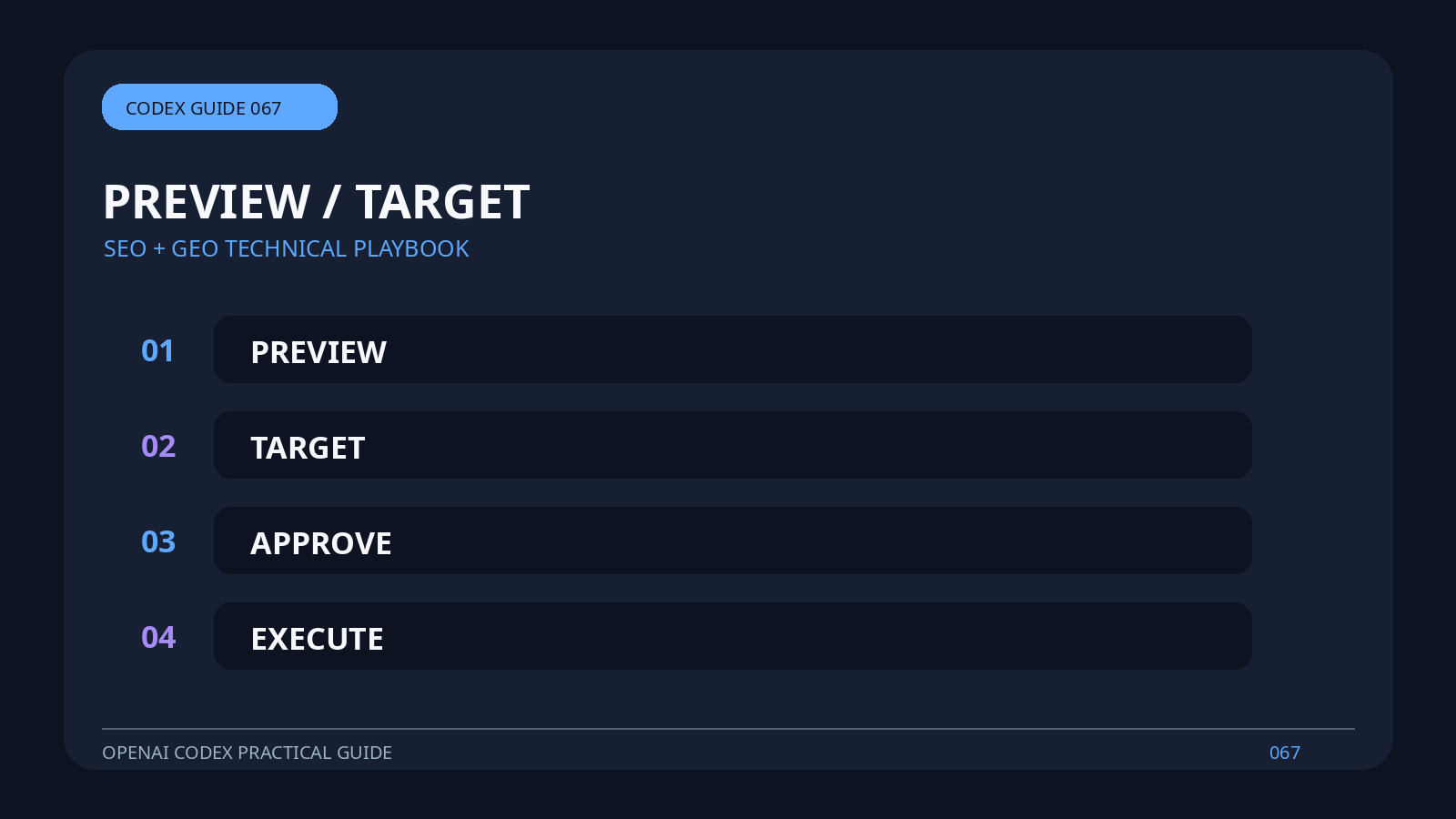
In order to enable Codex's external operation to be reproduced by another member, the mission record contains at least four check points: Preview, TARGET, APPROVE, EXECUTE. These are also available for branch, log or board search.
Two questions will be answered at the same time: whether to “store the results of the operation, object identification and rollback information” and whether there will be “a misunderstanding of the user's request to see the release of the authorization, which will cross the mission boundary.” The former will decide whether to proceed and the latter will decide whether to suspend, roll back or supplement the authorization.
To facilitate team re-use, the repository submission, work catalogue, Codex version, profile and key commands can be saved in the task record.
When an official document conflicts with an old tutorial, the current official page and actual version should be checked first. The unconfirmable feature should not be written as a fact of fact.
What is most important is to avoid is that misunderstanding of a user request for viewing as an authorization to publish will cross the mission boundary. If the operation may affect the user data or remote system, the manual confirmation point should be entered in the process, not just in the instructions.