
Many site maintainers look directly for a plugin or a fixed parameter when they encounter “how to properly establish a multilingual correspondence” but the real starting point is to sort out the problem. Hreflang is used to describe the language or regional version of the equivalent content, requiring a two-way and indexable address. First, it is determined whether the individual URL, the type of template or the whole station is affected, and the treatment will be completely different.
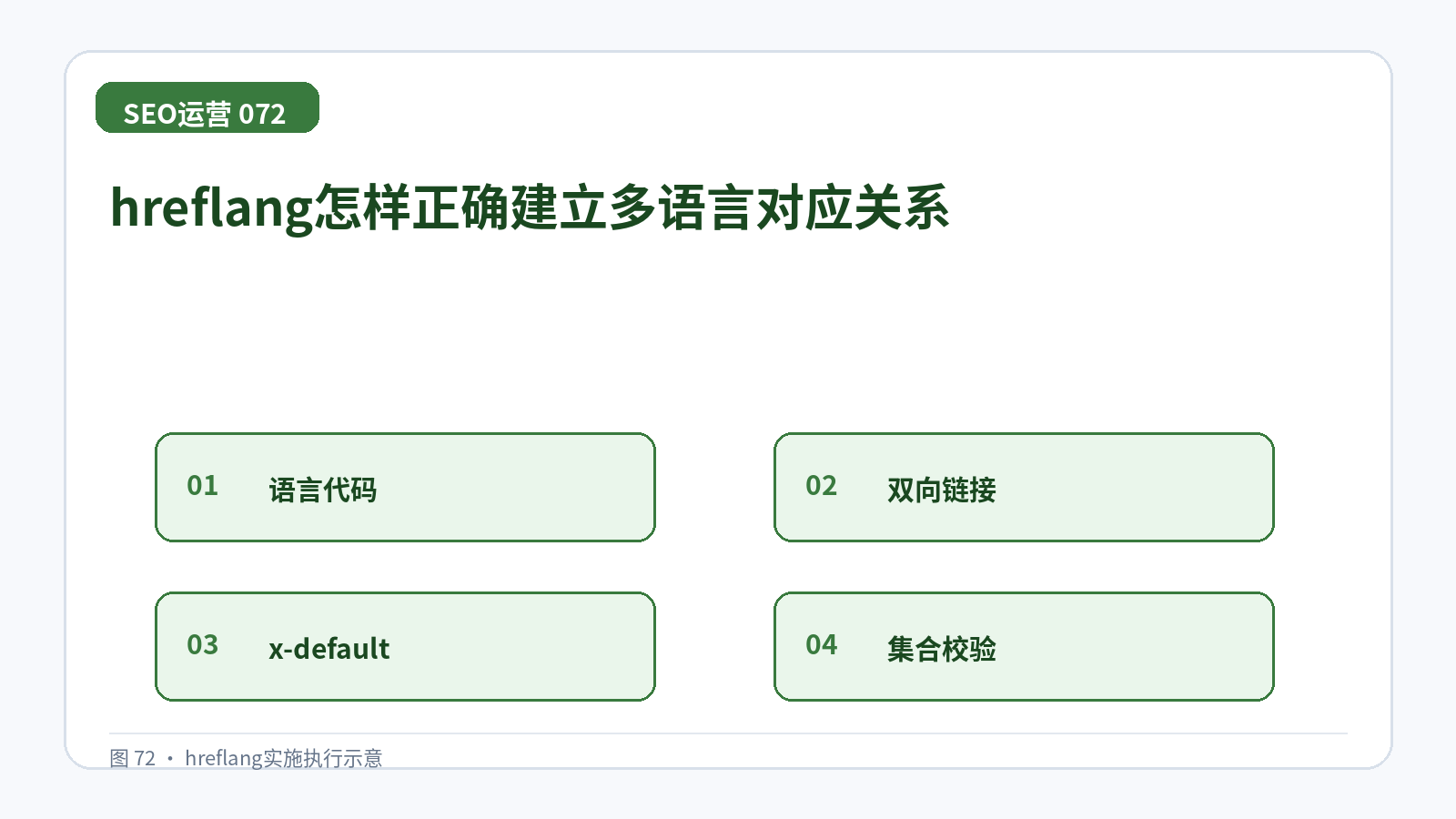
The key principle here is that the language code, the area code, the Canonical and the return link must form a coherent set. Therefore, a snapshot of the current situation should be made, with the status of the web site, internal links, capture time and natural search performance, followed by a re-editing exercise to avoid historical fluctuations as an optimisation.
The more conservative approach is to generate a map from Content ID, to output complete absolute URLs, to add a self-referenced and optional x-default, and to choose a way to maintain them on site maps or HTML. If the site is large, the high-value catalogue pilot can be selected first; if it is a small station, priority is given to the front page, the core category and the content that generates the query, without having to cover all sites in form.
The change is reviewed with the same calibre: regularly capture missing returns, error codes, re-direction and non-indexable targets, and sample them by language template.
In particular, the need to avoid replacing language codes with country codes, or setting them only on the home page, leads to incomplete coverage.
When you actually repeat a disk, you may choose a successful site and a failed site in parallel. It is easier to create the next set of clear actions than to look at the average of the entire site.
If site maintenance staff have limited resources, this method is first used on a web site that can generate a Query or take on a critical navigation. The two-way link and x-default can be steadily passed and then extended to the low-flow directory to avoid over-checking the sample and unprocessed observations.