
The choice of which one does not usually affect ranking is a matter of long-term consistency and complete re-orientation. Products, content, technology and sales see different parts of the same URL, and the end-to-end user problem must be agreed.
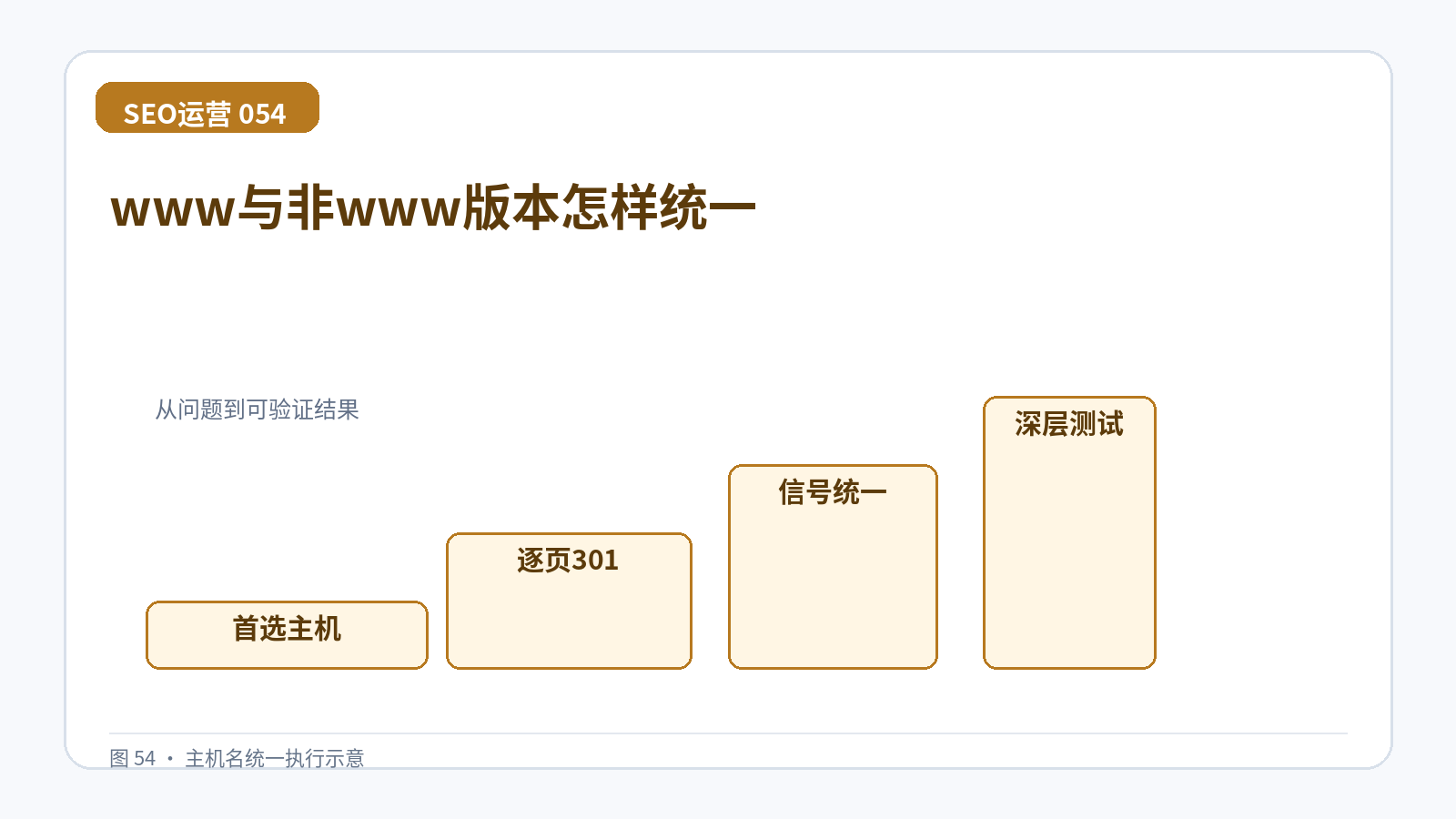
If there is a stable performance at present, it is not recommended to redo it immediately for the purpose of pursuing a form; first, it is confirmed that if both www and non-www can return 200, there will be two accessible mainframe versions. Small-scale adjustments will usually make it easier to keep a valid signal and to judge which elements actually work.
This can be done by identifying the preferred host, scaling all other versions of the path individually 301 to the corresponding URL, and aligning certificates, internal links, canonical, hreflang and site maps.
When you go online, grab the deep URLs of the two hosts, confirming that there is no chain jump, that resources fail and that the index is split. If core observations deteriorate and technical acceptance anomalies occur, the expansion should be suspended according to preset rules; if the data are stable, then the practice will be extended to similar URLs.
Redirect only the front page or point all deep URLs to the head page, thus losing the URL correspondence. The final deliverer is therefore not just a URL, but also includes a map, test results and a successor maintainer to ensure that after three months there is still an understanding of why this setting exists.
User feedback is also included in the SEO judgement. The search data indicates whether the URL was found, but does not fully explain whether the answer is clear; this is complemented by client questions, form content and sales logs, which allow the host name to be optimized back to real needs.
At the maintenance level, “host names” can be selected on a quarterly basis: randomly select old and new URLs, checking that configurations, text, links, and data are still consistent with current operations. Search rules and product information change, and the correct URL needs to be clearly updated.