
A common SEO accident is that the website team is “optimal” and the page on the site can be opened, but the search performance has deteriorated. On the downside of “how photo compression balances drawings with search displays”, the common root is that the picture should be actually shown in size, appropriate format and acceptable mass output, and that the original image should be uploaded with a waste of bandwidth. The surface is normal and does not mean that the signal received from the indexing system is correct.
Check back to the principle: Format selection depends on photo, transparency, and browser support, and cannot seek the smallest files alone. Compare the site pages that the browser sees, captured HTML, server status, and links to the site together, often finding reasons more quickly than repeatedly changing keywords.
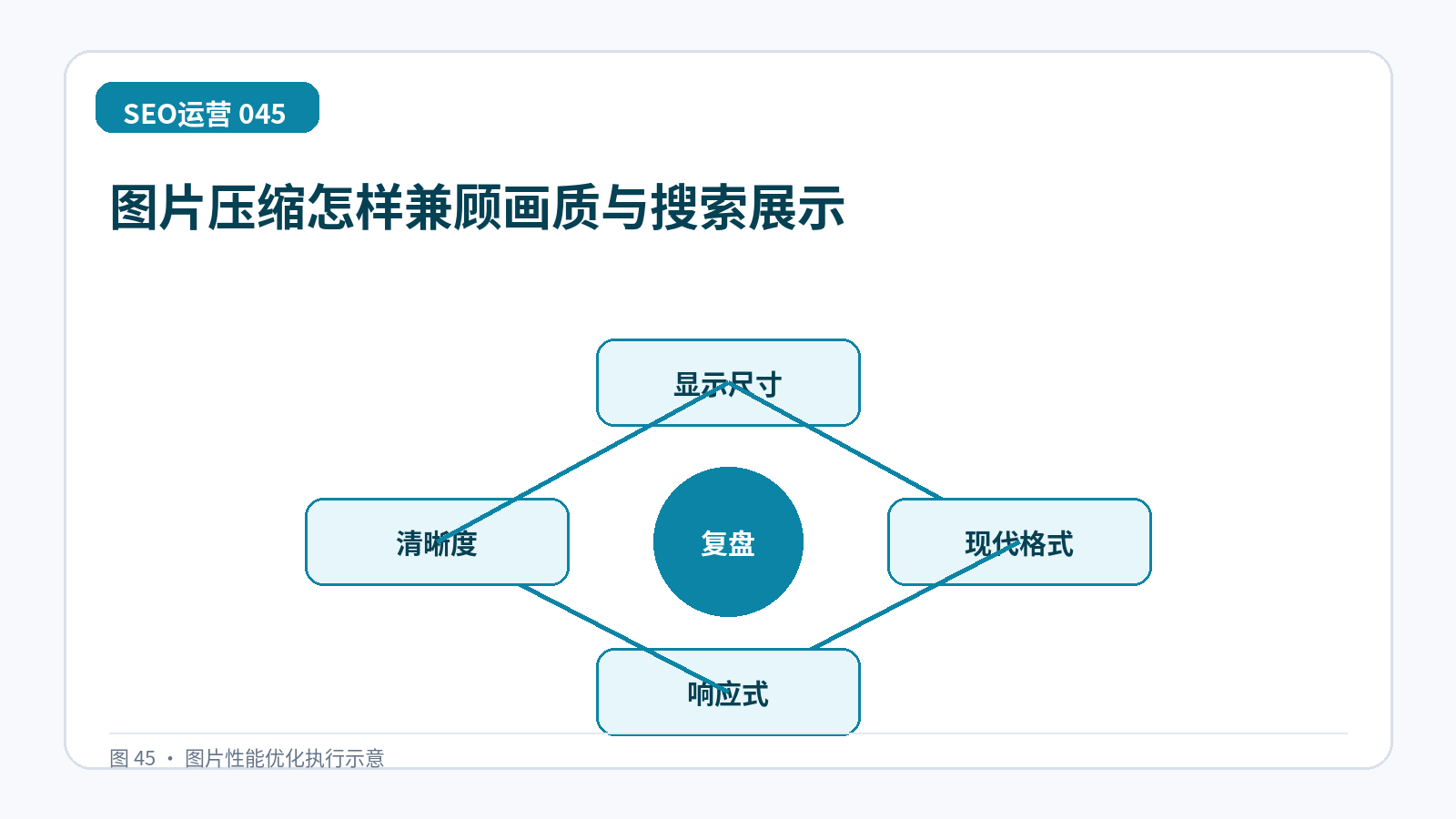
The restoration programme is to generate responsive srcsets, prioritize photos to assess WebP or AVIF, retain clear subject and necessary metadata, and allow CMS to limit super-high uploads. Prioritize high-flow, high-transformation and important extra-chain URLs, and then process long-end pages; each batch maintains a change archive and a roll-back version.
Compares byte size, LCP, clarity, photo search clicks and loads of different devices. If changes are seen only on a single day, do not rush to declare success because retakes, index updates and needs fluctuations take different time.
The subsequent disk must be clear about the details of the product that would be compromised by over-compression, and uniform conversion may also undermine transparency maps or text charts. Translating the cause of the accident into automatic screening and manual sampling before release is more reliable than relying on someone to remember lessons.
At the maintenance level, “pictogram performance optimization” can be added to the quarterly spot-check: randomly select the pages of the old and new stations, checking that configuration, text, links, and data are still consistent with current operations. Search rules and product information will change, and the correct inside pages will need to be clearly updated.
In order to prevent the conclusion from remaining only in the report, it is recommended that the display size and clarity be made a statement of acceptance and that the exception be determined by who and how long it will be repaired. This way the same standard is followed for the new station pages and the old site pages can be detected in time after the template changes.