
Many website teams look directly for a plugin or a fixed parameter when they encounter a “high IPP to locate an interactive delayed source”, but the real starting point is to clear out the failure range. The INP reflects the delay in the interaction of users into the next frame, with long assignments and complex incident processing being a common source. First, it is determined whether the individual URLs, certain types of templates or whole stations are affected, and the treatment is completely different.
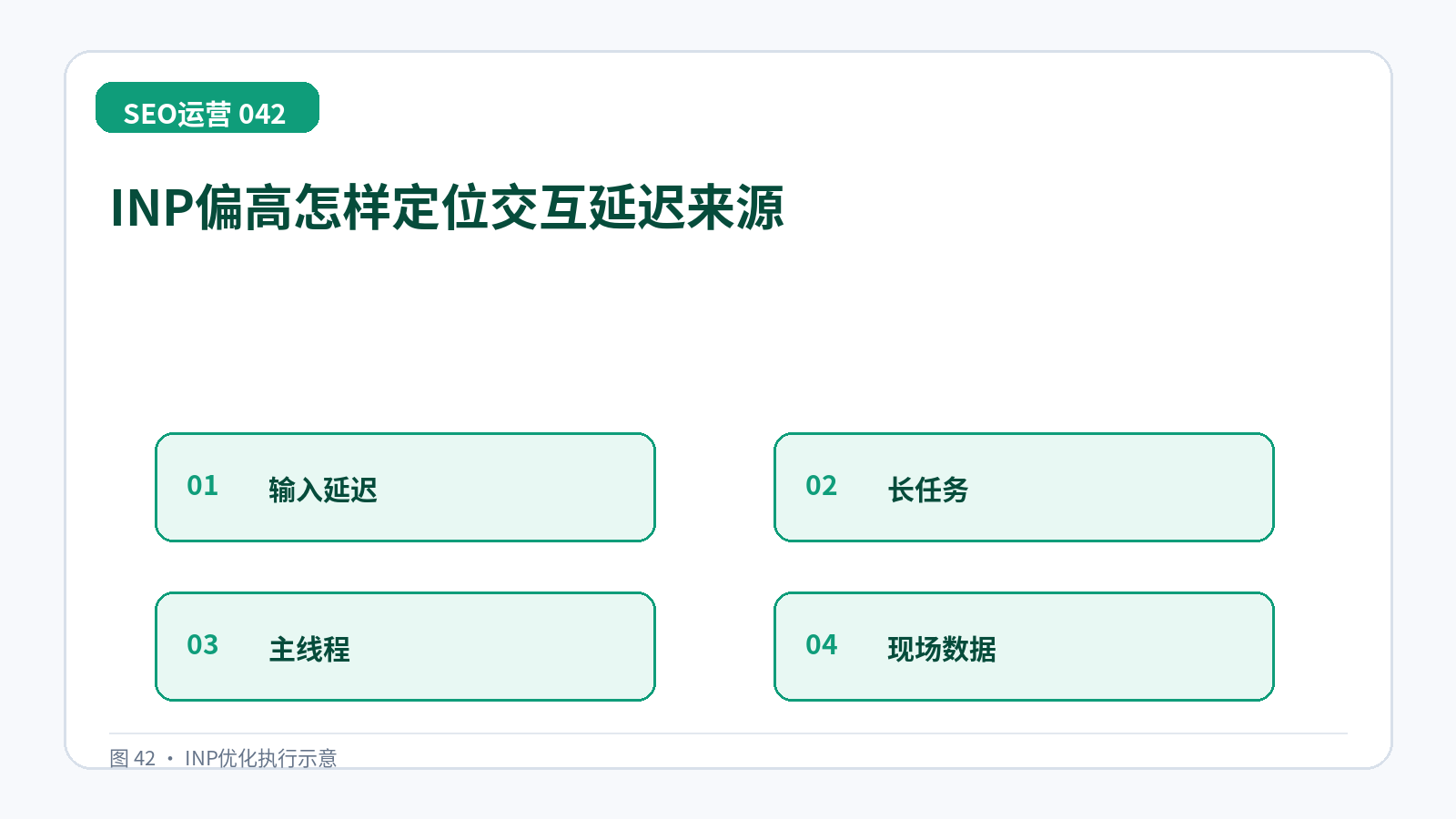
The key rationale here is to distinguish between input delays, processing times and the presence of delays, and not just the total score. Therefore, a snapshot of the status quo should be made, the status of the pages in the archive, internal links, capture time and natural search performance, followed by changes to avoid historical fluctuations as an optimisation.
A more conservative approach is to find affected templates with field data, re-click or input on the performance panel, divide long tasks, reduce the main route JavaScript and delay non-critical tasks. If the site is large, the high-value catalogue pilot can be selected; if it is a small station, priority is given to the front page, the core classification and the content that generates the Queries, without having to cover all the stations in form.
The change is reviewed with the same calibre: 75 percentage points of INP for real users, the number of long assignments and the time of critical interactivity, rather than a single in-house test. It is also checked whether users can read, navigate and complete the forms successfully, because the correct technical signal does not allow for sustainable SEO benefits.
In particular, it is not feasible to avoid the deletion of all scripts, with a focus on making critical interactive and timely responses and controlling third-party codes.
When you actually repeat a disk, you can select a page within a successful station and a page within a failed station in parallel. Optimizing the INP archive of their entry, content difference, capture status and conversion feedback makes it easier to create a clear next set of actions than simply looking at the average of the entire station.
If the website team has limited resources, use this method first for in-station pages that can generate Queries or take on critical navigation. Long tasks and main circuits can pass steadily, then expand to low-flow directories to avoid over-scopeing without feedback.