
The small website does not need to copy complex systems of large platforms when it deals with “how server logs help to detect sEO capture problems.” First, the front-end analysis tool does not see reptile requests, the server logs can reverse the search for robotics, matching the top 10 to 20 pages, which is often more effective than deploying a costly set of tools.
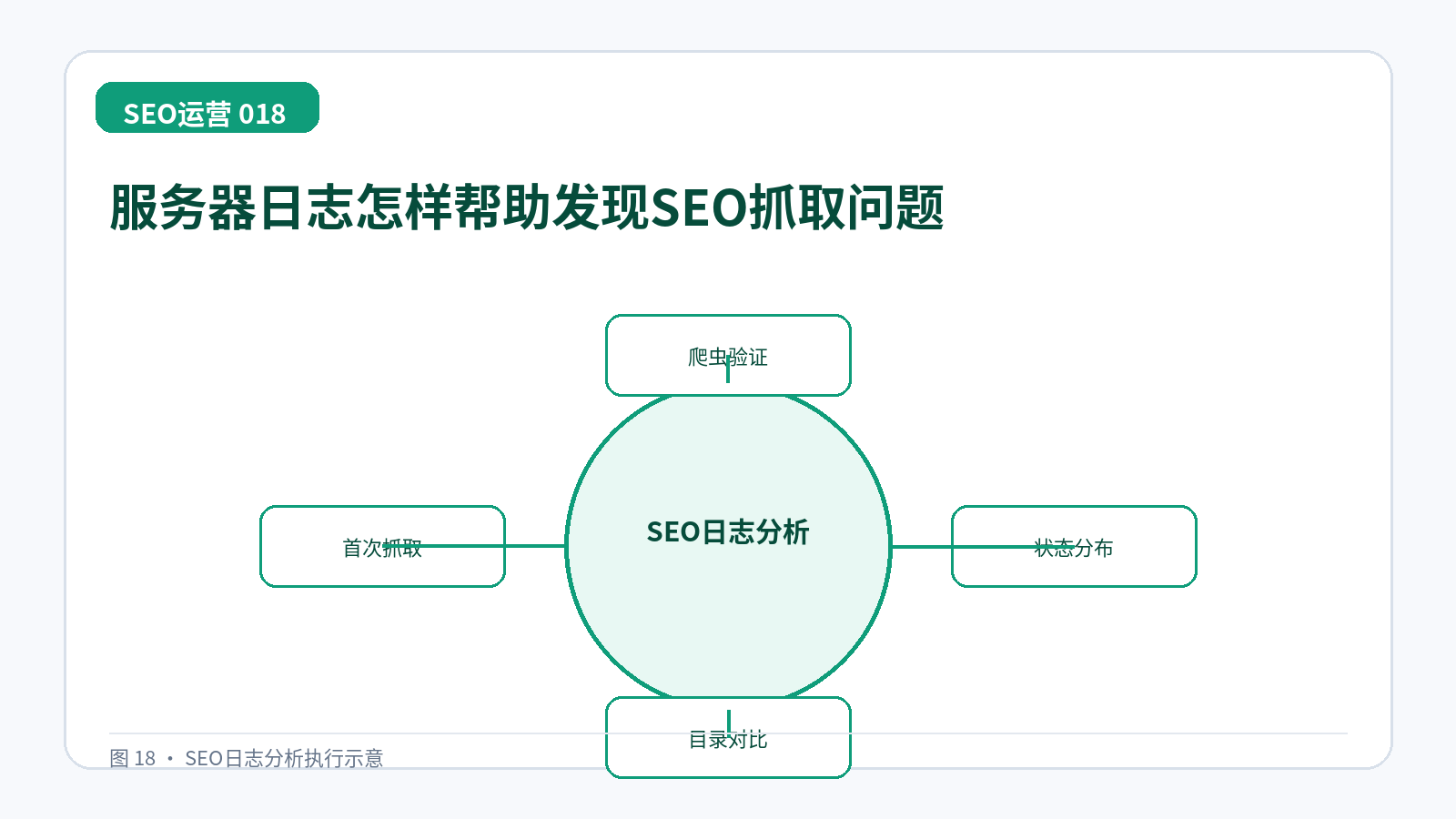
The lowest feasible criteria are derived from this principle: waste and omission can be detected by verifying reptile identity, state code, path, time and response time. As long as URLs, content, links and status signals are consistent, automation will follow; if the underlying relationship is confused, the tool will only produce more errors more quickly.
This can be done manually first: maintain original logs, reverse DNS to verify important reptiles, by catalogue 200, 3xx, 4x, 5x and capture frequency, and then compare with site maps. When the number of web pages increases, repeat steps are written into CMS fields, templates testing and time monitoring, so as to avoid individual memory dependency on each line.
Focus on whether the core URL is continuously captured, whether the abnormal state is centralized, and how long it takes to go online until it is first captured. Validation is passed and extended to the next page. Care needs to be taken that only User-Agent believes that robotic identity will include counterfeit requests in the analysis; logs are not directly equivalent to index performance.
If the project team has limited resources, the method is first used on a web page that can generate a Queries or take on a critical navigation. The status distribution and the catalogue can be stabilized and then extended to the low-flow catalogue to avoid over-scope verification and unprocessed performance.
User feedback is also included in the SEO judgement. The search data indicates whether the web page was found, but does not fully explain whether the answer is clear; this can be supplemented by client questions, form content and sales retention, allowing the SEO log analysis to optimize back to real needs.
At the maintenance level, the SEO log analysis can be added to the quarterly spot-check: randomly selects old and new pages, checking that configurations, text, links, and data are still consistent with current operations. Search rules and product information will change, and the correct web page will need to be clearly updated.