
Many project teams look directly for a plugin or a fixed parameter when they encounter a “XML site map that should have only one URL”, but the real starting point is to sort out the problem. The site map is not a full-stop URL repository, and should indicate that the website wishes to be indexed for a standard web page collection. First, it is determined whether the individual URL, the type of template or the whole site will be affected and the treatment will be completely different.
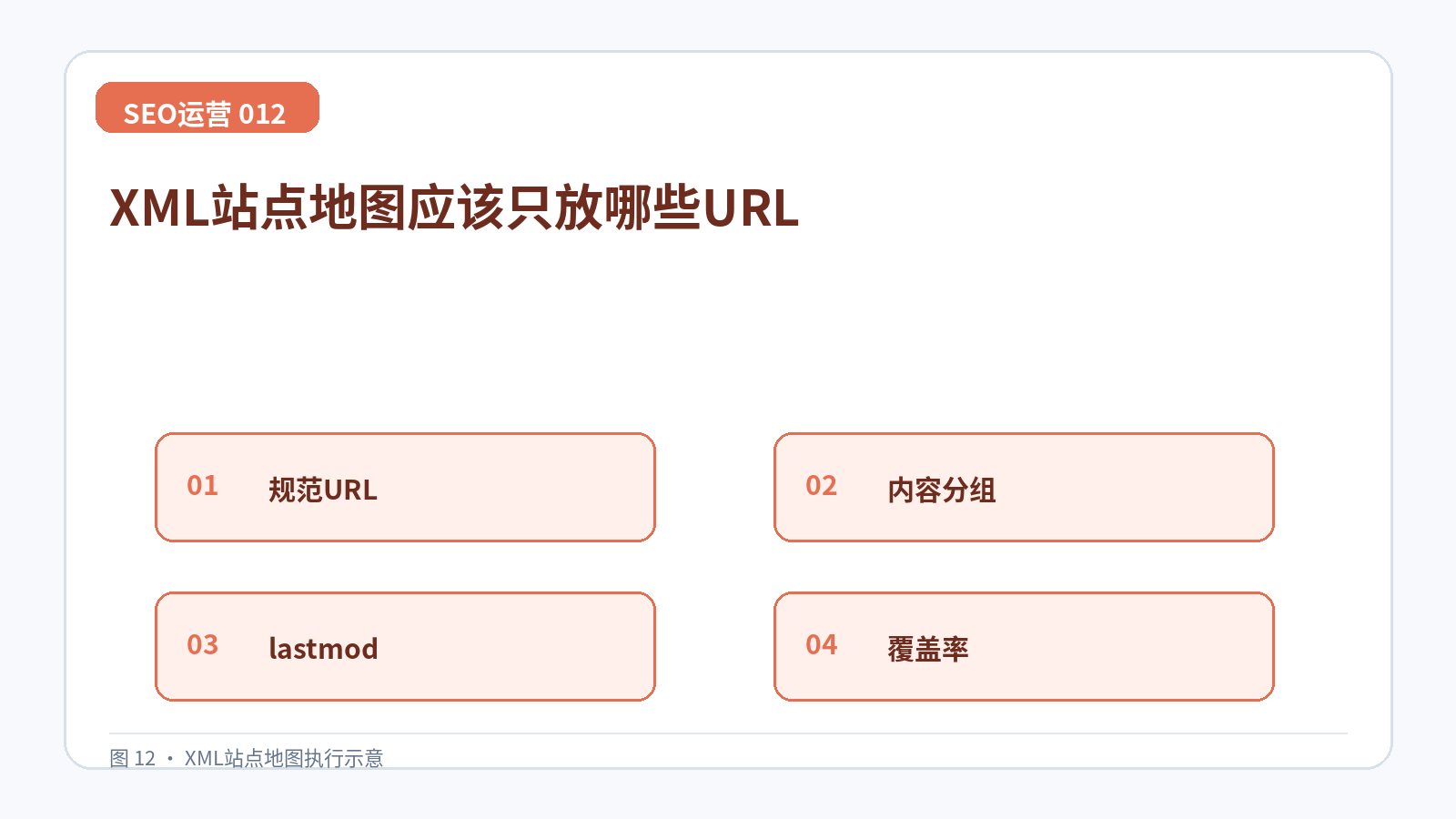
The key principle here is that only web sites that return 200, indexable, standardized and of operational value can make diagnostic signals clearer. Therefore, a snapshot of the current situation should be made, with the status of the web, internal links, timing and natural search performance retained, followed by adjustments to avoid historical fluctuations as an optimisation.
A more conservative approach is to split maps by type of content, automatically updating the lastmod, only to change the time when the substance changes, and to submit the index file in a uniform manner. If the site is large, the high-value catalogue pilot can be selected first; if it is a small site, priority is given to the front page, the core classification and the content that generates the queries, without having to cover all web pages in form.
The change is reviewed with the same calibre: comparing the number of files submitted with the index, taking a sample of unindexed samples and looking for reasons by template. At the same time, check whether users can read, navigate and complete the forms successfully, as the technical signals are correct but the web pages are not available and do not result in sustainable SEO returns.
There is a need to avoid, in particular, placing re-direction, 404, noindex, parameters, and duplicate URLs on maps that create contradictory signals.
When you actually repeat a disk, you can choose a successful page and a failed page in parallel. Retain their entry, content difference, capture status and transformation performance around the XML site map, making it easier to form a clear next round than by looking at the average of the entire site.
If the project team has limited resources, this method is first used on a web page that can generate a Query or take on a critical navigation. The content grouping and lastmod can go through and then be extended to the low-flow directory to avoid over-scope verification and unprocessed performance.