
How to make a key word gap analysis without replicating the competition is right. Three questions can be asked first: whether the target URL is clear, whether the search system has steady access and whether the user has the expected answers. The competition ranking only indicates the perceived demand of the market, and does not directly justify its own customers and products.
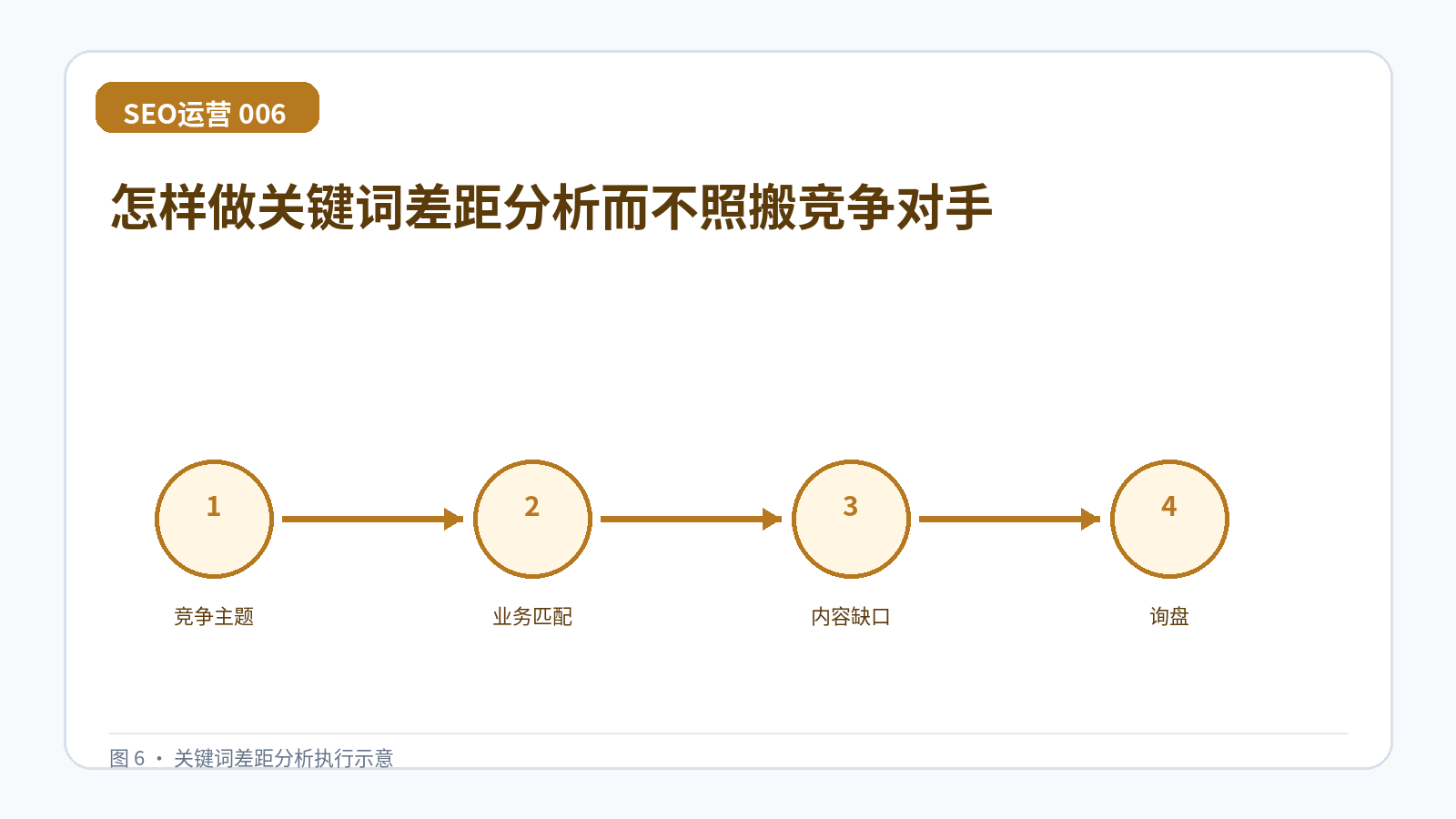
The gap analysis should cross-fer competition pages, business capabilities and search intentions. Therefore, it is not appropriate for the audit to export only a list of errors in the tool, but to mark the impact template, business value, repair costs and validation methods for each issue, first addressing the problem of disruption.
At the implementation level, you can screen topics related to products, service areas and the terms of the deal, and then judge whether the existing page can be expanded and then you can finally schedule new content.
The result of the review is a sample of the same pages: new non-brand displays, qualified queries, and subject coverage, rather than a number of statistical releases. Unimproved cases are also recorded, which often reveal rule exceptions or data calibre problems. The pursuit of all traffic words creates a large amount of non-conforming content and may deviate from the brand location, so any bulk operation should be validated first on the test environment and on a small amount of production URLs.
In order to prevent conclusions from remaining in the report, it is recommended that the subject of competition and the inquiry be published as an acceptance item, and that the anomaly be judged by whom and how long it will be repaired.
When you actually double-check, you may choose a successful page and a failed page in parallel. It is easier to record their entry, content difference, capture status and transformation results around a keyword gap analysis than to look at the average of the entire site.