
Let’s talk about the conclusion first: directly stacking parameters, prices and minimum order quantities, and explaining why the lack of parameters affects customer results is usually the core issue behind “How to write LinkedIn product content so that it doesn’t look like a hard advertisement”.Continuing to increase publication volume or budget will not automatically solve it, but may lead to more data in the wrong direction.
Draw the actual link first.Customers may be lost at every step from the first time they see the content to visiting the homepage or landing page, initiating a conversation, submitting information, becoming a valid lead, and entering into a quote.The core of LinkedIn B2B content is not to show how good the company is, but to help target decision-makers understand the problem, compare options, reduce risks, and remember trusted professional sources.Therefore, it is necessary to put target role exposure, stay and expansion, preservation, effective comments, data access, attention and content-assisted business opportunities in the same table, instead of just looking at the numbers that are easiest to increase.
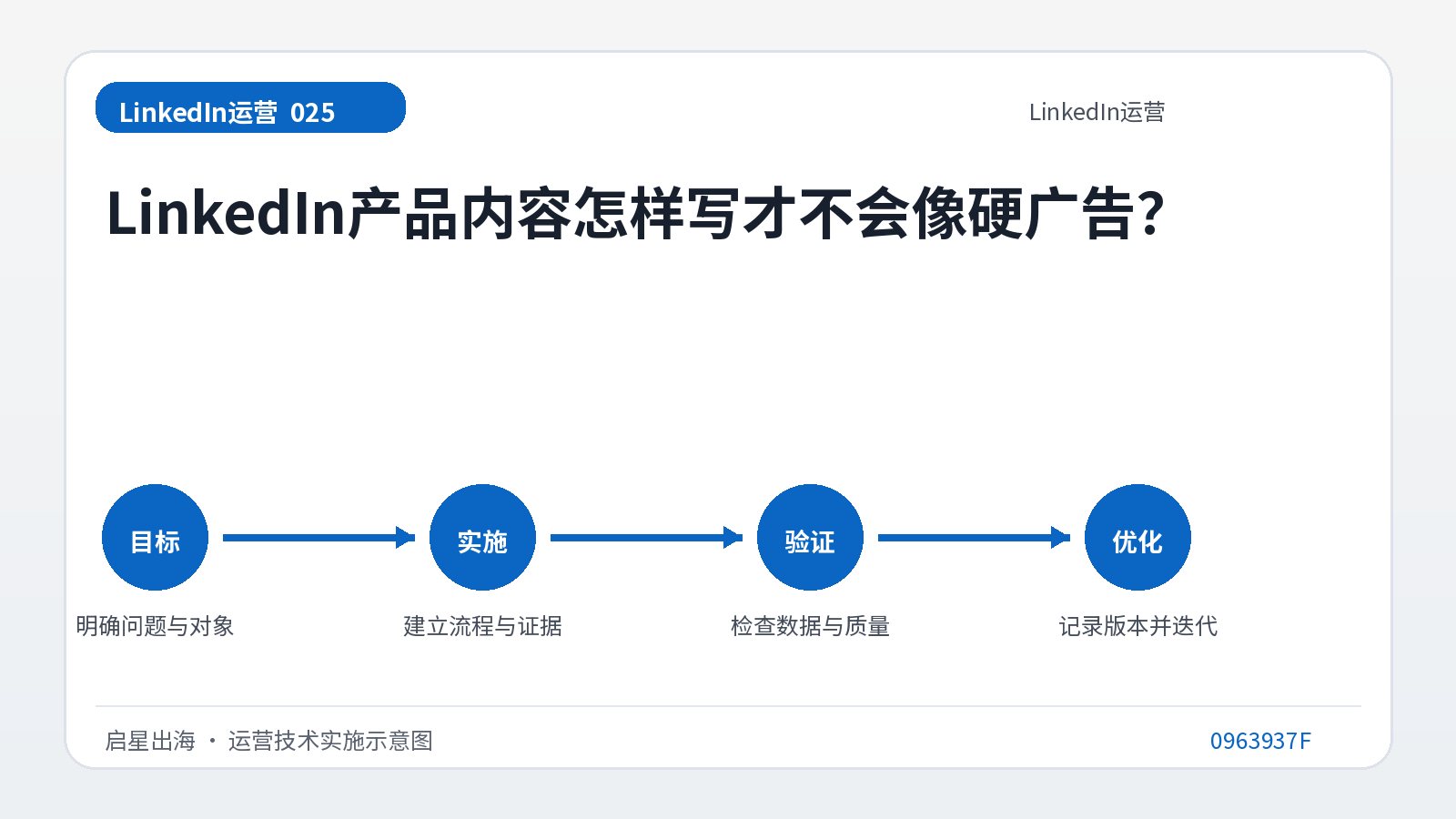
In terms of implementation, make minimal changes first: each article focuses on an application problem, explains the selection criteria, risks, evidence and applicable boundaries, and then naturally brings out the solution.Extract questions from the sales dialogue, establish topic selection according to the recognition, comparison, verification and action stages, and use opinions, methods, evidence, cases and CTA to complete the content closed loop.Keep the original version before adjusting, set a complete observation period, and mark the country, customer type and content or advertising version.In this way, when the results change, you can know which action has the impact.
The sales end must simultaneously verify the lead's company, role, application, specification or quantity, purchase time and next step.This question is recommended to see if the customer raises specific application, specification and data issues.If there are a lot of interactions or forms but a conversation with complete information cannot be formed, it means that the front end is still attracting the wrong people and low cost cannot be regarded as success.
During review, the conclusions are divided into four categories: retention, optimization, stop, and amplification.Only when content operations simultaneously reduce customer understanding costs, increase effective dialogue, and generate trackable business opportunities, is it worth copying to more countries or products.
When this question is implemented, you can first use a small group of real target accounts to verify it: each article focuses on an application problem, explains the selection criteria, risks, evidence and applicable boundaries, and then naturally brings out the solution.After execution, don’t just judge based on your feelings, but see if the customer raises questions about specific applications, specifications, and data; at the same time, save the customer’s identity, version, date, and subsequent sales results to avoid mistaking accidental replies for replicable methods.



