
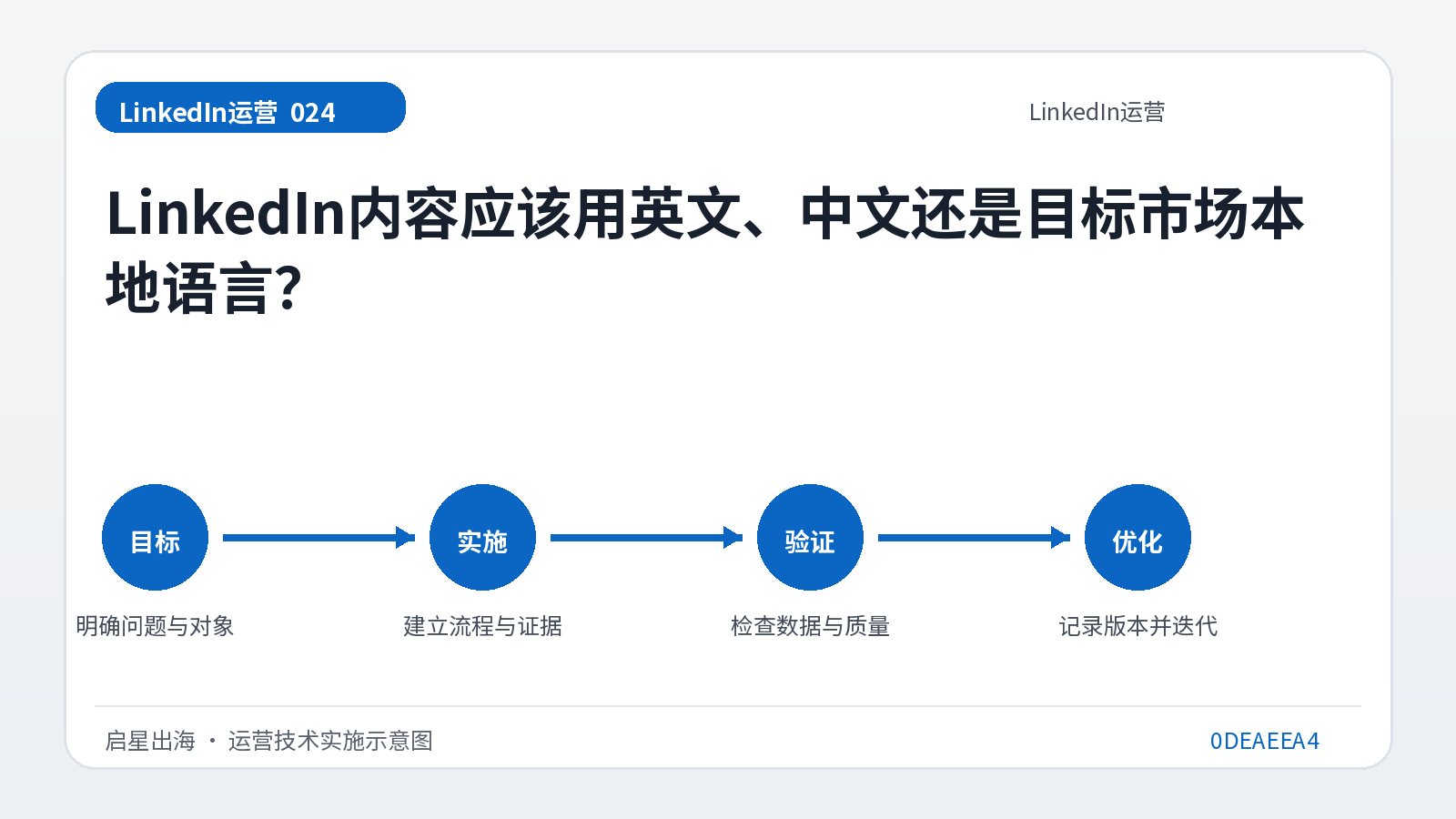
To solve this problem, the four-step method of "cause-action-indicator-decision" can be adopted.The current reason is that language selection only depends on team convenience and does not take into account buyers' reading habits, market size and maintenance capabilities. It will reduce at least one of customer relevance, trust or subsequent conversions.
In terms of action, first of all, the core pages should maintain unified business English, and local language content can be tested in key markets and proofread by people familiar with the industry.At the same time, follow the extraction of questions from sales conversations, establish topic selection according to the stages of cognition, comparison, verification and action, and use opinions, methods, evidence, cases and CTA to complete the content closed loop., ensuring that customers use consistent positioning, parameters, cooperation conditions and action instructions at every step from seeing the information to entering the sales process.
When it comes to metrics, don’t just look at a single cost or engagement volume.The operation side needs to observe the target role's exposure, stay and expansion, saving, effective comments, data access, attention and content-assisted business opportunities; the sales side needs to verify the company, role, application, specification quantity, time and follow-up stages.In particular, this question compares target country reach, interactions and inquiries by language.
In terms of decision-making, samples, observation periods and quality bottom lines are pre-set for each test.Don’t rush to draw conclusions when you haven’t reached the basic amount of data; don’t waste it for a long time just to “continue learning” when it obviously attracts the wrong crowd.The core of LinkedIn B2B content is not to show how good the company is, but to help target decision-makers understand the problem, compare options, reduce risks, and remember trusted professional sources.
Finally, write the results into the SOP: which conditions should be retained, which situations need to be changed, and which signals can be amplified.Content operation is not a one-time setup, but a process of continuous collaboration between market, content, data and sales.Solutions that increase the chances of effective conversations and quotes are truly replicable.
When this question is implemented, you can first use a small group of real target accounts to verify: the core pages maintain unified business English, and local language content can be tested in key markets and proofread by people familiar with the industry.After execution, don’t just judge based on your feelings, but compare target country reach, interactions, and inquiries by language; at the same time, save customer identity, version, date, and subsequent sales results to avoid mistaking accidental responses for replicable methods.



