
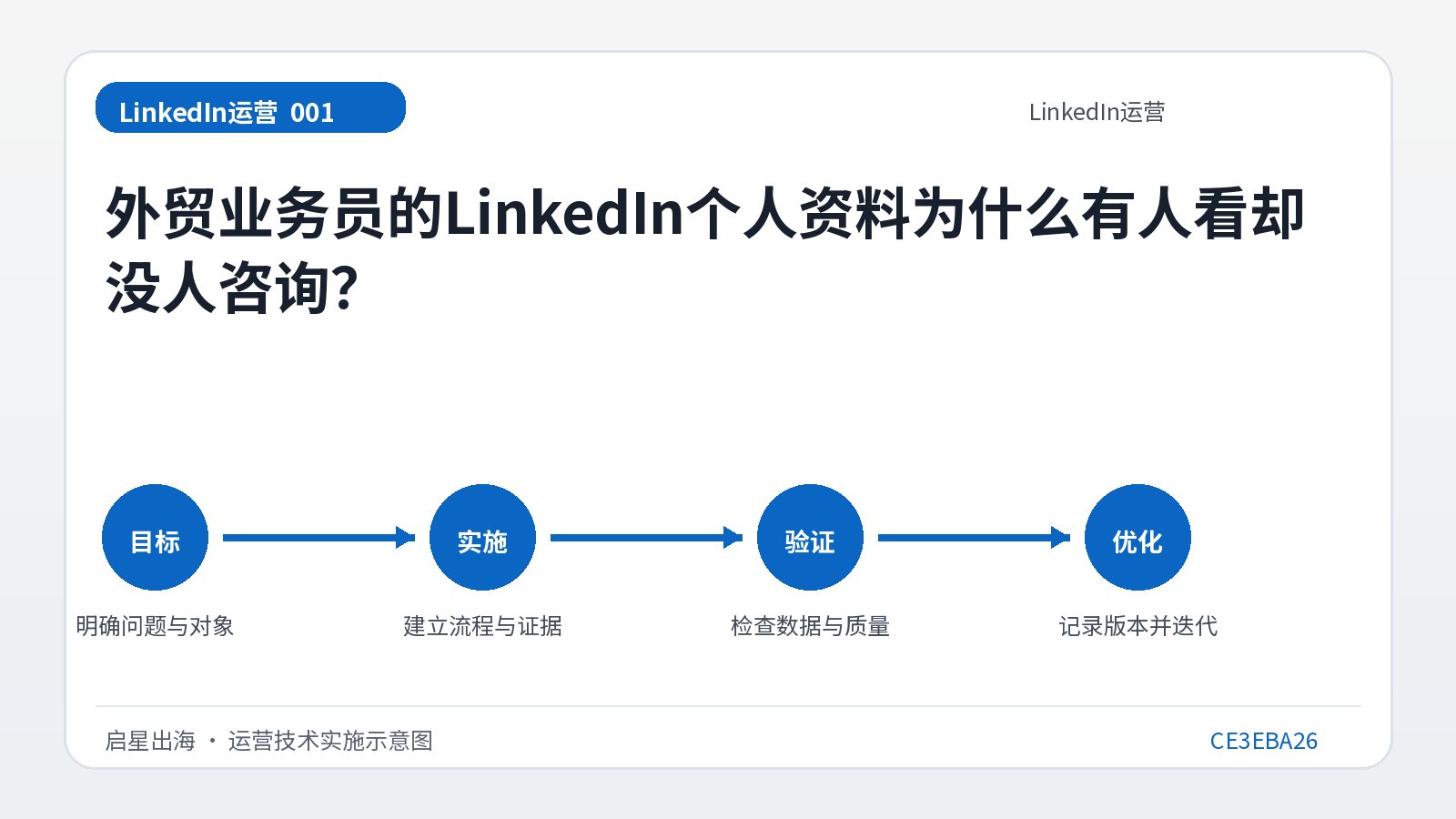
Let’s talk about the conclusion first: the information only states the position and products, but does not explain what procurement problems it can solve for which types of buyers. This is usually the core problem behind “Why is the LinkedIn profile of a foreign trade salesperson viewed but not consulted?”Continuing to increase publication volume or budget will not automatically solve it, but may lead to more data in the wrong direction.
Draw the actual link first.Customers may be lost at every step from the first time they see the content to visiting the homepage or landing page, initiating a conversation, submitting information, becoming a valid lead, and entering into a quote.The LinkedIn profile is not only the business card of the content publisher, but also the first place for buyers to verify their identity after receiving interactions or messages. It must also describe the service recipients, professional capabilities and credible evidence.Therefore, it is necessary to put target customer profile visits, search exposure, attention growth, featured content clicks, website visits and effective conversations in the same table, rather than just looking at the numbers that are most likely to increase.
Make minimal changes in execution first: rewrite the Headline and About, and use customer types, application scenarios, capability evidence, and next steps to form a clear value proposition.Check the avatar and name, Headline, About, experience, selected content, skill certification, contact information and action entry in sequence, and make all information focus on the same type of target customers.Keep the original version before adjusting, set a complete observation period, and mark the country, customer type and content or advertising version.In this way, when the results change, you can know which action has the impact.
The sales end must simultaneously verify the lead's company, role, application, specification or quantity, purchase time and next step.This question suggests comparing the conversion of data visits to website clicks, attention, or conversations.If there are a lot of interactions or forms but a conversation with complete information cannot be formed, it means that the front end is still attracting the wrong people and low cost cannot be regarded as success.
During review, the conclusions are divided into four categories: retention, optimization, stop, and amplification.Only when account positioning simultaneously reduces customer understanding costs, improves effective dialogue, and generates trackable business opportunities, is it worth copying to more countries or products.
When implementing this question, you can first use a small group of real target accounts to verify: rewrite the Headline and About, and use customer types, application scenarios, capability evidence, and next steps to form a clear value proposition.After execution, don’t just judge based on your feelings, but compare the conversion of data visits to website clicks, attention or conversations; at the same time, save the customer identity, version, date and subsequent sales results to avoid mistaking accidental replies for replicable methods.



