
Let’s talk about the conclusion first: testing too many countries, audiences, and materials at the same time, making each unit data-insufficient and unable to make decisions. This is usually the core problem behind “How should the LinkedIn advertising budget be set to be valuable for testing?”Continuing to increase publication volume or budget will not automatically solve it, but may lead to more data in the wrong direction.
Draw the actual link first.Customers may be lost at every step from the first time they see the content to visiting the homepage or landing page, initiating a conversation, submitting information, becoming a valid lead, and entering into a quote.Professional identity data for LinkedIn advertising is suitable for B2B targeting, but if the audience is too narrow, misdefined, or the creative lacks role relevance, it will result in high cost and low quality.Therefore, it is necessary to put audience size, frequency, click-through rate, landing page or form conversion, effective lead rate, audience penetration, opportunity cost and sales feedback in the same table, instead of just looking at the number that is easiest to increase.
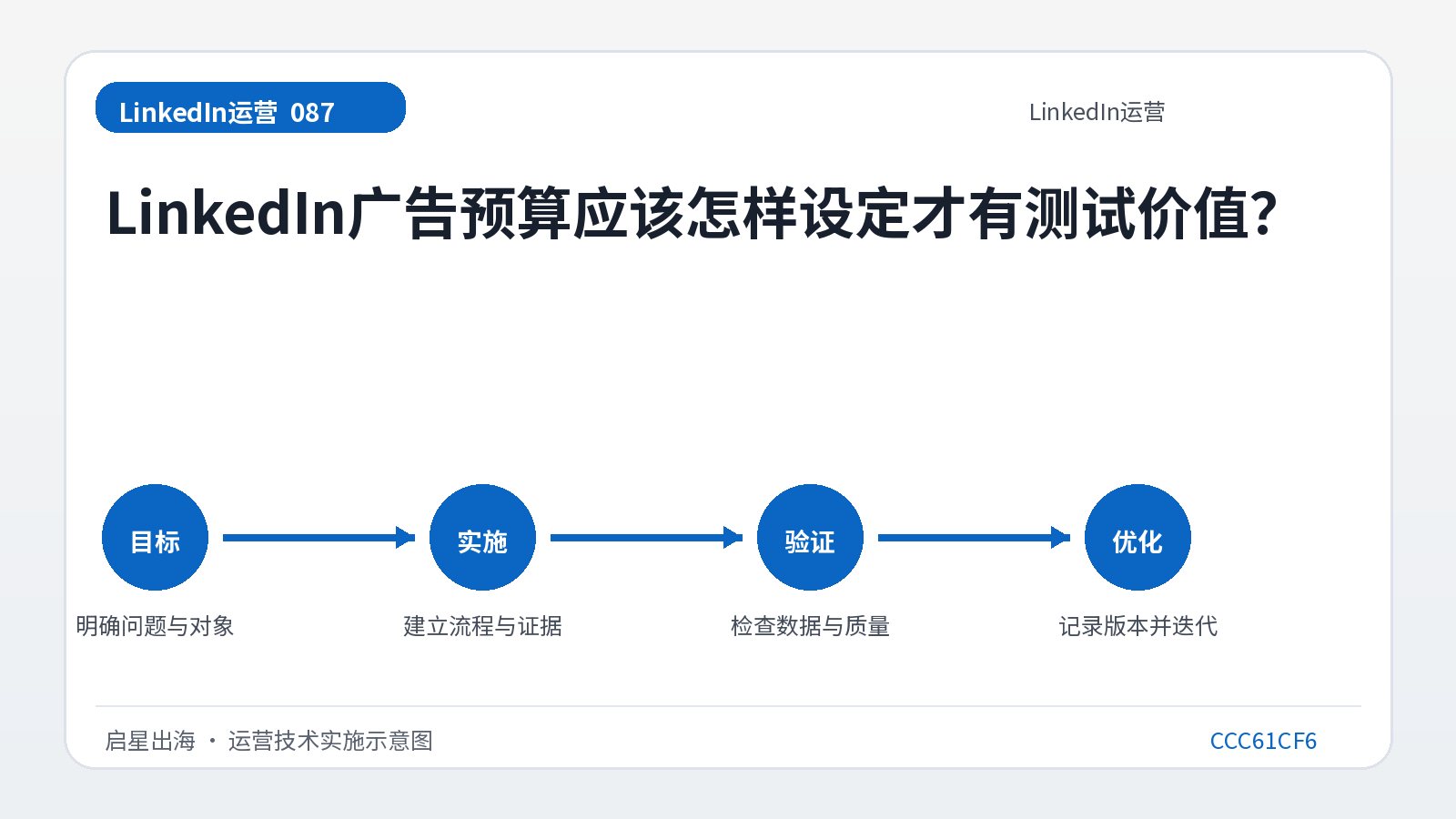
Make minimal changes in execution first: first determine the maximum acceptable business opportunity cost, test period and minimum samples, and reduce parallel variables when the budget is insufficient.Build audiences and exclusions from ICP, split key assumptions by country or persona, design matching creatives for each group, and combine click, conversion and sales quality decisions after a sufficient observation period.Keep the original version before adjusting, set a complete observation period, and mark the country, customer type and content or advertising version.In this way, when the results change, you can know which action has the impact.
The sales end must simultaneously verify the lead's company, role, application, specification or quantity, purchase time and next step.For this question, it is recommended to check whether valid events and sales feedback are obtained that are sufficient for judgment.If there are a lot of interactions or forms but a conversation with complete information cannot be formed, it means that the front end is still attracting the wrong people and low cost cannot be regarded as success.
During review, the conclusions are divided into four categories: retention, optimization, stop, and amplification.Only when placement optimization simultaneously reduces customer understanding costs, increases effective dialogue, and generates trackable business opportunities, is it worthwhile to replicate to more countries or products.
When this question is implemented, you can first use a small group of real target accounts to verify: first determine the maximum acceptable business opportunity cost, test period and minimum sample, and reduce parallel variables when the budget is insufficient.After execution, don't just rely on your feelings to judge, but see whether you have obtained valid events and sales feedback that are sufficient for judgment; at the same time, save the customer's identity, version, date and subsequent sales results to avoid mistaking accidental replies for replicable methods.



