
To solve the problem of "The audience of LinkedIn advertising is too large, how to avoid the budget being consumed by non-target customers", the first step is not to find skills, but to eliminate wrong assumptions.The team likely interpreted the problem as a lack of traffic, but the real reason was that the targeting criteria were broad and did not exclude employees, peers, students, or unrelated industries.The two judgments lead to completely different actions.
Start by sampling recent content, interactors, or leads to answer three things: are they your target customers, do they understand your value, and are the next steps clear enough.Professional identity data for LinkedIn advertising is suitable for B2B targeting, but if the audience is too narrow, misdefined, or the creative lacks role relevance, it will result in high cost and low quality.If you cannot answer one of the three items, it means that delivery optimization still needs to be restructured.
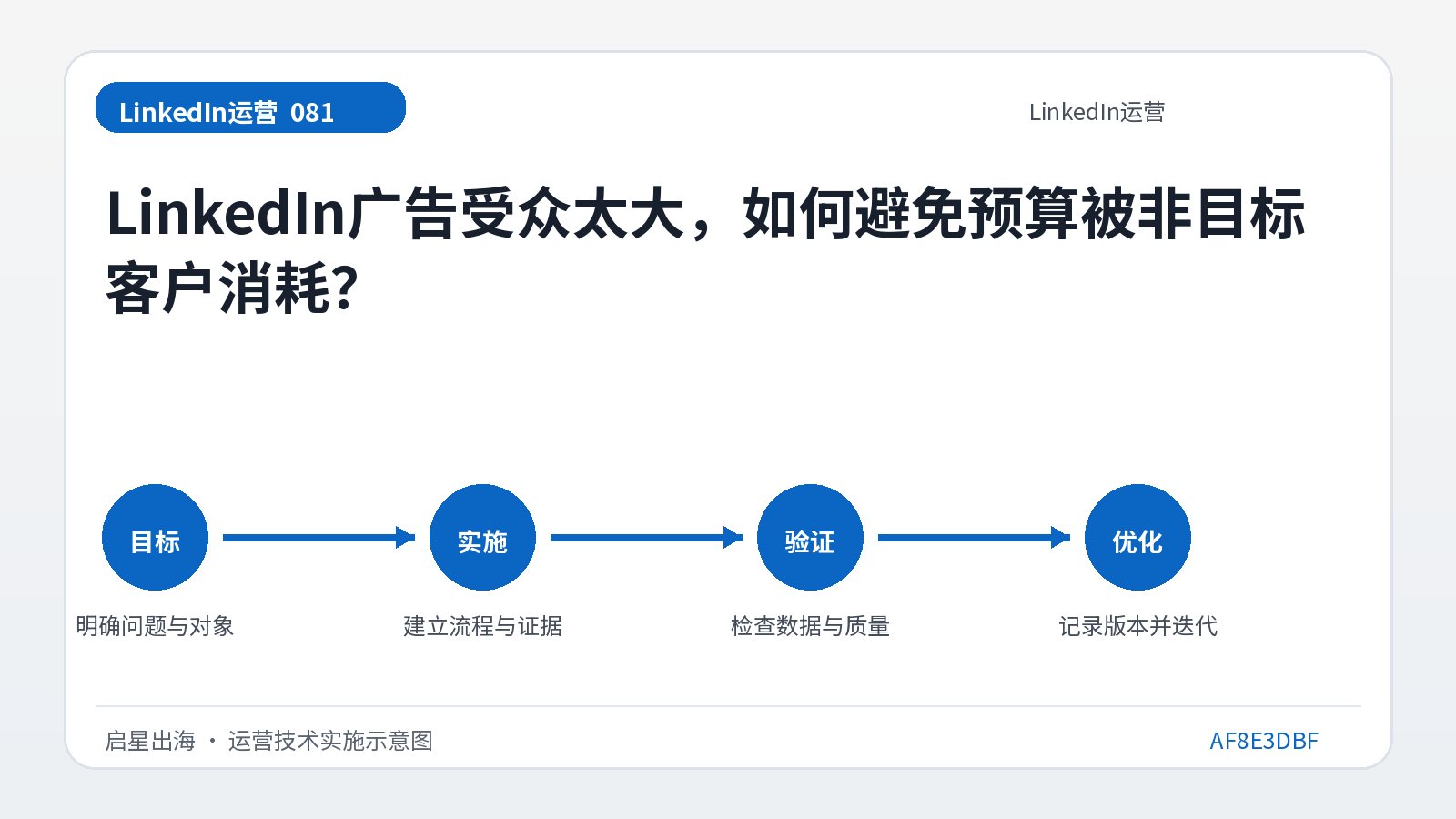
Prioritize execution: split the core and explore the audience, set industry, company, position and existing customer exclusions and spot-check demographic attributes.At the same time, we use ICP to establish audiences and exclusions, split key assumptions by country or role, design matching creatives for each group, and jointly make click, conversion and sales quality decisions after a sufficient observation period.order, do not skip the previous positioning and evidence and directly pursue the final inquiry.Only test one key difference in each round and set stopping conditions to avoid constantly adding resources without reaching a conclusion.
Evaluation metrics are divided into two categories: leading and results.The leading indicators are audience size, frequency, click-through rate, landing page or form conversion, effective lead rate, audience penetration, opportunity cost and sales feedback, and the result indicators are effective leads, quotations and business opportunities.This question will compare effective lead rates and sales acceptance rates by audience.Only when the two types of indicators are in the same direction can the changes be truly effective.
A common misconception is to immediately amplify when you see a drop in costs or an increase in engagement.The B2B sample is small, so customer identity and needs should be verified first, and then a stable period should be observed.Results that can be used by sales, can be followed up, and can be traced to their source are results worth retaining.
When implementing this question, you can first use a small group of real target accounts to verify: split the core and explore the audience, set up industry, company, position and existing customer exclusions and randomly check demographic attributes.After execution, don’t just judge based on your feelings, but compare the effective lead rate and sales acceptance rate according to the audience; at the same time, save the customer identity, version, date and subsequent sales results to avoid mistaking accidental replies for replicable methods.



