
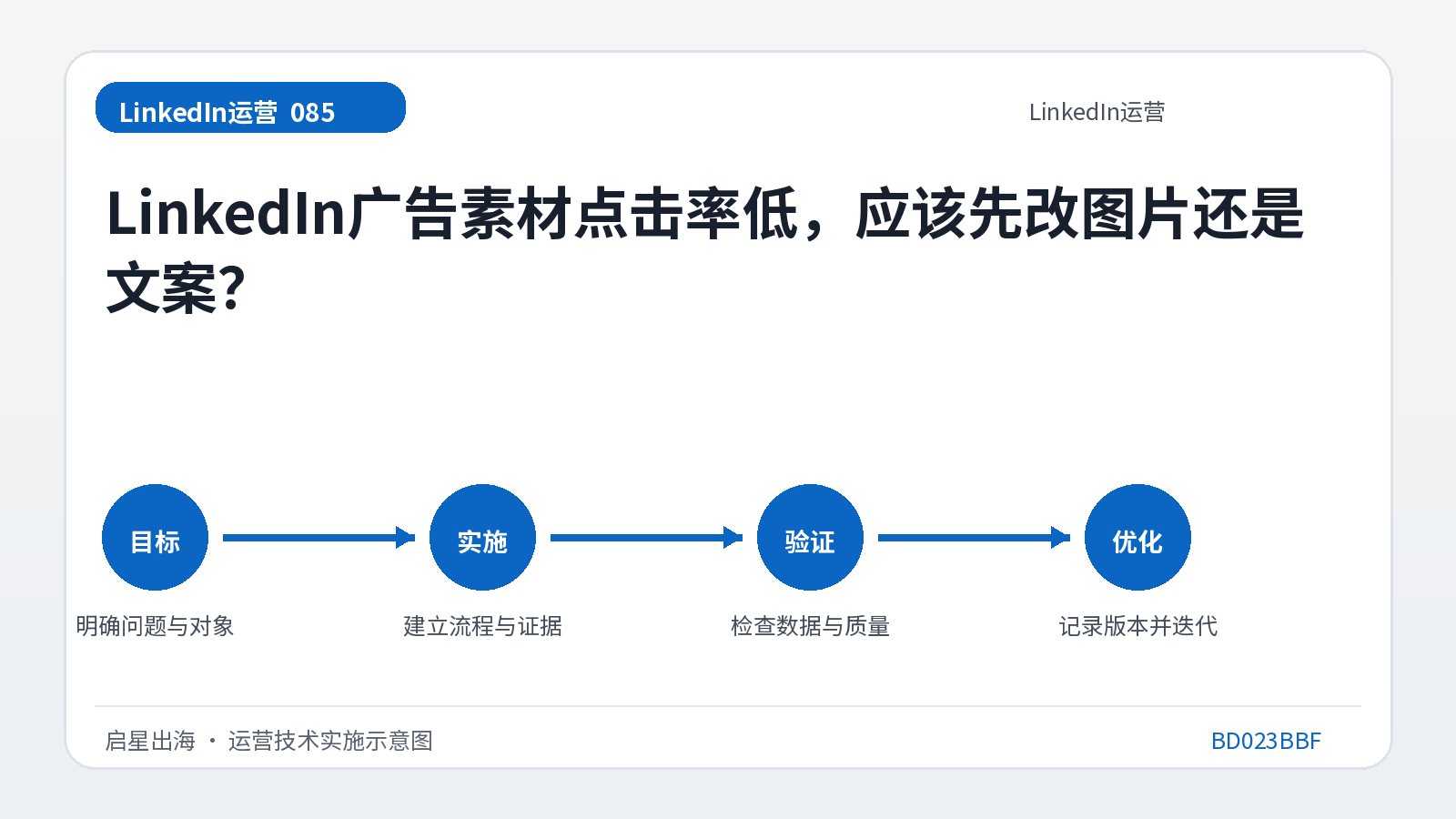
The click-through rate of LinkedIn advertising creative is low. Should I change the image or the copy first?
POST

The click-through rate of LinkedIn advertising creative is low. Should I change the image or the copy first?

Qixing Global analyzes the common reasons why LinkedIn advertising materials have low click-through rates and whether pictures or copy should be changed first, the troubleshooting sequence, execution methods and core indicators, and helps individual SOHOs, internal to external factories and foreign trade teams improve customer accuracy and effective business opportunities for LinkedIn paid promotions.A common problem is to redo all elements at the same time without locating the problem, and the real cause of the change in results cannot be known.

The click-through rate of LinkedIn advertising creative is low. Should I change the image or the copy first?

This problem is easy to be misjudged, because the platform data only shows the behavior and will not directly tell you the purchasing intention behind the behavior.A common root cause is to redo all elements at the same time without locating the problem. The real cause of the change in results cannot be known, and it needs to be verified with real customer data.

It is recommended to extract the latest 20 to 30 interactors, visitors or leads, check the country, company, position, industry and demand, and classify them into three categories: target, possibly relevant, and obviously invalid.Professional identity data for LinkedIn advertising is suitable for B2B targeting, but if the audience is too narrow, misdefined, or the creative lacks role relevance, it will result in high cost and low quality.The sampling results can help determine whether the content, audience, or acceptance should be changed.

The next step is to first determine whether the exposure group is correct, then test the opening, value proposition, evidence, visual and CTA respectively, and establish audiences and exclusions from ICP, split key assumptions by country or role, design matching creatives for each group, and jointly make decisions on click, conversion and sales quality after a sufficient observation period.Complete the full link check.Every time you make a change, you must clearly state what kind of invalid people you want to reduce and what kind of target customers you want to increase. You can't just write unverifiable goals like "improving results."

The platform layer looks at audience size, frequency, click-through rate, landing page or form conversion, effective lead rate, audience penetration, business opportunity cost and sales feedback, while the business layer uses single-variable comparison and effective conversion judgment.At the same time, record the first response time and next step results, because no matter how accurate the clue is, if no one follows up in time, it will be misjudged as a poor channel quality.

It is recommended to look at trends every week, make decisions every month, and review strategies every quarter.Only when continuous data and sales feedback support both, can we expand investment in paid promotion; if the two conflict, unify the effective lead standards first, and then discuss the quality of the channel.

When implementing this question, you can first use a small group of real target accounts to verify: first determine whether the exposure group is correct, and then test the opening, value proposition, evidence, visuals and CTA respectively.After execution, don’t just rely on your feelings to judge, but use single-variable comparison and effective conversion judgment; at the same time, save the customer identity, version, date and subsequent sales results to avoid mistaking accidental replies for replicable methods.


Related content

Should LinkedIn ad audiences be targeted by industry, job title or function?

Qixing Global analyzes the common reasons why LinkedIn advertising audiences should be targeted by industry, position, or function, the troubleshooting sequence, implementation methods, and core indicators, helping individual SOHOs, internal to external factories, and foreign trade teams to improve customer accuracy and effective business opportunities for LinkedIn paid promotions.A common problem is that using only a single field can easily miss synonymous positions or include people with the same function in unrelated companies.

Read more →

The audience for LinkedIn advertising is too small to serve. How should we expand it?

Qixing Global analyzes the common reasons why the LinkedIn advertising audience is too small to be launched, and how to expand it, the troubleshooting sequence, implementation methods and core indicators, helping individual SOHOs, internal to external factories and foreign trade teams to improve customer accuracy and effective business opportunities for LinkedIn paid promotions.Common problems are superimposing too many AND conditions or writing the position in too detail, resulting in the system not being able to reach enough members.

Read more →

The audience for LinkedIn advertising is too large, how to avoid the budget being consumed by non-target customers?

Qixing Global analyzed the common reasons why the LinkedIn advertising audience is too large and how to avoid the budget being consumed by non-target customers, the troubleshooting sequence, implementation methods and core indicators, and helped individual SOHOs, internal to external factories and foreign trade teams improve customer accuracy and effective business opportunities for LinkedIn paid promotions.A common problem is that the targeting criteria are broad and do not exclude employees, peers, students, or unrelated industries.

Read more →

