
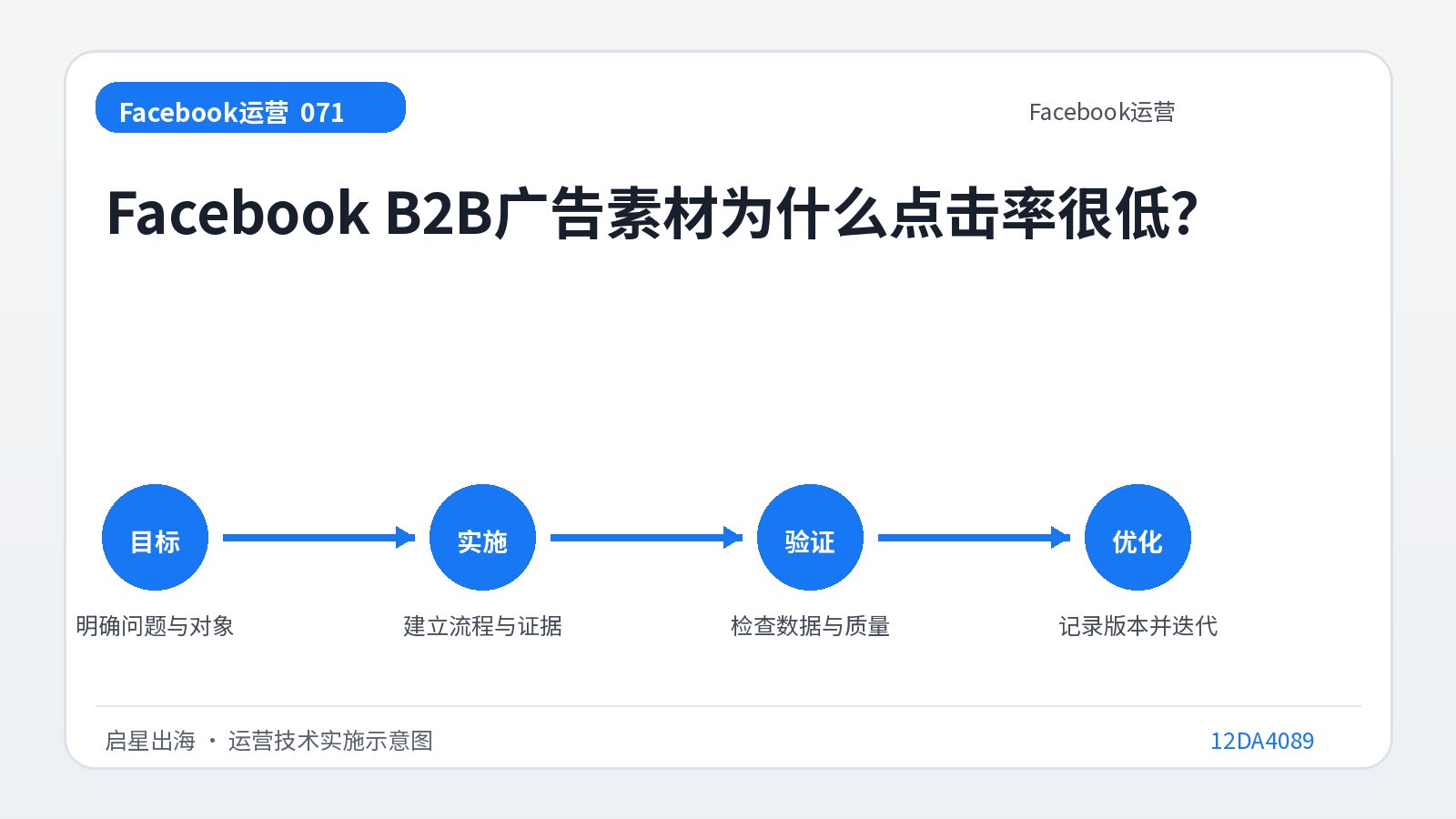
Why do Facebook B2B creatives have low click-through rates?
POST

Why do Facebook B2B creatives have low click-through rates?

Qixing Global analyzes the common reasons why the click-through rate of Facebook B2B advertising materials is very low, the troubleshooting sequence, execution methods and core indicators, and helps individual SOHOs, internal to external factories and foreign trade teams improve Facebook paid promotion customer acquisition and effective inquiry quality.The main problem is often that there are no specific scenarios or customer problems on the first screen. Although the product is clear, it lacks a reason for target customers to stop.

Why do Facebook B2B creatives have low click-through rates?

This question cannot be answered with a one-size-fits-all setting.The decision-making cycle of foreign trade B2B is long. First of all, we must determine whether the data is poor because no one has looked at it, because they are not interested, or because they are interested but have not entered the sales process.The most questionable thing at the moment is that there are no specific scenarios or customer problems on the first screen. Although the product is clear, it lacks a reason for target customers to stop.

It is recommended to conduct a reverse check first: work backwards from the final quotation opportunity you want to obtain, and determine what content the customer needs to see, what evidence to obtain, where to click, and what information to submit.B2B creatives need to both make people stay in the information flow and actively screen customers; the clearer the relevance, the closer the leads received by sales are usually to the real needs.If these steps are not connected, optimizing for reach, clicks, or fans alone will be difficult to produce stable results.

The first step in this question is: present the usage scenarios, risks or procurement difficulties in the first three seconds or the main title of the picture, and then quickly explain the applicable customers and solution value.Then follow the "Design hooks around customer scenarios, prove the solution with products or services, add factory, quality or case evidence, and explain the next step with specific calls to action." Check each item one by one.Don’t change positioning, materials, audiences, and hosting pages on the same day; if you change too many variables at once, you won’t be able to replicate the results even if they get better.

Two sets of data are used when measuring: the platform side looks at retention in the first three seconds, click-through rate, landing page views, form opening and completion, effective lead rate and negative feedback; the sales side looks at company matching, demand authenticity, quotation possibility and follow-up results.In particular, it is necessary to look at the click-through rate, target customer comments, and landing page views at the same time to avoid the operations team only reporting good-looking superficial data.

A practical judgment is: if the data is small but the customers are accurate, it can continue to be accumulated; if there is a lot of data but the customers are wrong, the screening and expression should be corrected immediately.It takes a week to observe execution problems, a month to judge trends, and then a complete procurement cycle to test whether the advertising materials are actually creating business opportunities.


Related content

Facebook ads have high click-through rates but poor inquiries. What’s wrong with the material?

Qixing Global analyzes the common reasons why Facebook ads have high click-through rates but poor inquiries, and where there are problems with the materials, troubleshooting sequences, implementation methods and core indicators, helping individual SOHOs, internal to external factories and foreign trade teams to improve the quality of Facebook paid promotion customer acquisition and effective inquiries.The main problem is often that exaggerated titles, generalized offers or visual gimmicks can bring clicks, but there is no filtering of purchasing identity and order conditions.

Read more →

Should Facebook ads for foreign trade factories use product images or scene images?

Qixing Global analyzes the common reasons why foreign trade factories should use product pictures or scene pictures for Facebook ads, troubleshooting order, implementation methods and core indicators, helping individual SOHOs, internal to external factories and foreign trade teams to improve Facebook paid promotion customer acquisition and effective inquiry quality.The main problem is often that pure product diagrams are suitable for people with known needs, while scenario diagrams make it easier for customers to identify problems, and the two undertake different tasks.

Read more →

What should be shown in the first 3 seconds of a Facebook video ad?

Qixing Global analyzes the common reasons, troubleshooting sequence, execution methods and core indicators of what should be displayed in the first 3 seconds of Facebook video ads, helping individual SOHOs, internal to external factories and foreign trade teams to improve Facebook paid promotion customer acquisition and effective inquiry quality.The main problem is often putting logos, factory doors or long subtitles at the beginning, which will lose a large number of viewers before the value appears.

Read more →

