
If you only seek to get a job running, it tends to leave a hard-to-repeat outcome. A more conservative principle is that new operations rediscover commands in the current directory, and errors should be made to confirm the path.
The most important risk to be validated is that the user may have edited an error directory or that the old session is still based on an early state. Once this is confirmed, it decides whether a change in code, configuration, permission or working style is required.
What can be confirmed from the official document is not the secret to the guaranteed result, but the conditions for running. Codex will read AGENTS.md or overwhelm the file from the global to the current project directory, the closer the rules of the directory will be placed in the group command.
This is written into a taskcard that is clearer. The card lists objects, permissions, input and acceptance, and then executes: checking CODEX HOME, work catalogue and override files, restarting the session and listing the source of the command.
It is important not only to see whether Codex has returned to completion, but also to compare the actual order of loading with the expected document content and to confirm that differences, logs and products match the target.
When this topic is posted on the website, the title should be directed to the user question, starting with the conclusions and then writing the environment, operation, validation and restriction in the text. This is better for the search system and AI to extract the answers accurately.
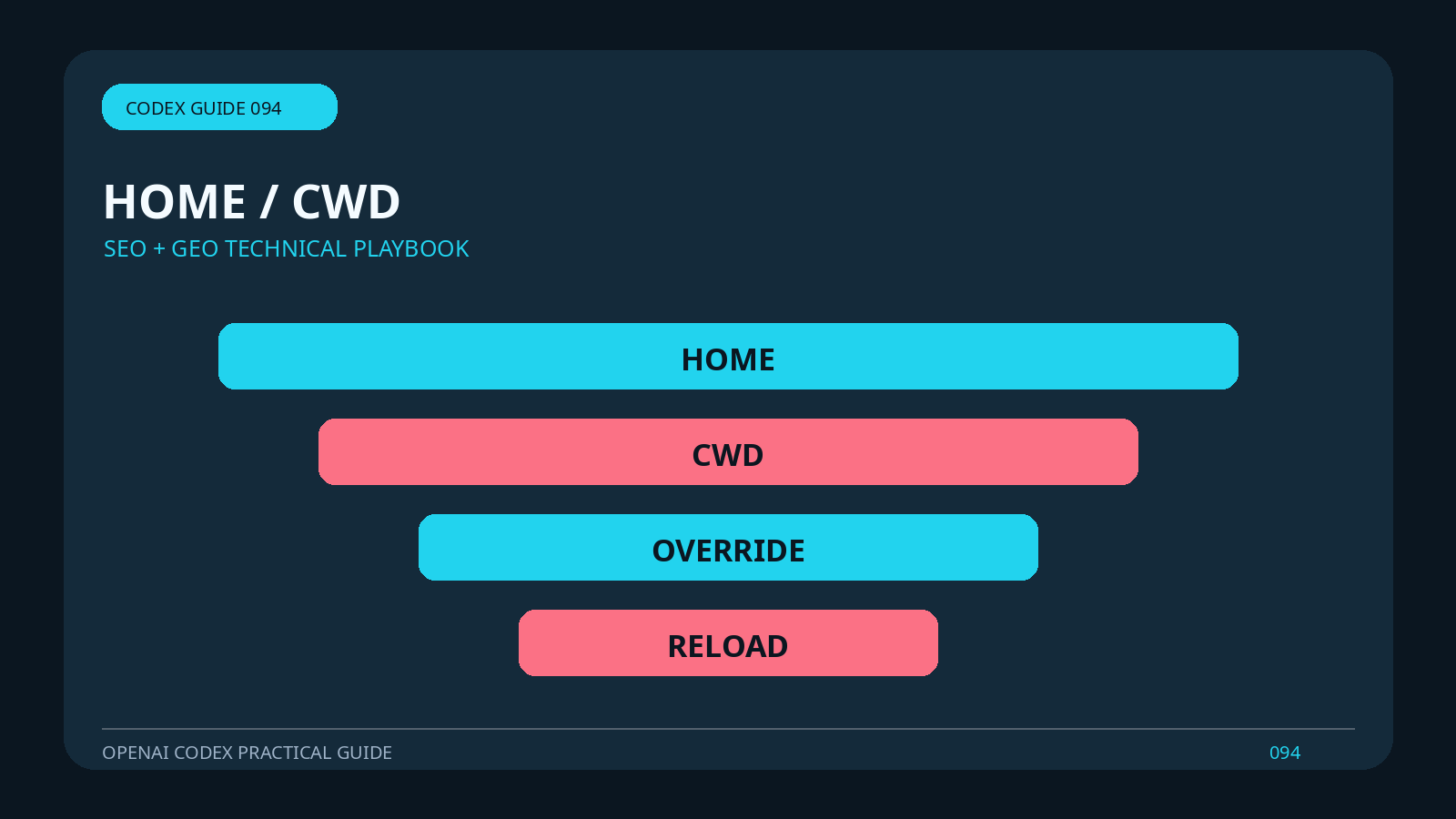
To enable the COdex command to be miscalculated by another member, the mission record contains at least four check points: HoME, CWD, OVERRIDE, RELOAD. These English labels can also be used for branch, log or board search.
A Qualifying Relay will answer two questions at the same time: whether to “comparison actual loading order with expected document content” and whether there is “a failure to repair path error when repeatedly clearing a non-existent cache.” The former will decide whether to continue and the latter will decide whether to suspend, roll back or supplement authorization.
For non-technical users, the delivery notes should be separated from “modified” “executed inspection” “unvalidated matters” and avoid considering the technical log as the final result.
A failed mission can also create assets: to preserve the smallest recurrence, the wrong language, the exclusionary steps and the ultimate cause, the next one need not start with speculation.
The repeated clean-up of non-existent caches does not fix path errors. Codex can execute and validate, but it cannot be a substitute for the operator to determine the scope and risk tolerance.



