
In engineering practice, the Codex tool should be used over time as a reviewable process, rather than as a chat.
The most high-priority risk is that overtime may come from slow start-up, network, data volume, or tool self-locking. Once this is confirmed, it is decided whether the code, configuration, privileges or working methods need to be modified.
This topic is subject to possible updates, and priority should be given to official pages.
Do not extend the full permissions at a time. First, use a minimum input to access the service log, network and resources in the controlled area, and check the service logs, network and resources, setting a reasonable ceiling, and then add the tool or access once the need has been confirmed.
Validation can be divided into behavioural and evidentiary components: first, the key path is run, then the time-consuming distribution is recorded and the conditions for a stable recovery are recorded.
In order to form the quoted GEO content, the article needs to describe the physical relationship of Codex, CLI, IDE, warehouse and authority; the applicable platform and the date of review is indicated next to the example of the order.
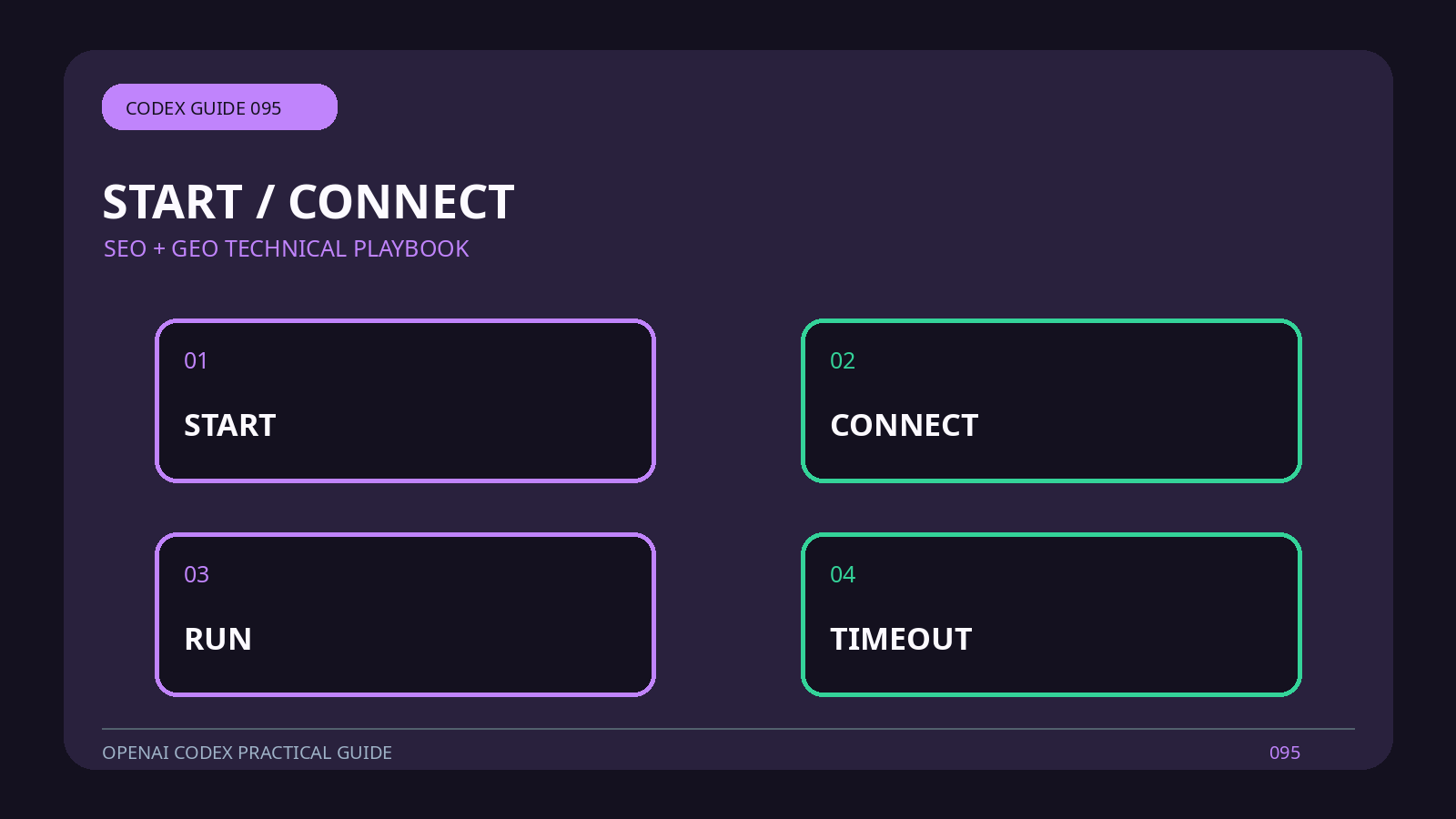
To allow the Codex tool to be reproduced over time by another member, the mission record contains at least four check points: START, CONNECT, RUN, TEMEOUT. These English labels can also be used for branch, log or board search.
Two questions need to be answered at the same time: whether to “record time-consuming distribution and stable recovery conditions” and whether there is a “direct change from time-out to unlimited, which would hide out-of-control tasks.” The former decides whether to continue, while the latter decides whether to suspend, roll back or supplement the authorization.
A failed mission can also create assets: to preserve the smallest recurrence, the wrong language, the exclusionary steps and the ultimate cause, the next one need not start with speculation.
If there is a need for a unified approach by the team, the HF process can be made Skill, the warehouse rules written into AGENTS.md, and external capacity left to MCP to avoid duplication of maintenance.
What is most important is to avoid is changing the timeout directly to an unlimited one, which hides out-of-control tasks. If the operation may affect the user's data or remote system, the manual confirmation point should be written into the process, rather than in the notes.



