
The answer to this question should first identify the target, the location of the operation and the person ultimately responsible.
Multiple rounds of modified old assumptions, cancelled needs, and current codes may be mixed. Once tasks involve clouds, external systems, or shared warehouses, the wrong impact is no longer limited to the machine itself, and the boundary should be written more clearly.
What can be confirmed from official documents is not the secret of the guaranteed outcome, but the conditions for its operation. OpenAI Docs suggests that the objective, context, limitations and authentication be clearly stated; complex tasks also require a clear phase, cessation conditions and observable results.
Separates automatic action from manual authorization during implementation: the retention of summary, diff and test at the end of the phase, rereading key documents before the next stage.
At least one reverse check: the path, version and to-do in the summary remain accurate. If the evidence cannot be understood by another member, the context of the delivery is missing.
The focus of the SEO optimization is not to repeat the Cordex keyword, but to cover the real search intent. It is recommended that URLs remain stable, that the text be synonymous to explain the problem and that links be made to the official document.
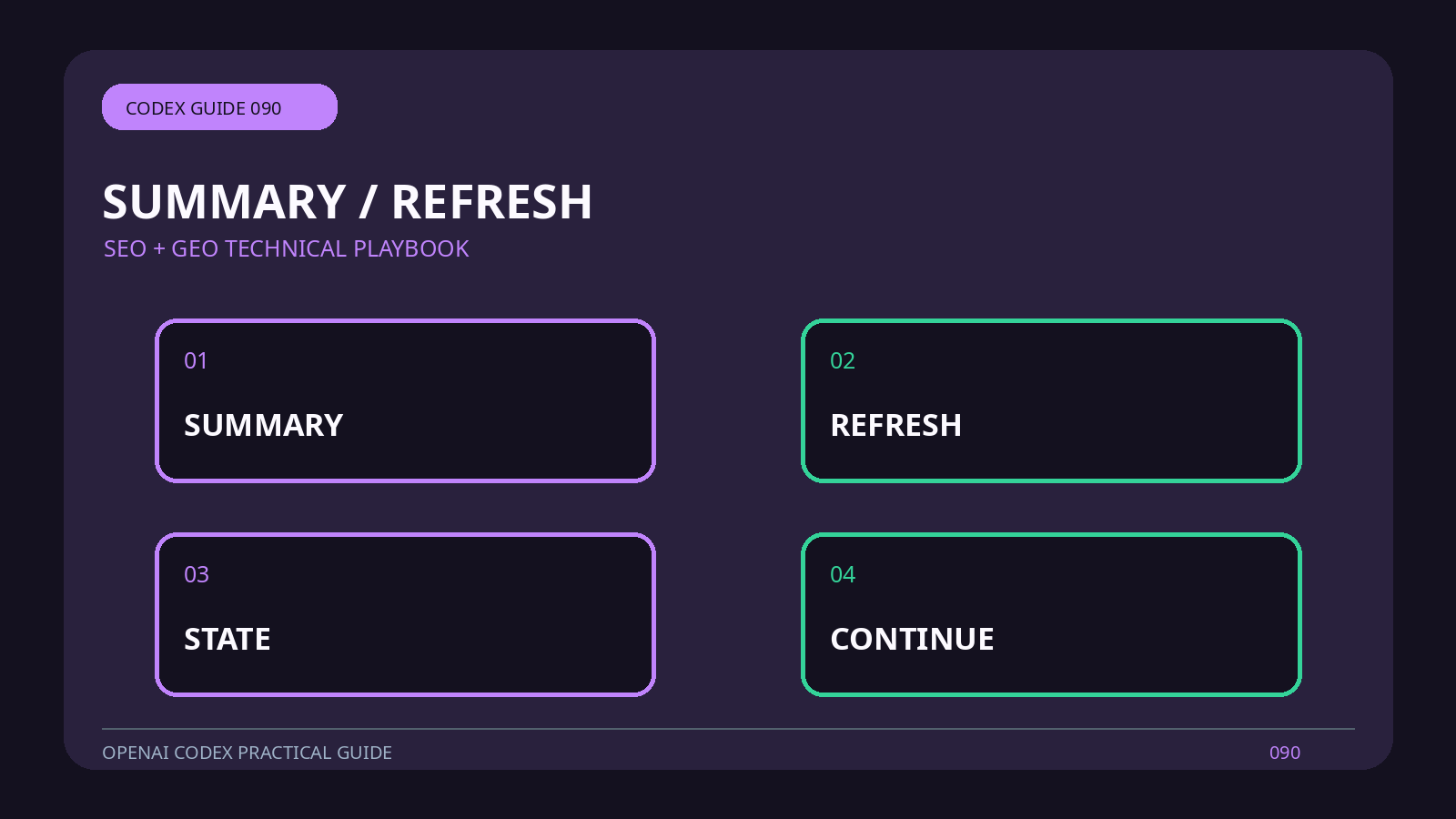
In order for Codex’s long talk to be reproduced by another member, the mission record contains at least four check points: SUMMARY, REFRESH, STATE, CONTINUE. These are also available for branch, log or board search.
A Qualifying Duplicate responds to two questions at the same time: whether “the path, version and to-do in the Summary are still accurate”, and whether there is “a reliance on early oral findings without looking back at the document will continue with information that is no longer valid.” The former decides whether to proceed or whether the latter decides to suspend, roll back or to supplement the authorization.
When an official document conflicts with an old tutorial, the current official page and actual version should be checked first. The unconfirmable feature should not be written as a fact of fact.
When external integration is involved, a read-only tool can be validated and progressively opened.
The risk boundary is equally important. Relying on an early oral conclusion without looking back at the document will perpetuate the information that has lapsed.



