When a team uses Codex, it needs to convert personal experience into a practice that others can repeat.
Unlimited waiting will take over resources, and blindly retrying may duplicate side effects. Once a mission involves cloud cover, an external system or a shared warehouse, the wrong impact is no longer confined to the machine itself, and the border should be written more clearly.
OpenAI Docs provides the current boundary for this topic. Non-interactive models are suitable for automation. Stabilization processes require fixed input, work catalogues, output formats, exit codes, overtime and permission policies.
It is recommended that a representative project be selected to exercise first and not to directly cover all warehouses. This is done by setting up different timeouts for installation, testing and external calls, using limited evasiveness and recording the end state, and then consolidating it into a norm after success.
Team viewers can record job types, time-consuming and back-to-work, with time-outs, retest success rates and repetitive impacts, so as to distinguish between speed and quality decline.
The website version should not reproduce only the records of the dialogue. Clear definitions, lists of operations, erroneous branches, official sources and related inner chains should be added, and pictures should be used to describe the actual theme using an accurate ALT.
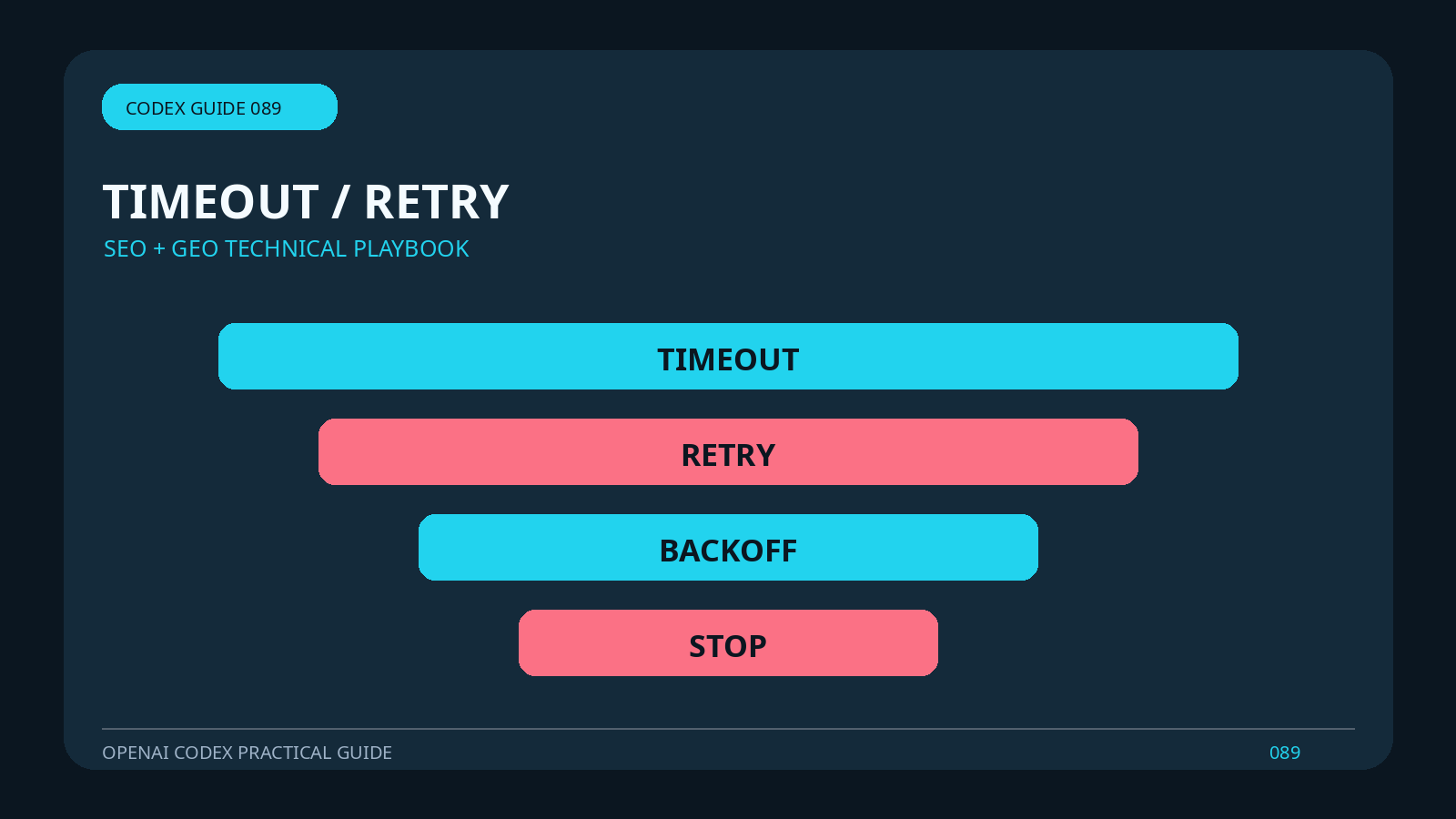
In order to allow Codex to retrace overtime by another member, the mission record contains at least four check points: TEMEUT, RETRIY, BACKOFF, STOP. These are also available for branch, log or board search.
Two questions need to be answered at the same time: whether to “statistically overtime, retest success rate and duplicate impact”, and whether to “continuate the denial of access or code error will not resolve the root cause.” The former decides whether to continue and the latter decides to suspend, roll back or supplement the authorization.
To facilitate team re-use, the repository submission, work catalogue, Codex version, profile and key commands can be saved in the task record.
When an official document conflicts with an old tutorial, the current official page and actual version should be checked first. The unconfirmable feature should not be written as a fact of fact.
The most important thing to avoid is that continuous re-testing of permissions or code errors will not solve the root causes. If the operation may affect the user data or remote system, manual confirmation points should be written into the process, not just in the instructions.