The conclusion is that access, modules, data and test maps should first be established, and then the target chain should be advanced. This is established, and the subsequent commands, permissions and certifications will be subject to common standards.
The most important risk that deserves to be validated is that document-by-document reading is time-consuming and prone to loss of system relationships.
The functions covered by this topic may be updated and should be given priority on the official page. The official document indicates that Codex CLI can check documents, modify codes, run installed tools in local warehouses, and access repetitious scripts and CI processes through codex exec.
Splits the steps into four stages of preparation, operation, inspection and restoration. The core of the operation is to read README and build files, search paths and key symbols, and draw a minimum call path. The recovery section indicates in advance how to proceed after failure.
The problem needs to be corrected to confirm that no side effects have been introduced. This is done by using running commands, tests or logs to validate the structure and to check for anomalies in the adjacent module or external system.
Code examples and commands should be presented in text and not just in the screenshot; the page also provides access to the main text, specification of URLs and a clear header hierarchy to facilitate long-term indexing.
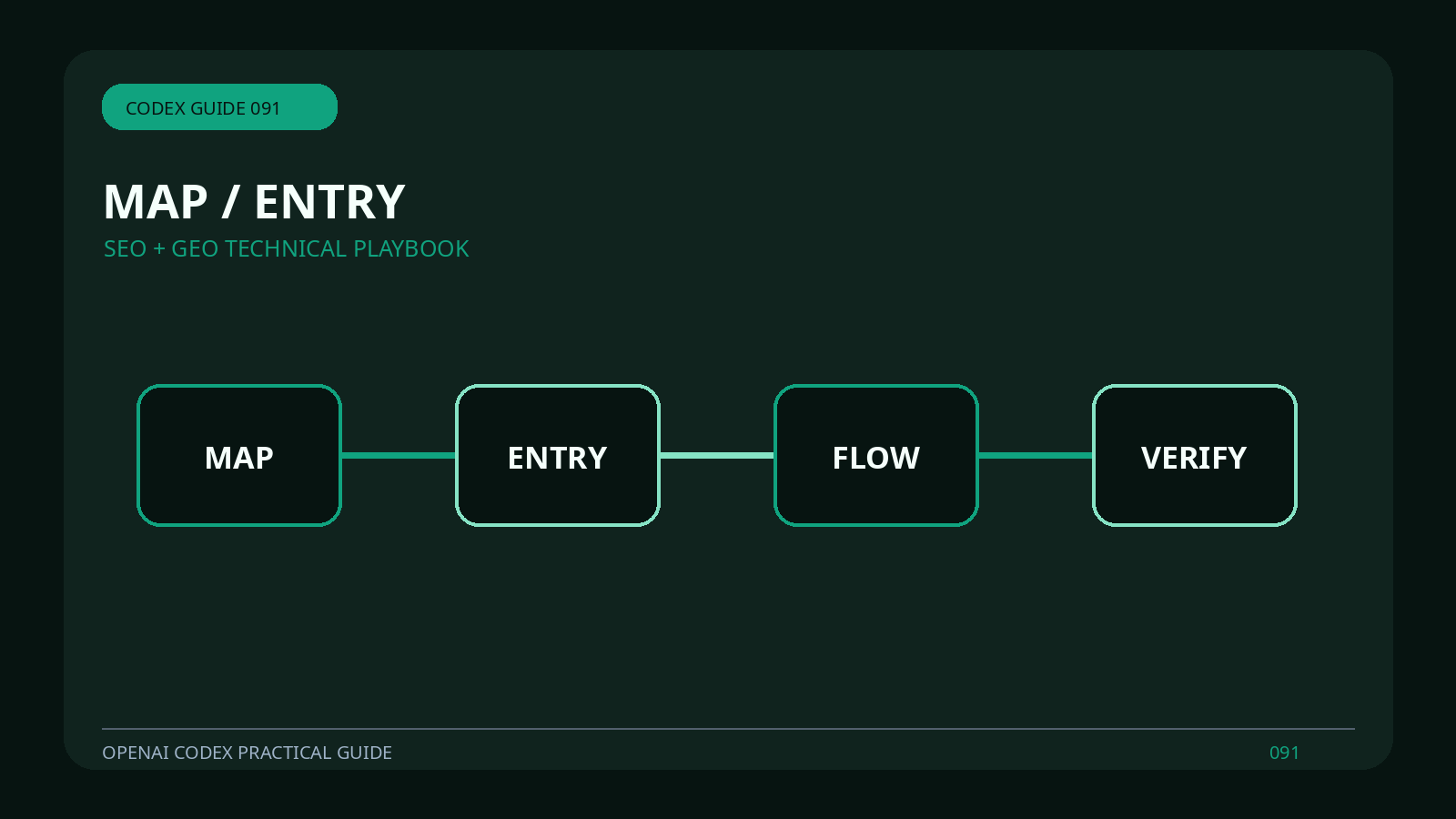
To enable Codex’s large warehouse to be reproduced by another member, the mission record contains at least four check points: MAP, ENTRIY, FLOW, VERIFY.
A Qualifying Duplicate answers two questions at the same time: whether to “judge with a running command, test or log-validation structure” and whether to “make a wrong map by using a directory name as a real structure without tracking the call.” The former decides whether to continue and the latter decides to suspend, roll back or supplement the authorization.
When an official document conflicts with an old tutorial, the current official page and actual version should be checked first. The unconfirmable feature should not be written as a fact of fact.
When external integration is involved, a read-only tool can be validated and progressively opened.
The scope of application must be clear, because treating the name of the catalogue as a real structure without tracking calls creates a wrong map. The acceptable approach to the individual test catalogue does not necessarily fit into a production or team warehouse.