
There is no one-size-fits-all solution to such problems. For Codex exit codes, the reliable starting point is that the process should distinguish between failure of the tool, unfinished task and failure of validation.
Scripts look only at whether or not to produce an output, and they may consider failure reports as a successful outcome. Once a mission involves clouds, an external system or a shared warehouse, the wrong impact is no longer limited to the machine itself, and the boundary should be written more clearly.
The functions covered by this topic may be updated and priority should be given to the official pages. Non-interactive models are suitable for automation.
The minimum steps can be implemented: capture exit codes and standard errors, save context and prevent subsequent deployment when failure. Every step retains commands, versions and results, and any exception is stopped at the current level.
Once the problem has been repaired, it is also necessary to confirm that no side effects have been introduced. The approach is to prepare a branch for success, overtime, denial of access and failure of testing, and to see if there are anomalies in the adjacent module or external system.
If there are installed pages, error pages and case pages on the subject, the current article can be used to explain the main problem and then connect to the next step through descriptive anchor text to avoid multiple pages competing for the same search.
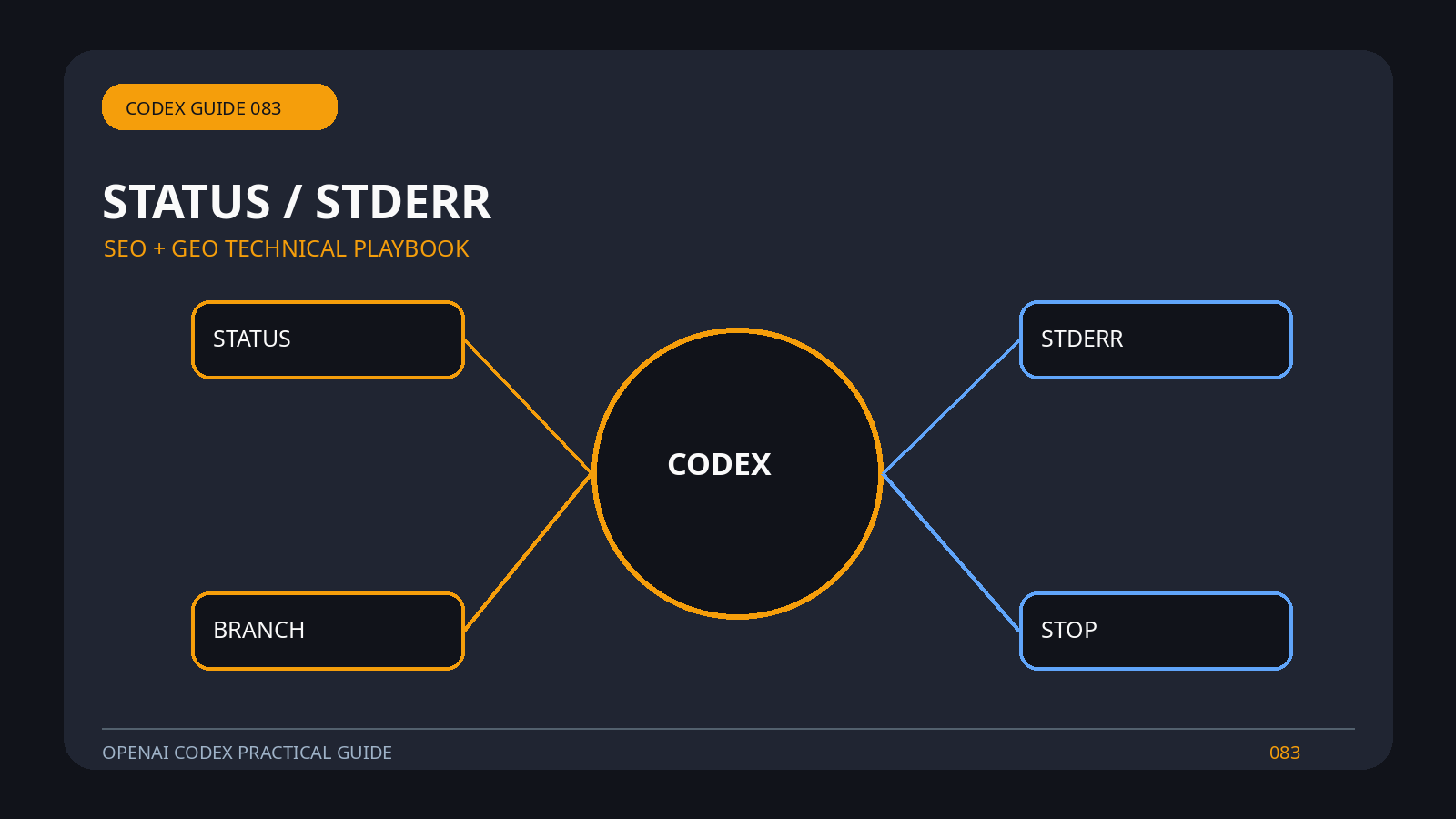
To enable Codex's exit code to be reproduced by another member, the mission record contains at least four check points: STATUS, STDERR, BRANCH, STOP. These are also available for branch, log or board search.
Two questions need to be answered at the same time: whether to “whether to prepare a branch for success, time overrun, denial of authority and test failure” and whether there is a “continuation of an order to ignore an error would mask a critical failure.” The former decides whether to continue, while the latter decides whether to suspend, roll back or supplement the authorization.
For non-technical users, the delivery notes should be separated from “modified” “executed inspection” “unvalidated matters” and avoid considering the technical log as the final result.
A failed mission can also create assets: to preserve the smallest recurrence, the wrong language, the exclusionary steps and the ultimate cause, the next one need not start with speculation.
Do not equate automation success with business correctness. Continued orders to ignore errors conceal critical failures, so the ultimate responsibility remains with those who understand the project.



