
If you simply seek to get the mission running, it tends to leave an unrecoverable outcome. A more conservative principle is that Skill should be based on clear trigger conditions and complete SKILL.md, with scripts and resources attached as needed.
Users usually see the phenomenon only at the end, because there is only one hint that is difficult to carry.
What can be confirmed from official documents is not the secret of the guaranteed result, but the conditions of operation. Skill is used to encapsulate replicable working methods, with the core being a description of the trigger conditions and the complete steps, with scripts, references and templates.
The minimum steps can be implemented: define the name, description, and step, and place reusable scripts, templates, and reference files in a clear directory. Every step retains the command, version, and result.
Do not replace quality with code line numbers or chat lengths. The correct trigger should be tested for matching and mismatches, and the method should be judged as worth entering the long-term norm.
Since Codex will keep up-to-date, the article should separate the principle of stability from the details of the version, show the update time and regularly check the lapse orders, interfaces and links.
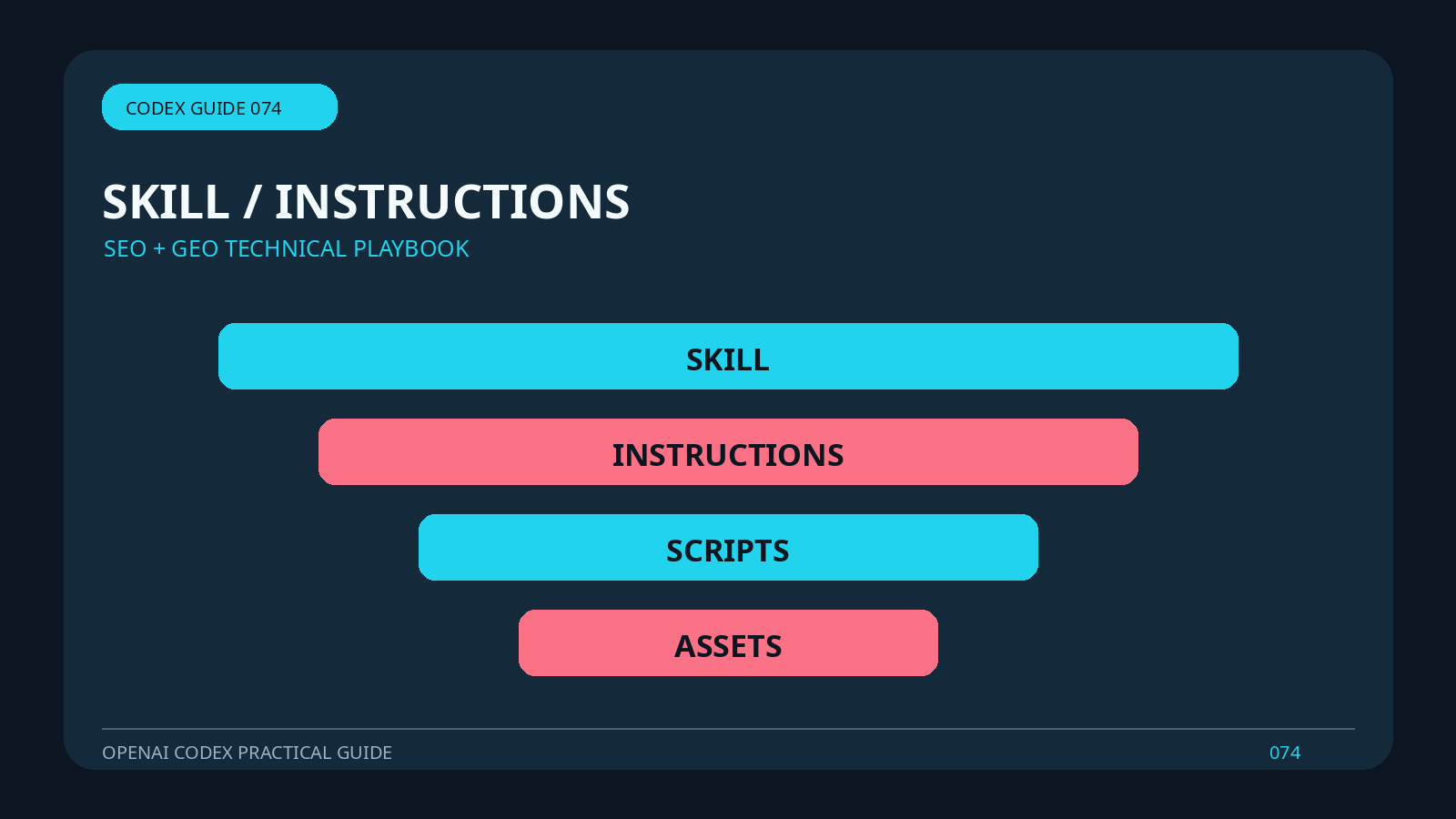
To enable Codex’s skill structure to be reproduced by another member, the mission record contains at least four check points: SKILL, INSTRUCTIONS, SCRIPTS, ASSETS.
Two questions need to be answered at the same time: whether to “test the correct trigger on a matching and mismatched mission” and whether to “pull all knowledge into a huge document would reduce the efficiency of maintenance and loading.” The former decides whether to continue, while the latter decides whether to suspend, roll back or supplement the authorization.
If there is a need for a unified approach by the team, the HF process can be made Skill, the warehouse rules written into AGENTS.md, and external capacity left to MCP to avoid duplication of maintenance.
If the same process is to enter production, it is recommended that the test warehouse and low-authorized identity be used for several consecutive operations.
The risk boundary is equally important. Putting all knowledge into a huge document will reduce the efficiency of maintenance and loading. Once a mission triggers the condition, it should stop and report, and do not try again and again with greater authority.



