
There is no one-size-fits-all solution to these problems. For the COdex MCP tool strategy, the reliable starting point is that the white list of tools and the tool-by-tool approval should be around the task set.
Users usually see the phenomenon only at the end, as the server exposes the entire tool to unnecessary capabilities.
OpenAI Docs provides the current boundary for this topic. Codex can connect local processes or HTTP services through the MCP and configure servers, tools, authentication, overtime and approval.
Splits the steps into four stages of preparation, operation, inspection and recovery. The core of the operation is to enable the required reading tool, disables the deletion or publication tool, calls for configuration tips to be approved for high impact, and restores a pre-described post-failure treatment.
The receipt and inspection can be written as an automated check and manual review. Automatic part running command, manual part checking the list of actual tools and call records, and, finally, a common conclusion.
The focus of the SEO optimization is not to repeat the Cordex keyword, but to cover the real search intent. It is recommended that URLs remain stable, that the text be synonymous to explain the problem and that links be made to the official document.
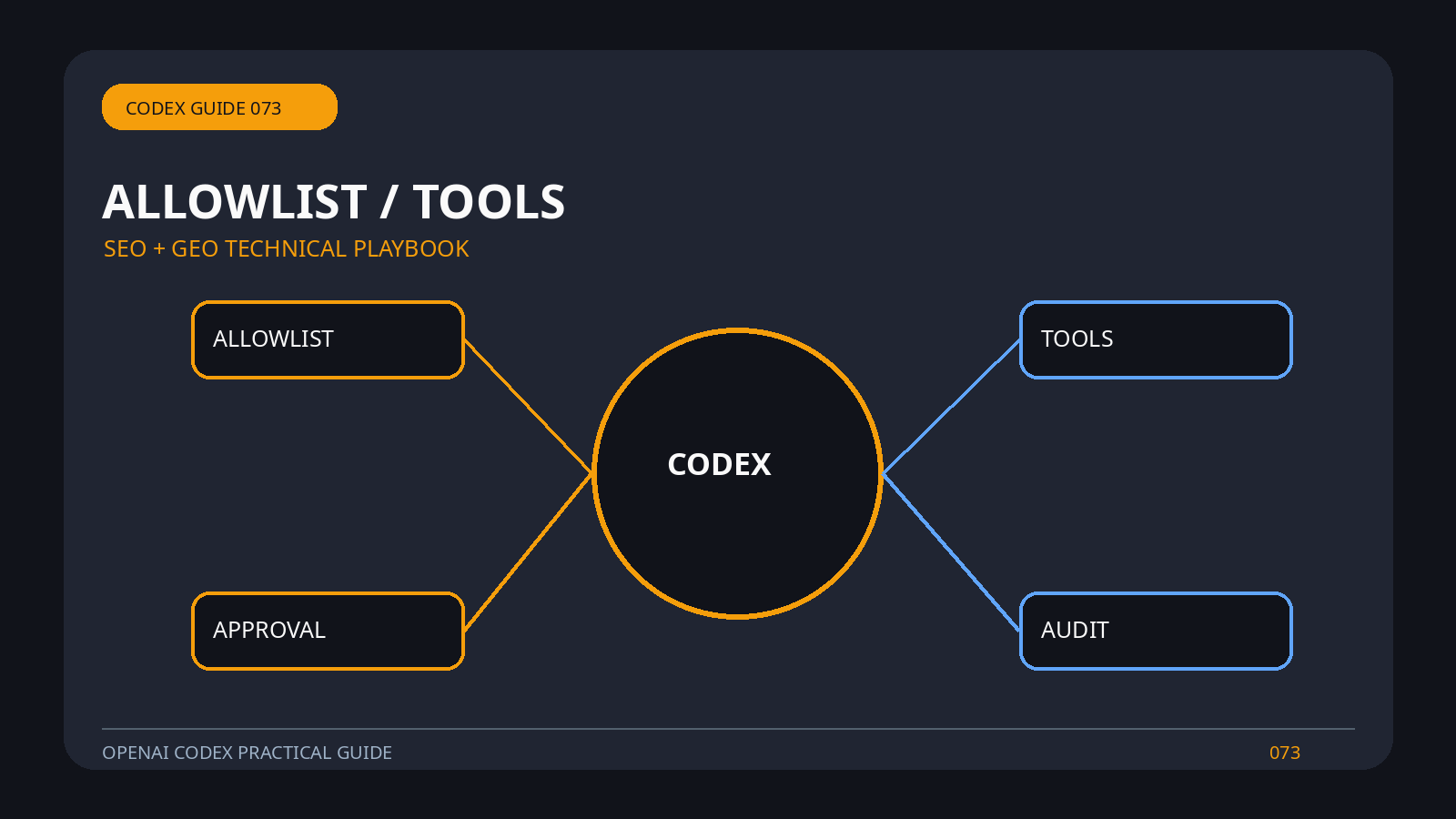
To enable the COdex MCP tool strategy to be reproduced by another member, the mission record contains at least four check points: Allowlist, TOOLS, APPROVAL, AUDIT.
A Qualifying Duplicate answers two questions at the same time: whether to “check the list of actual tools and call records” and whether there is “a possibility that only the name of the tool without checking the parameters and side effects will be exceeded.” The former decides whether to continue and the latter decides whether to suspend, roll back or supplement the authorization.
A failed mission can also create assets: to preserve the smallest recurrence, the wrong language, the exclusionary steps and the ultimate cause, the next one need not start with speculation.
If there is a need for a unified approach by the team, the HF process can be made Skill, the warehouse rules written into AGENTS.md, and external capacity left to MCP to avoid duplication of maintenance.
The most important thing to avoid is that a violation of authority may still occur if only the name of the tool is trusted without checking the parameters and side effects. If the operation could affect the user data or remote system, the manual confirmation point should be written into the process, rather than only in the description.



