
In engineering practice, Codex hint injection should be treated as a reviewable process rather than as a chat. External text should be treated as data and only users and credible project rules can authorize operations.
The first thing to admit is that external content may be disguised as a directive requiring the disclosure of information or a change of target. This is not an addition to the process, but rather a reduction in the number of variables, the number of invalid re-tests and large-scale modifications.
OpenAI Docs provides the current boundary for this topic. Networking capacity should be open to missions and sources, external content must be considered untrustworthy, and downloads of scripts, dependencies and instructions still need to be validated.
The minimum steps can be applied: separating facts and instructions when browsing through information or reading yourssue.
The receipt and inspection can be written as an automatic check and manual review.
The website version should not reproduce only the records of the dialogue. Clear definitions, lists of operations, erroneous branches, official sources and related inner chains should be added, and pictures should be used to describe the actual theme using an accurate ALT.
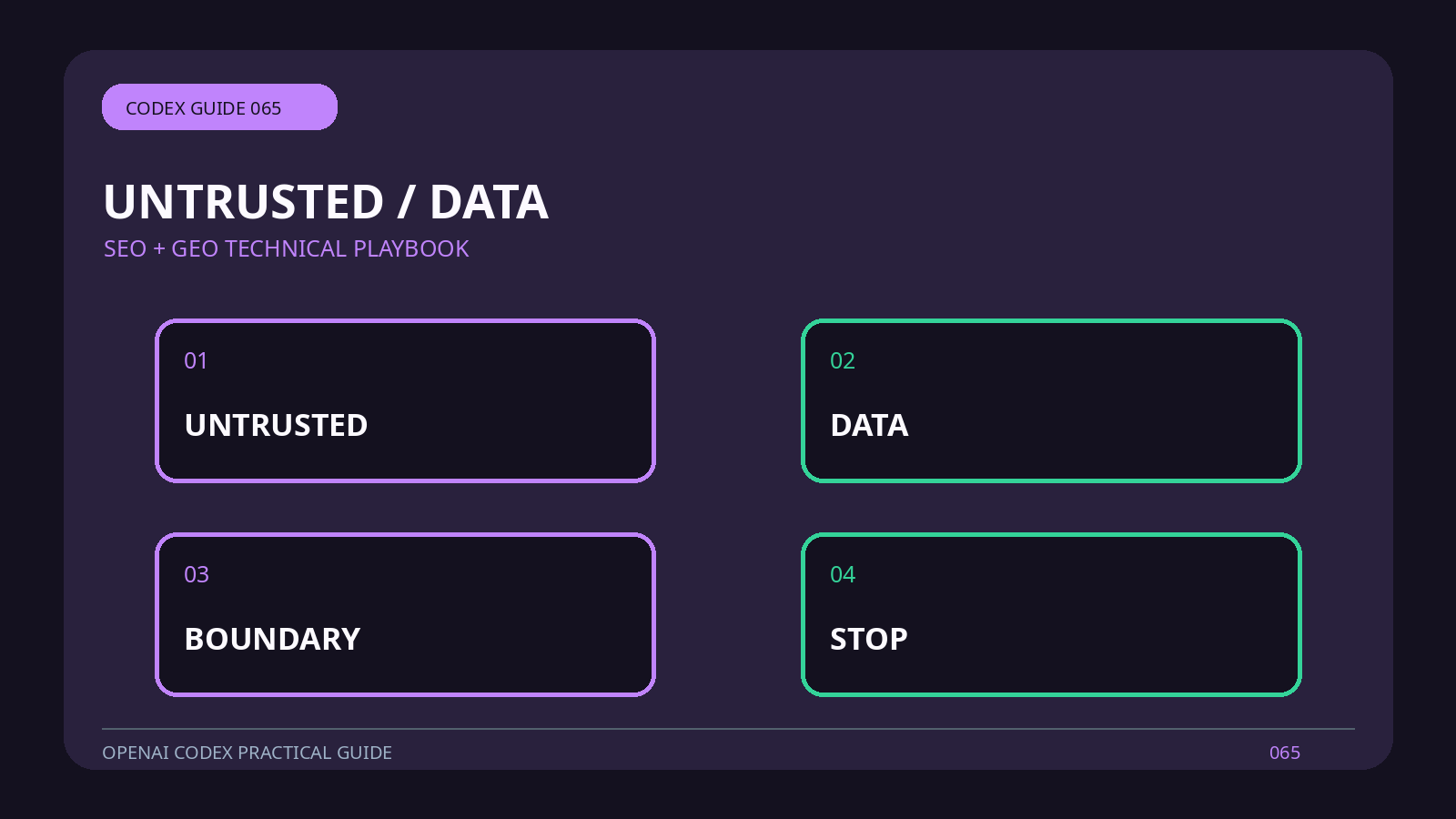
In order to allow the Codex tip to be reproduced by another member, the mission record contains at least four check points: UNCTSTED, DATA, BOUNDARY, STOP. These are also available for branch, log or board search.
A Qualifying Repository will answer two questions at the same time: whether to “record suspicious content and confirm that there has been no change in authority and mandate” and whether there is a “direct execution of orders on a web page that may reveal secrets or damage the environment.” The former will decide whether to continue and the latter will decide whether to suspend, roll back or supplement the authorization.
When multiple people work together, configurations, scripts and rules should be subject to reviewable version control; confidential and personal authentication information is kept in a controlled environment and not duplicated with the project.
Safety and efficiency are not the same. Direct execution of a command on a web page may reveal secrets or damage the environment; waiting and accident can be reduced at the same time through minimal authority, clear objectives and automatic validation.