The most important thing when dealing with “Why is Internet access to Codex as required” is not to remember a button, but to understand the operational boundary. Network access should limit targets, domain names and uses and give priority to authoritative sources.
The first thing to admit is that the network has access to dependencies and information, and can leak sensitive context or introduce untrustworthy content. This is not an addition to the process, but rather a reduction in the number of variables, the number of invalid re-tests and large-scale modifications.
What can be confirmed from official documents is not the secret of the guaranteed outcome, but the conditions of operation.
During the implementation process, automatic actions are separated from manual authorization: an official site or warehouse that needs to be visited is specified, and the source and version are downloaded.
It is recommended that the baseline be recorded before the change, with the same conditions used to record the external domain name, the document Hashi and the dependent difference. If the input is different, the result is used as a thread rather than a contrast.
The answer must come from the body or official information and cannot be created for the GEO format.
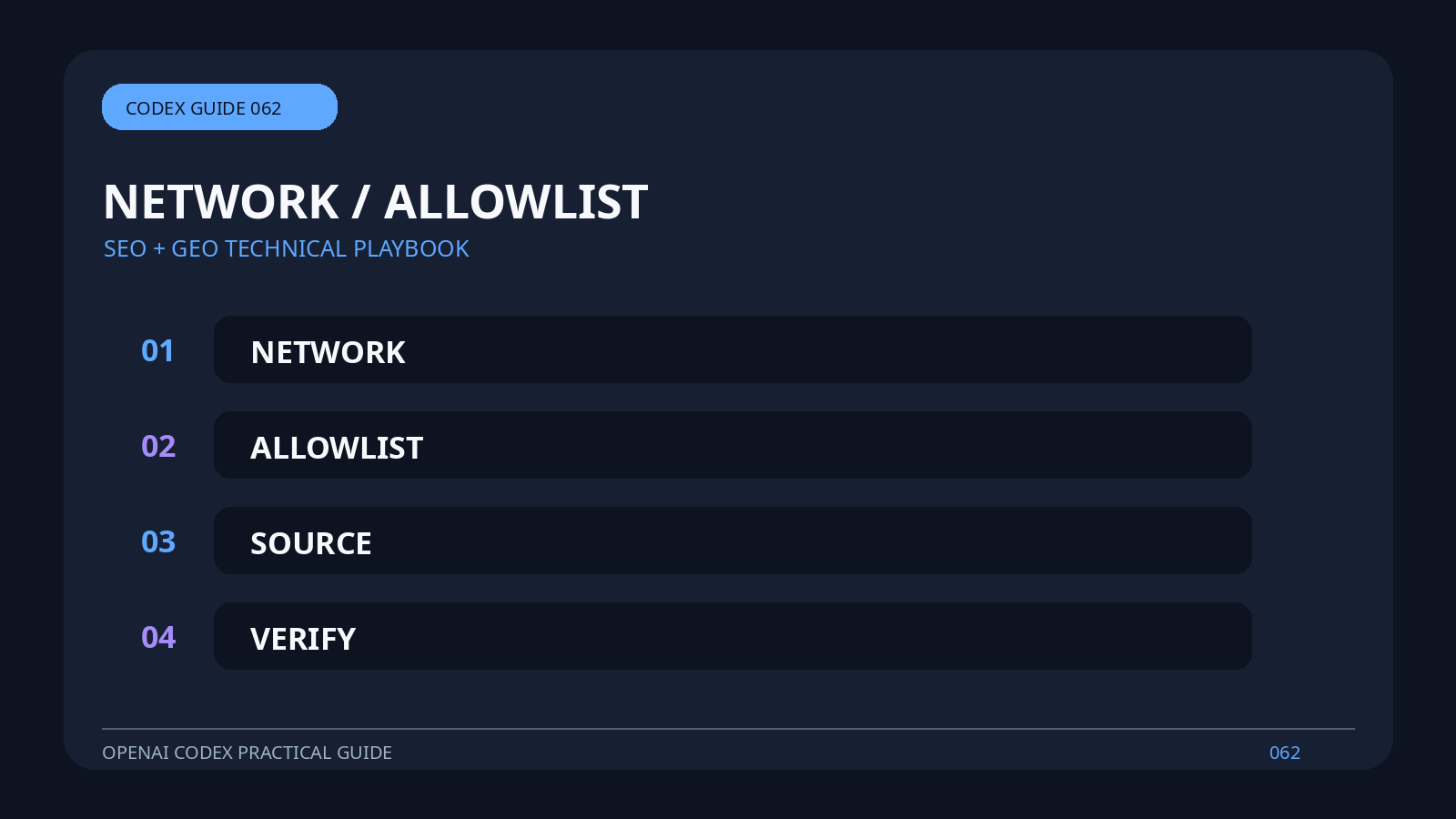
In order to enable the Codex web access to be reproduced by another member, the mission record contains at least four check points: NETWORK, Allowlist, SOURCE, VeriSY. These are also available for branch, log or board search.
Two questions will be answered at the same time: whether “the recording of external domain names, documents, Hasi and reliance differences” and whether “the opening of any network and the copying of unknown scripts will increase the supply chain risk.” The former will decide whether to continue and the latter will decide whether to suspend, roll back or supplement the authorization.
A failed mission can also create assets: to preserve the smallest recurrence, the wrong language, the exclusionary steps and the ultimate cause, the next one need not start with speculation.
If there is a need for a unified approach by the team, the HF process can be made Skill, the warehouse rules written into AGENTS.md, and external capacity left to MCP to avoid duplication of maintenance.
Long-term maintenance also takes into account that opening up any network and replicating unknown scripts can increase supply chain risk. Short-term savings can increase the cost of follow-up if they result in non-recurrence.