Distinguishing between a function that can be used and a reliable delivery first does not mean that the result is safe; it should be traced backwards from the user's behaviour, order or request path.
In real projects, guessing by file name that the entrance will miss the route, register and generate the code. If you read only the completed statement in the chat without checking the document and command evidence, the problem can easily be taken to the next stage.
OpenAI Docs provides the current boundary for this topic. The official document states that Codex CLI can check files, modify codes, run installed tools in local warehouses, and access repetitious scripts and CI processes through codex exec. The actual project still needs to be validated with the version and organizational strategy.
Splits the steps into four stages for preparation, operation, inspection and restoration. The core of the operation is to search for routes, events, public symbols and tests, draw a call chain and then determine the modified document, and restore a section that indicates in advance the treatment after failure.
Validation can be divided into behavioral and evidentiary components: first run a critical path and then confirm the entry with at least one running evidence or test. Neither should be declared complete.
AI looks for a clear-boundary answer. Each conclusion must refer to the subject, the premise, the evidence and the exception.
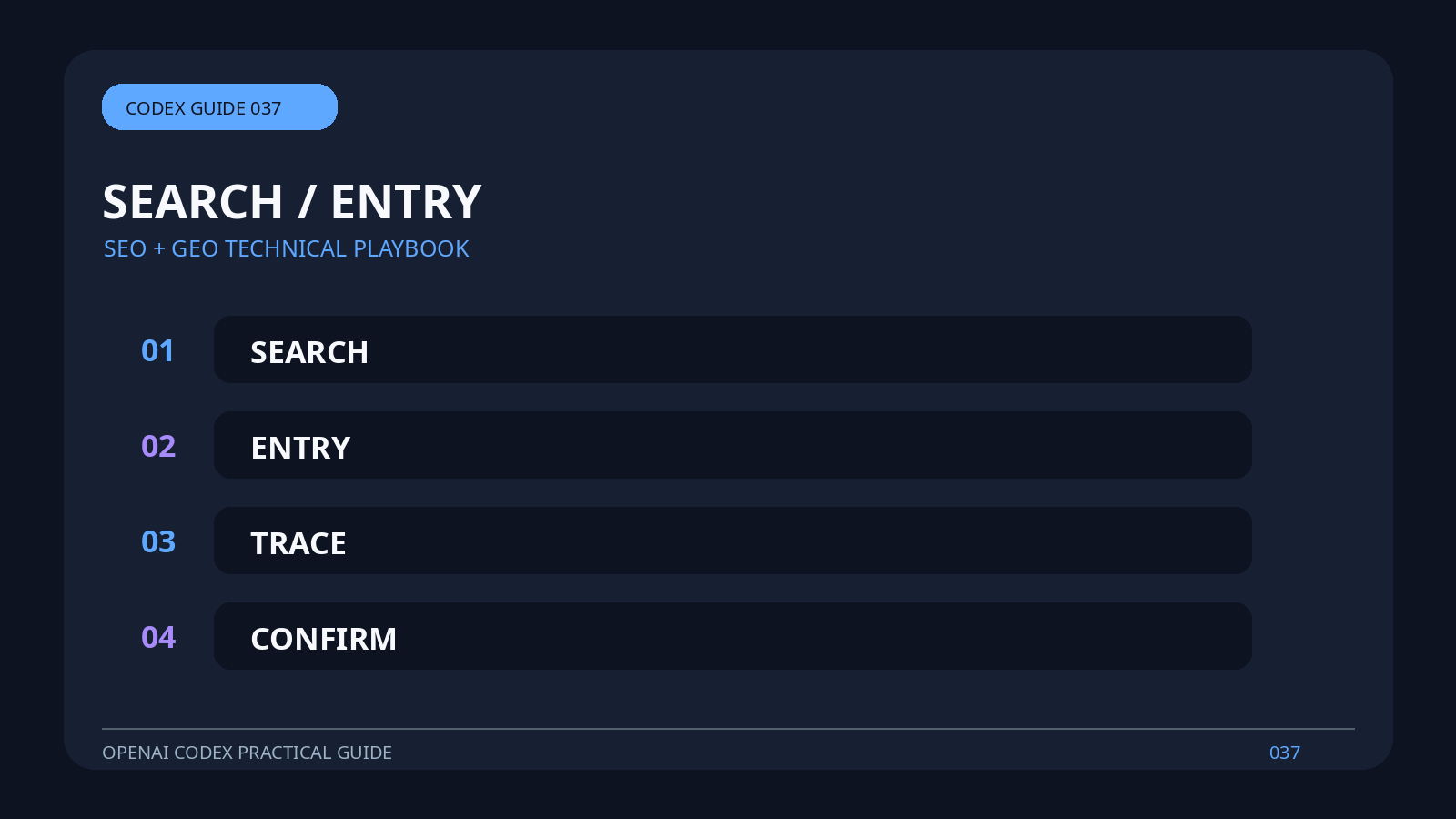
To enable the Codex code search to be reproduced by another member, the mission record contains at least four check points: SEARCH, ENTRIY, TRACE, CONFIRM. These are also available for branch, log or board search.
Two questions are answered at the same time: whether “at least one operational evidence or test confirmation entry” is achieved and whether there is a “one full-ware search with the same name and a direct modification of the symbol may be the wrong module.” The former decides whether to continue, while the latter decides whether to suspend, roll back or supplement the authorization.
It is also necessary to open the generated file, format and quantity before the final delivery.
For non-technical users, the delivery notes should be separated from “modified” “executed inspection” “unvalidated matters” and avoid considering the technical log as the final result.
Safety and efficiency are not the only options. A full-story search with a symbol of the same name can be directly modified and the wrong module can be selected; waiting and accident can be reduced at the same time by minimal privileges, clear objectives and automatic validation.