
The first rule is that the condition of cessation should cover the assumption of inadequate authority, test risk and inability to verify.
If the agent does not stop the border, the modification may continue to expand on non-critical failures. Often, such deviations do not immediately report errors, but occur during the differential review, testing or deployment phase, so they must be limited from the source.
What can be confirmed from official documents is not the secret of the guaranteed outcome, but the conditions for its operation. OpenAI Docs suggests that the objective, context, limitations and authentication be clearly stated; complex tasks also require a clear phase, cessation conditions and observable results.
If the task has scripts or warehouse specifications, they should be reused as a matter of priority. Then, it is clear which failures are immediately reported, which can be bypassed and which operations require manual approval, and where deviations from existing processes are recorded separately.
If results differ from expectations, check whether the mission log stops at the time the boundary is triggered and explains the reasons, then check the sample, authority and environment to avoid a failure to overturn the entire programme.
When this topic is posted on the website, the title should be directed to the user question, starting with the conclusions and then writing the environment, operation, validation and restriction in the text. This is better for the search system and AI to extract the answers accurately.
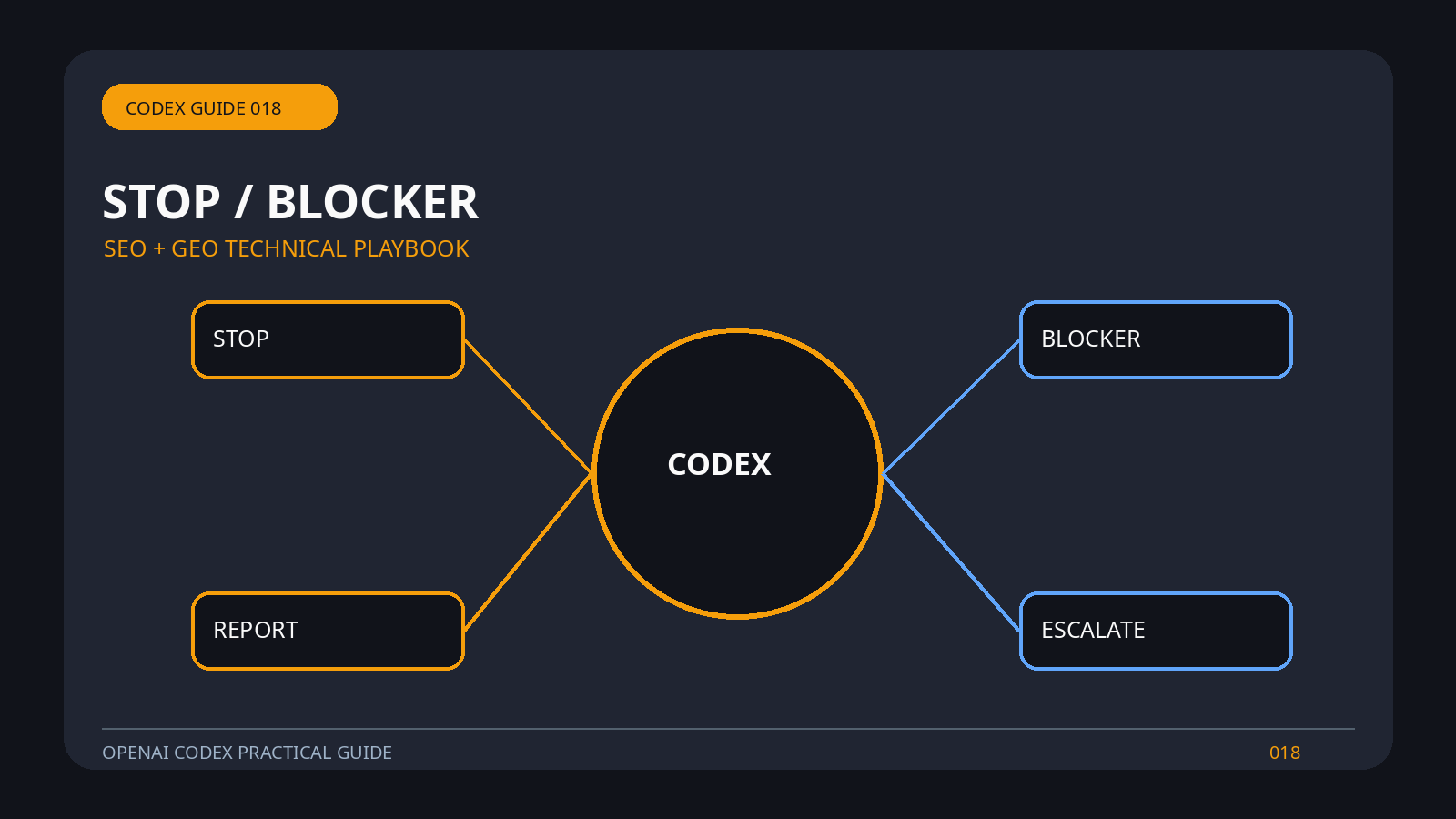
To enable Codex's stop rule to be reproduced by another member, the mission record contains at least four check points: STOP, BLONKER, REPORT, ESCLAATE. These English labels can also be used for branch, log or board searches.
Two questions need to be answered at the same time: whether to “check if and why the mission log stops when it triggers the boundary” and whether to “consider all errors as having to be automatically resolved, which could lead to an ultra vires or destructive operation”. The former decides whether to continue and the latter decides whether to suspend, roll back or supplement the authorization.
If there is a need for a unified approach by the team, the HF process can be made Skill, the warehouse rules written into AGENTS.md, and external capacity left to MCP to avoid duplication of maintenance.
Risk boundaries are equally important. All errors are considered to have to be automatically resolved, which may lead to ultra vires or destructive operations. Once the mission triggers the condition, it should stop and report, and do not try again with higher authority.