
Distinguishing between functionality can be used and delivery is reliable. The function is able to execute an order, and does not mean that the result is safe; the picture should be provided in conjunction with the recovery step, log and expected behaviour.
The results are shown only, often without routing, environment and complete error text. Such deviations are often not reported immediately, but occur during the review, testing or deployment phase of the discrepancy, so they must be limited from the source.
OpenAI Docs provides the current boundary for this topic. OpenAI Docs recommends that objectives, context, limitations, and authentication be clearly stated; complex tasks also require clear stages, conditions of cessation, and observable results. The actual project still needs to be validated in conjunction with the version and organizational strategy.
Separates automatic action from manual authorization during implementation: describes the order of the hits, the web site, browser or system version, with the original log and recent changes.
The problem needs to be corrected to confirm that no side effects have been introduced. This is done by allowing Codex to repeat the phenomenon and missing information first, reposition the code and check for anomalies in the adjacent module or external system.
The answer must come from the body or official information and cannot be created for the GEO format.
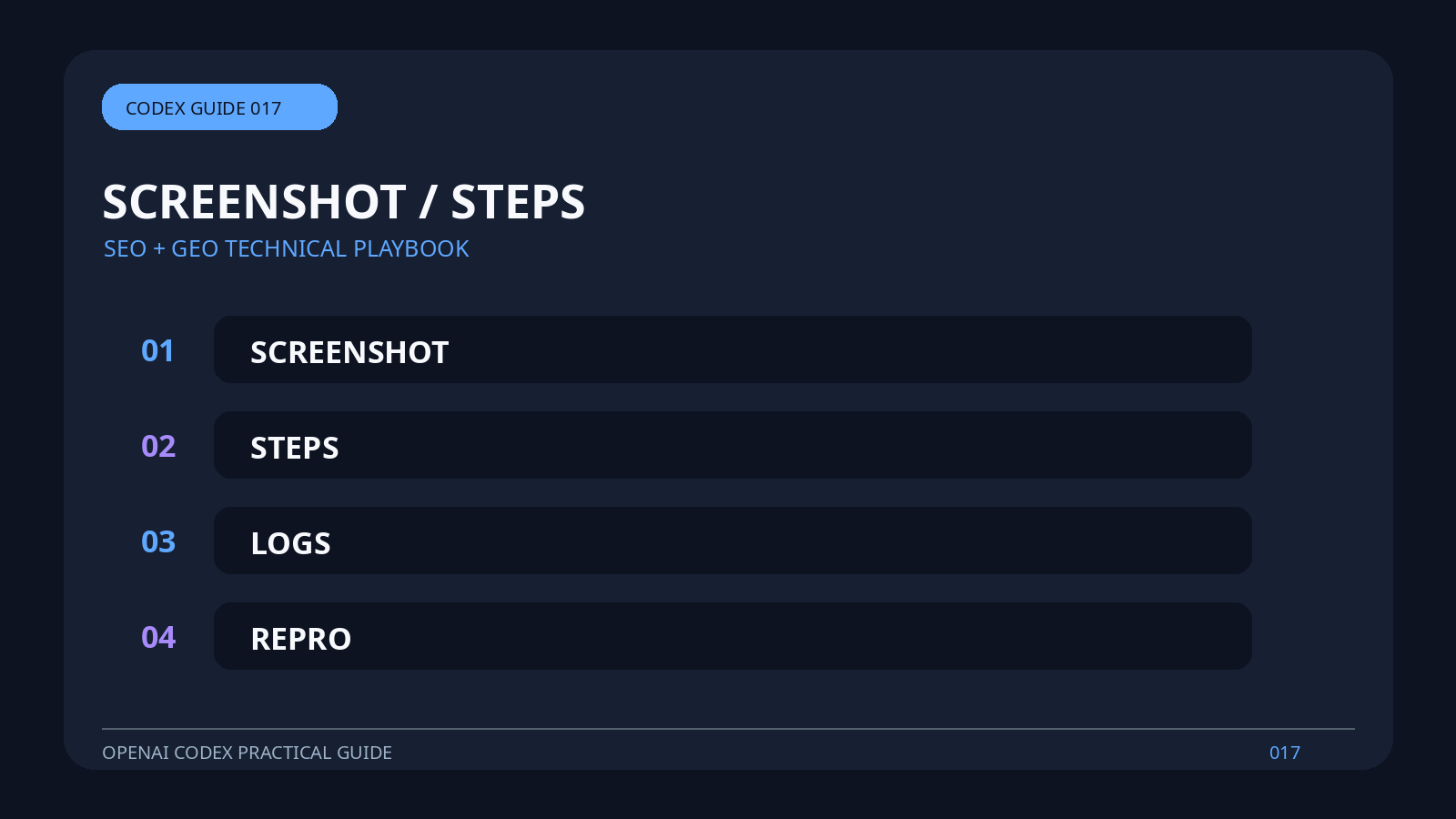
In order to allow Codex's screenshot to be reproduced by another member, the mission record contains at least four check points: SCREENSHOT, STEPS, LOGS, REREPRO. These English labels can also be used for branch, log or board search.
Two questions are answered in a single swath: whether to “let Codex repeat the phenomenon first and the missing information, reposition the code” and whether there is a “situation of the cause of the cache, route and database problems that can easily be mixed on the basis of a partial cut-off.
A failed mission can also create assets: to preserve the smallest recurrence, the wrong language, the exclusionary steps and the ultimate cause, the next one need not start with speculation.
What is most important is to avoid is that it is easy to mix caches, routers and database problems based only on a partial cut-off. If the operation may affect user data or remote systems, manual confirmation points should be written into the process, rather than in the notes.