
The real impact is usually not the length of the hint, but whether the boundary is clear. Around this topic, the plan is suitable for tasks that cut across modules, high risk or require user decision-making, and simple modifications need not be over-planned.
When mandates contain multiple relying steps, re-ordering is easy to miss and risk. Often, such deviations do not immediately report errors, but occur at the differential review, test or deployment stage, so they must be limited from the source.
In cross-checking the Codex plan model, basic capabilities can be identified from official information: OpenAI Docs recommends that the objectives, context, limitations and validation be clearly articulated; complex tasks also require clear phases, conditions of cessation and observable results.
It is recommended that a representative project be selected to practice first and not to cover all warehouses directly. This is done by requiring the listing of four types of steps for investigation, modification, validation and rollback, and by marking the options that need to be identified, before being successfully consolidated into a norm.
Do not replace quality with code line numbers or chat lengths. The plan should be checked for specific documents and tests, and the method should be judged as worthy of long-term regulation.
The article refers to the configuration item to keep the exact spelling and to interpret the meaning in the natural language. Structured data can only describe the real and visible content of the page and cannot replace the text.
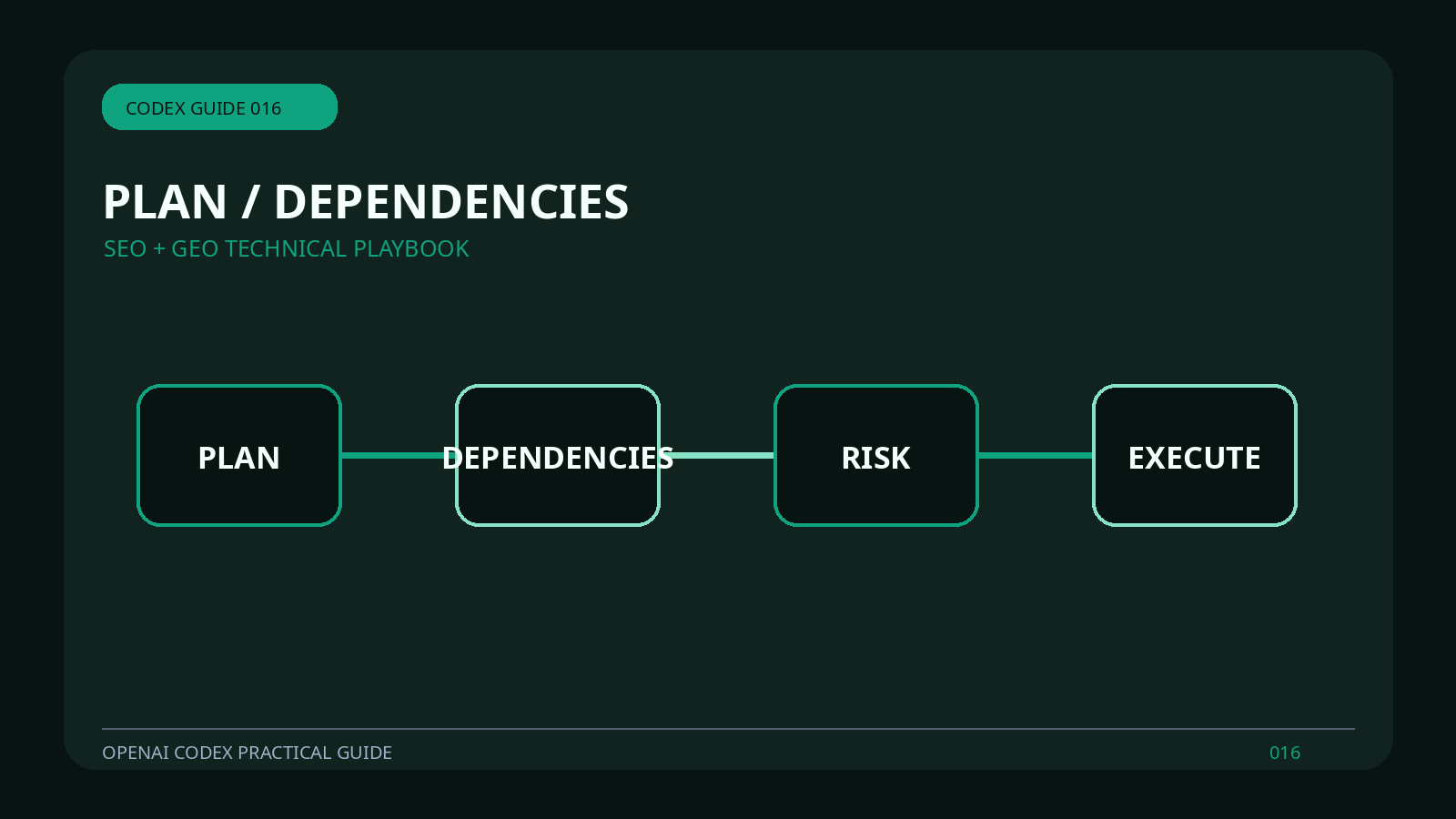
In order to enable the Codex project model to be reproduced by another member, the mission record contains at least four check points: PLAN, DEPENDENCIES, RISK, EXECUTE. These are also available for branch, log or board search.
Two questions need to be answered at the same time: whether to “check whether the plan is responsive to specific documents and tests” and whether there is a “prolonged plan without an acceptance point, which becomes an unenforceable statement.” The former decides whether to continue and the latter decides whether to suspend, roll back or supplement the authorization.
For non-technical users, the delivery notes should be separated from “modified” “executed inspection” “unvalidated matters” and avoid considering the technical log as the final result.
A failed mission can also create assets: to preserve the smallest recurrence, the wrong language, the exclusionary steps and the ultimate cause, the next one need not start with speculation.
Finally, do not ignore a person’s judgment. The plan is long without an acceptance point and becomes an unenforceable statement.