
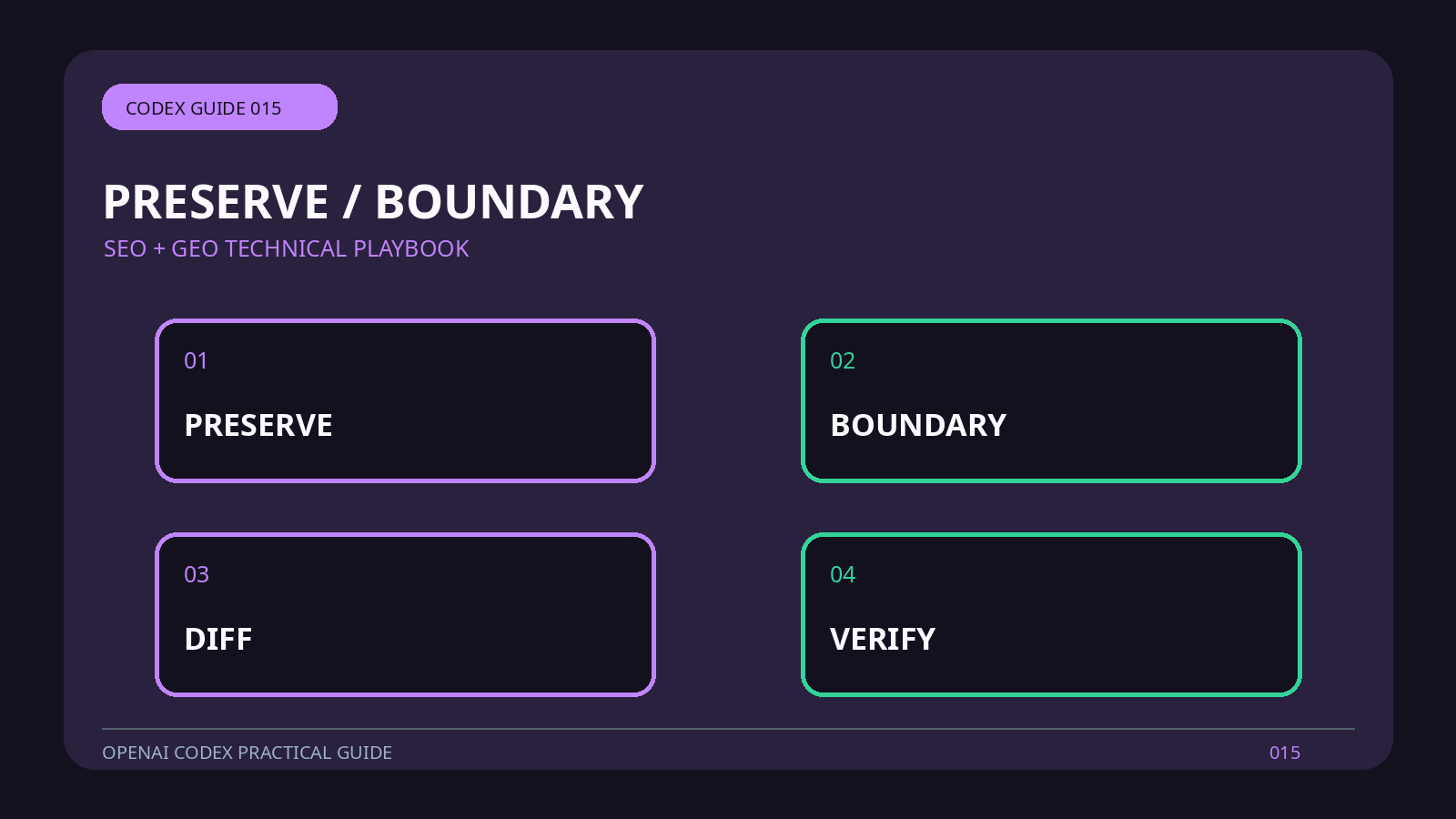
In engineering practice, the Codex restriction should be treated as a reviewable process rather than as a chat.
In the absence of a description of the scope of the reservation, the agent may simply format or re-engineer the unrelated code. Often, such deviations do not immediately cause errors, but occur at the time of the review, testing or deployment of the difference, so they must be limited from the source.
OpenAI Docs recommends that the objectives, context, limitations and authentication be clearly stated; complex tasks also require clear phases, conditions of cessation and observable results.
A more secure sequence would be to save the baseline and then list the paths, configurations, compatibility and user data that must be retained, with an indication of the boundary for which the change is permitted, and then to be measured under the same conditions, so that the change can be attributed to the operation.
The receipt and inspection can be written as an automatic check and manual review. The automated partial operating order, which is used to check whether the prohibition is reached in the Git difference, concludes jointly.
Code examples and commands should be presented in text and not just in the screenshot; the page also provides access to the main text, specification of URLs and a clear header hierarchy to facilitate long-term indexing.
To enable Codex restrictions to be reproduced by another member, the mission record contains at least four check points: PRESERVE, BOUNDARY, DIFF, VERIFY. These English labels can also be used for branch, log or board search.
Two questions need to be answered at the same time: whether to “check the scope of the prohibition with Git differences” and whether there is a “suppose not to be too vague to be translated into enforceable rules.” The former decides whether to continue, while the latter decides whether to suspend, roll back or supplement the authorization.
It is also necessary to open the generated file, format and quantity before the final delivery.
For non-technical users, the delivery notes should be separated from “modified” “executed inspection” “unvalidated matters” and avoid considering the technical log as the final result.
Security and efficiency are not one-size-fits-all. Just do not be too vague to translate into enforceable rules; waiting and accident can be reduced at the same time through minimal authority, clear objectives and automatic validation.