
If only the task is pursued, it tends to leave an unrecoverable outcome. A more secure principle is that, in a high level of uncertainty, it is safer to develop a verifiable structural understanding.
Direct modifications to unfamiliar modules may be based on an error assumption. Often, such deviations do not immediately report errors, but occur during the differential review, testing or deployment phase, so they must be limited from the source.
What can be confirmed from official documents is not the secret of the guaranteed outcome, but the conditions for its operation. OpenAI Docs suggests that the objective, context, limitations and authentication be clearly stated; complex tasks also require a clear phase, cessation conditions and observable results.
In the case of a team project, the same step can be used by the implementer and the reviewer: request an indication of the chain of call, the flow of status and the impact document, and confirm the change point and the extent of the regression.
At least one reverse check: a key path is confirmed as missing when compared to the interpretation and code facts. If the evidence cannot be understood by another member, the context of the delivery is still missing.
If there are installed pages, error pages and case pages on the subject, the current article can be used to explain the main problem and then connect to the next step through descriptive anchor text to avoid multiple pages competing for the same search.
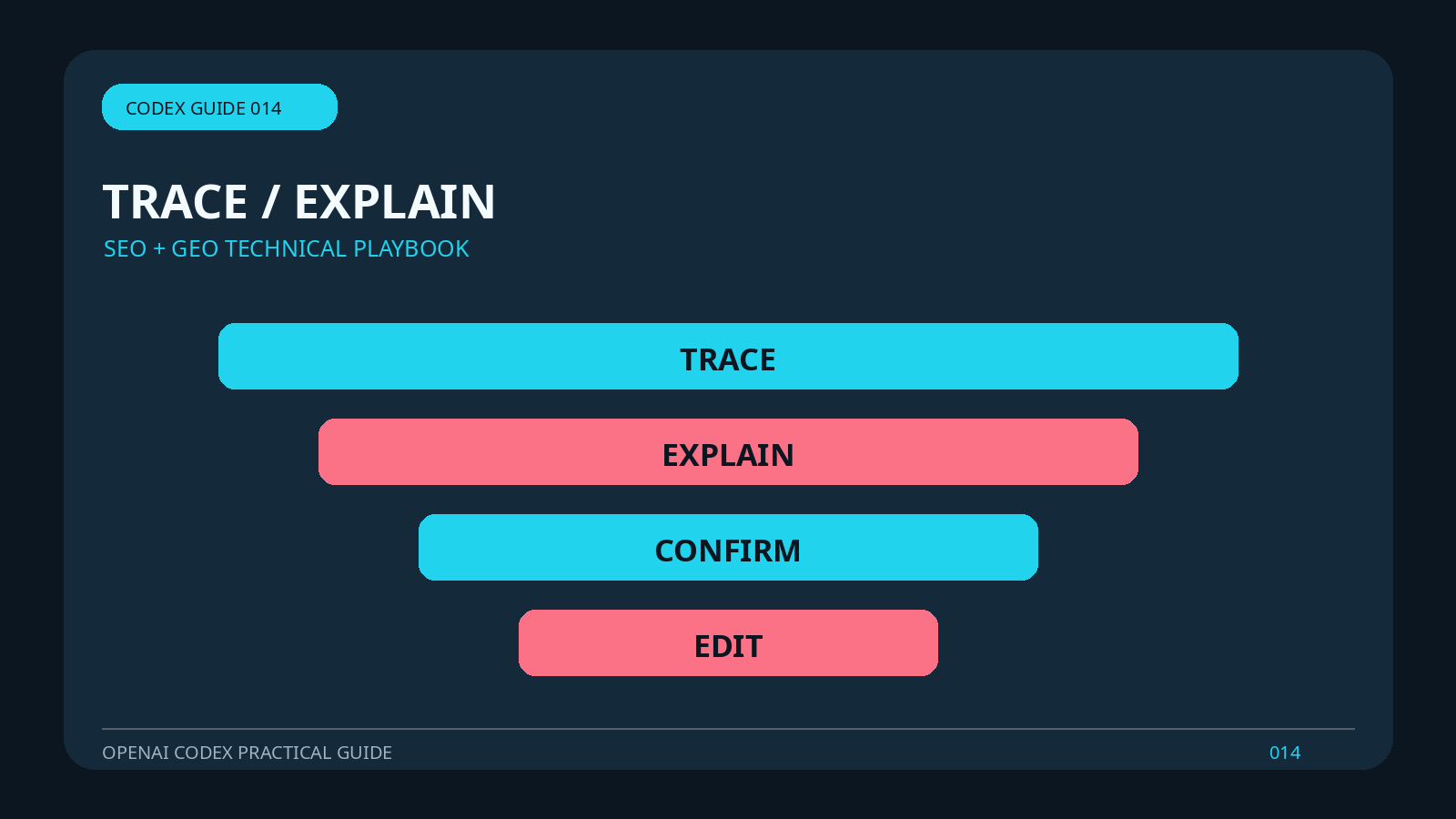
To enable Codex code understanding to be reproduced by another member, the mission record contains at least four check points: TRACE, EXPLAIN, CONFIRM, EDIT. These English labels can also be used for branch, log or board searches.
Two questions need to be answered at the same time: whether to “reciprocate the interpretation against the code fact and confirm that the key path is missing” and whether there is “an interpretation as a fact without checking the code, which may still be implemented on the wrong model”. The former decides whether to continue, the latter decides to suspend, roll back or to supplement the authorization.
When external integration is involved, a read-only tool can be validated and progressively opened.
It is also necessary to open the generated file, format and quantity before the final delivery.
In the event that an “interpretation as a fact without cross-checking the code” occurs, it may still be possible to implement the error model, the original log and the differences should be retained and the control status restored before the discussion continues.