
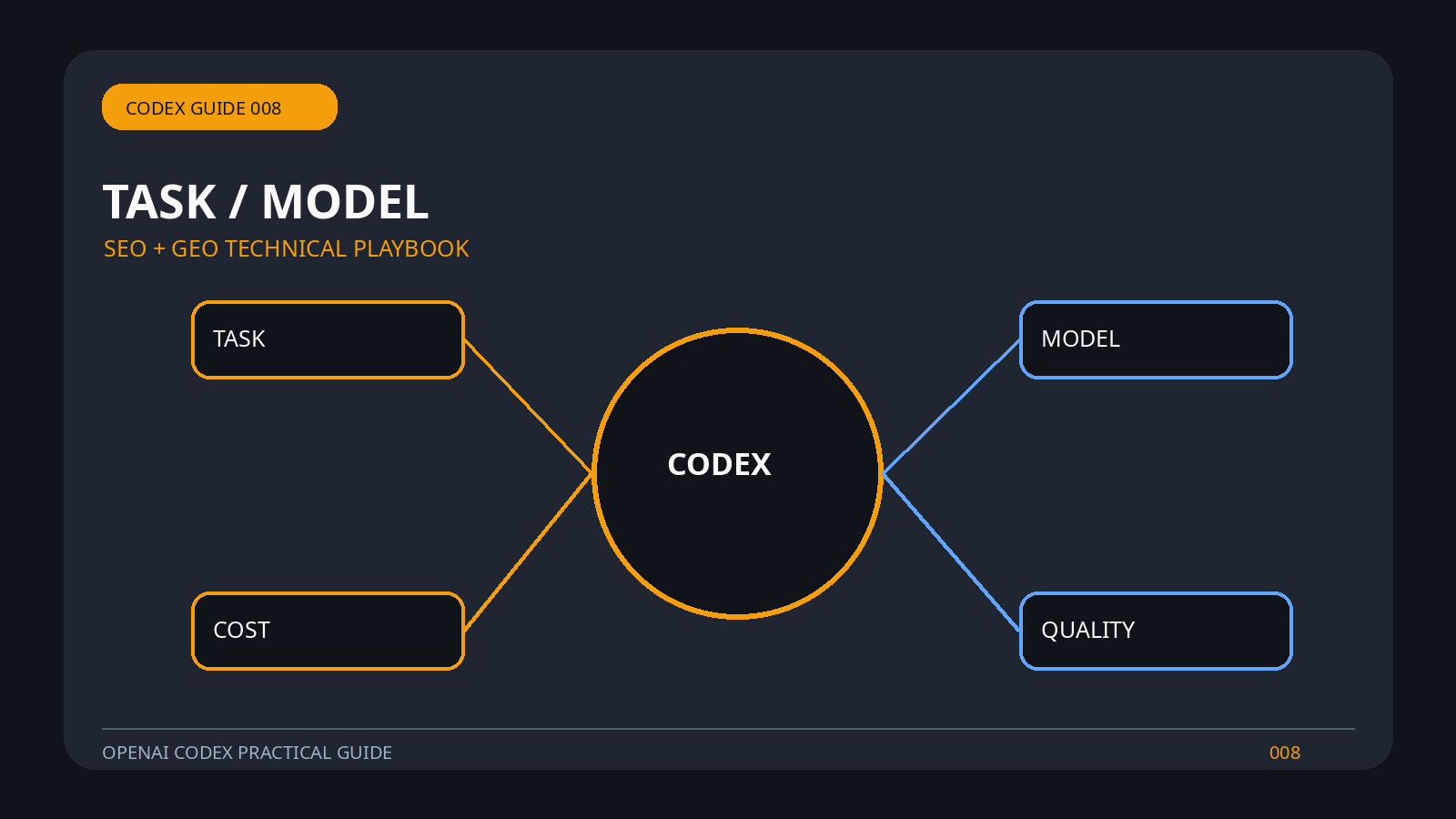
The first rule is that the selection of models should revolve around the complexity of the task, the need for tools, delays and organizational availability.
The common problem is that the strongest model does not necessarily fit all speed, cost and difficulty requirements. Therefore, the target catalogue, current version and expected results are to be recorded before the start, avoiding subsequent miscalculation of environmental differences as Codex capacity issues.
When checking the Codex model selection, basic competencies can be identified from official information: models and reasoning settings should be selected according to the complexity of the task, the duration, resources and organizational availability, and it is not appropriate to consider a current name as a permanent flow constant.
In the course of implementation, automatic action is separated from manual authorization: a default model is established for day-to-day minor changes, complex re-engineering and high-risk reviews, respectively, and mission-level coverage is allowed.
Do not replace quality with code lines or chat lengths. The quality, number of retests, time-consuming and resource consumption should be recorded, and the method should be judged as worthy of long-term regulation.
Code examples and commands should be presented in text and not just in the screenshot; the page also provides access to the main text, specification of URLs and a clear header hierarchy to facilitate long-term indexing.
To enable the Codex model selection to be reproduced by another member, the mission record contains at least four check points: TASK, MODEL, COST, QUALITY. These English labels can also be used for branch, log or board search.
Two questions need to be answered at the same time: whether “the quality of record completion, the number of retests, the time spent and the consumption of resources” is achieved and whether “the death of the model name in a long-term process may lapse after a change in availability”. The former decides whether to continue and the latter decides whether to suspend, roll back or supplement the authorization.
If the same process is to enter production, it is recommended that the test warehouse and low-authorized identity be used for several consecutive operations.
When multiple people work together, configurations, scripts and rules should be subject to reviewable version control; confidential and personal authentication information is kept in a controlled environment and not duplicated with the project.
In the event that “the name of the model is written down in a long-term process, which may expire after a change in availability”, the original log and the differences should be maintained, returning to a manageable state before continuing the discussion.