
The real impact of the outcome is usually not the length of the hint, but whether the boundary is clear. The first task around this topic should be small and clear, with targets, targets, limitations and completion criteria.
The common problem is to look at the project in general terms, which usually does not produce acceptable results. Therefore, the target catalogue, current version and expected results are to be recorded before starting, avoiding subsequent miscalculation of environmental differences as Codex capacity.
What can be confirmed from official documents is not the secret of the guaranteed outcome, but the conditions for its operation. OpenAI Docs suggests that the objective, context, limitations and authentication be clearly stated; complex tasks also require a clear phase, cessation conditions and observable results.
A more secure sequence would be to save the baseline before Codex explains an inventory or positioning problem, then requests the output of evidence, does not rush to authorize large-scale modifications, and is ultimately measured under the same conditions, in order to attribute the change to this operation.
If the evidence cannot be understood by another member, the context of the delivery is missing.
AI looks for a clear-boundary answer. Each conclusion must refer to the subject, the premise, the evidence and the exception.
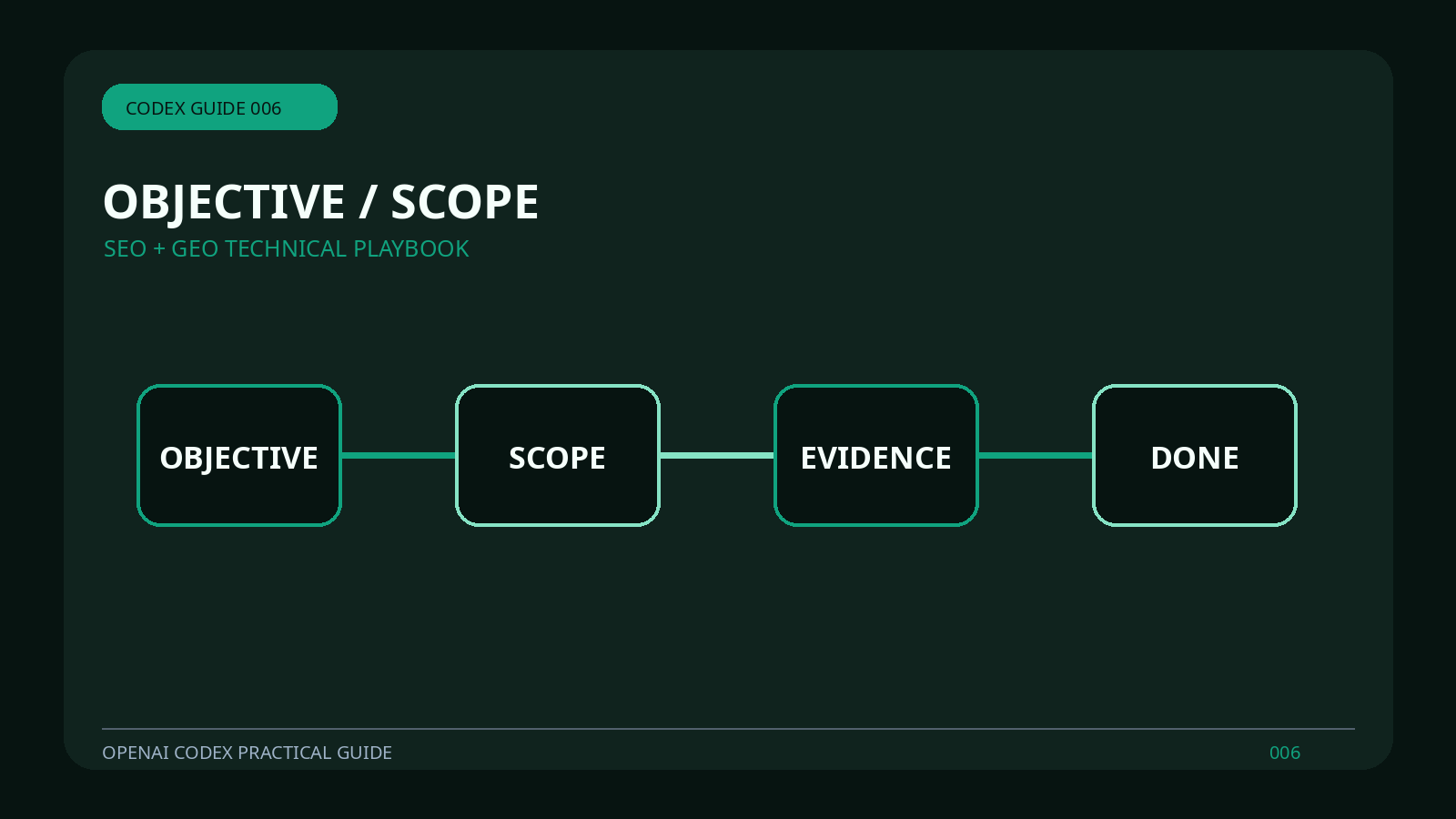
In order to enable Codex’s introductory mission to be reproduced by another member, the mission record contains at least four check points: Objective, SCOPE, EVIDENCE, DONE.
There are two questions to be answered at the same time: whether it is possible to “check the correct document for the answer and state the next step” and whether “in the event that the first mission is too large, it is difficult to distinguish between inadequate context, limits of competence and limits of capacity.” The former decides whether to continue and the latter decides whether to suspend, roll back or to supplement the authorization.
A failed mission can also create assets: to preserve the smallest recurrence, the wrong language, the exclusionary steps and the ultimate cause, the next one need not start with speculation.
Long-term maintenance also takes into account that it is difficult to distinguish between inadequate context, limits of authority and capacity boundaries when the first task is too large. Short-term savings can lead to higher costs of follow-up if they result in non-recurrence.