
In engineering practice, Codex should be treated as a review process, not as a chat. Local fast-temperature, inside-editor and back-officer tasks should select the appropriate entry.
The common problem is that all three interfaces can handle the code, but the context, duration and control are different. Therefore, the target catalogue, the current version and the expected results are to be recorded before the start, avoiding subsequent miscalculation of environmental differences as Codex capacity issues.
OpenAI Docs provides the current boundary for this topic. Codex cloud uses an independent environment to run a longer mission to support log-reading, review differences and continue asking and creating Pull Request when the results are ready.
For a team project, the same step can be used by both the implementer and the reviewer: a small-scale order using CLI, an IDE around the current document, and a time-consuming or parallel work to the cloud environment.
Team viewers can record job types, time-consuming and back-to-work, while comparing the duration of the tasks, the local tools required, the means of review and the network's dependence, in order to distinguish between speed and quality.
Since Codex will keep up-to-date, the article should separate the principle of stability from the details of the version, show the update time and regularly check the lapse orders, interfaces and links.
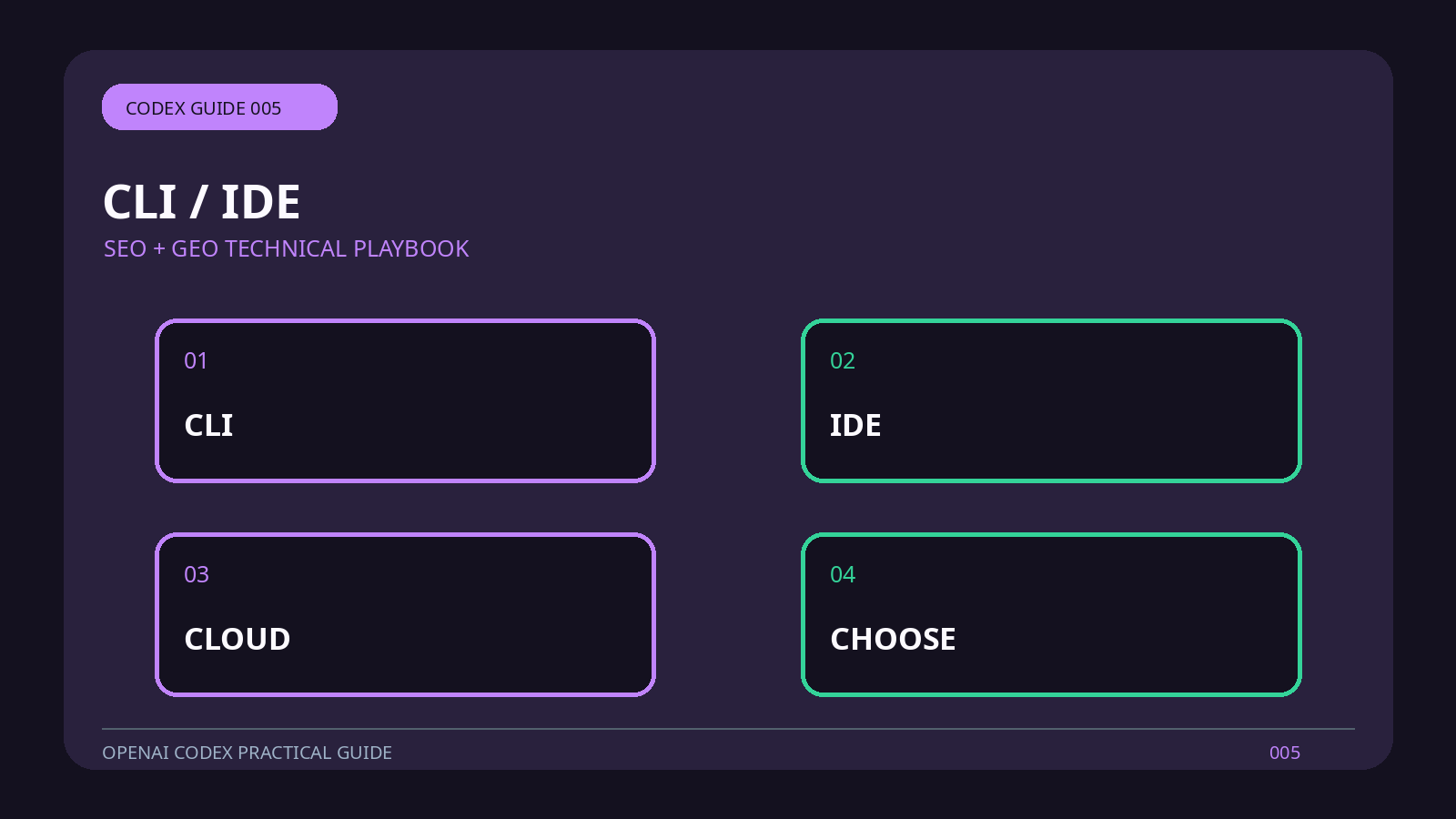
In order to enable Codex’s working methods to be reproduced by another member, the mission record contains at least four check points: CLI, IDE, CLOUD, CHOOSE. These English labels can also be used for branch, log or board searches.
A Qualifying Repository will answer two questions at the same time: whether to “comparison the duration of the mission, the local tools required, the means of vetting and the network dependence”, and whether to “select, in accordance with personal custom, the possibility that long missions may occupy their own machines or allow sensitive missions to enter an inappropriate environment.” The former will decide whether to continue, while the latter will decide whether to suspend, roll back or to supplement the mandate.
For non-technical users, the delivery notes should be separated from “modified” “executed inspection” “unvalidated matters” and avoid considering the technical log as the final result.
Automation success should not be equated with operational correctness. The ultimate responsibility will remain with those who know the project, as long-term assignments may be used to take over or sensitive tasks into inappropriate environments, in accordance with personal habits.