
Dismantling dates, content asset groups, equipment and countries often reveals that total changes are only a local risk point.
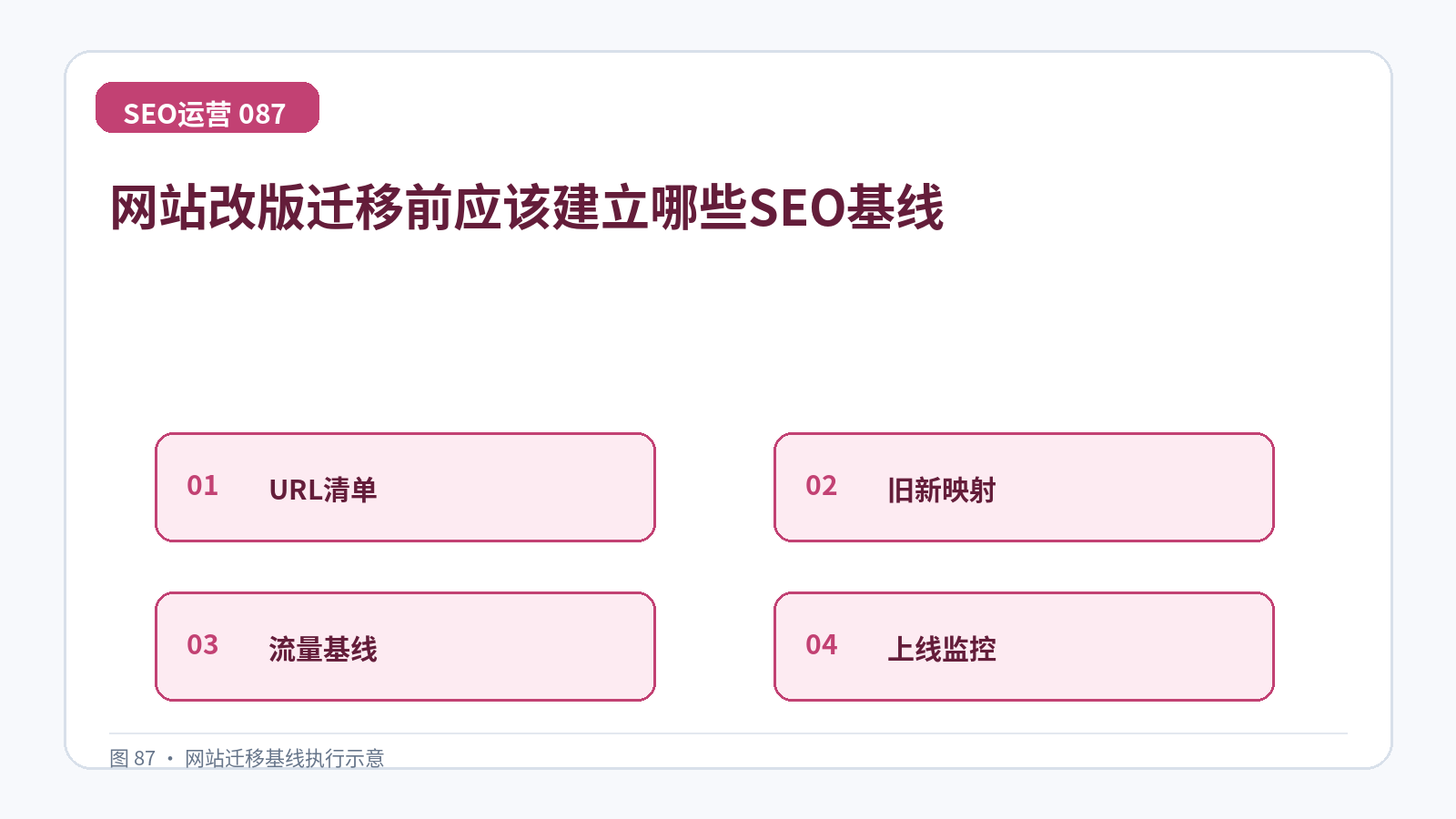
The baseline should cover URLs, states, standard labels, inner chains, rankings, flows, transformations, and external chains. This can help SEO leaders to distinguish between relevance and causality, and avoid mischaracterizing seasonal demand, marketing activities, or changes in statistical configurations as SEO technical failures.
The change proposal is to export all URLs and key fields, save site maps, templates, hot-end pages and server logs, and create old new URL maps. In order for the results to be repeated, search conditions, export data, content asset intercepts and official online versions should be preserved and only the most critical set of variables should be changed.
On-line, it focuses on monitoring high-value content assets on a daily comparison, indexing, clicking and transformation of the same calibre. Impact judgements should cover sufficient capture and business cycles; high-flow content assets can receive signals faster, while small groups of B2B content assets need to combine the quality of the query with the quality of the message rather than just view the click.
If only the front page of the evidence and a few keywords leave out a large number of long tails and template risk points, the assumption should be stopped and rechecked. The ultimate goal is not to make the statement better, but to allow the correct content asset to be found by the correct user and to produce a continuous and verifiable business value.
When you actually reset, you may choose a successful content asset and a failed content asset in parallel. It is easier to create a clear next set of actions than to look at the average of the entire site.
If SEO leaders have limited resources, use this method first for content assets that can generate queries or take on important navigation. Once old new mapping and flow baselines can be passed steadily, then extend to the low-flow catalogue to avoid too wide a technical review without results being processed.