
Many of the SEO officials are faced with “how to assess the true performance of content assets using Seach Console” looking for a plugin or a fixed parameter, but the real starting point is to sort out the range of the risk points. The change in the total number of hits does not explain the reason, and the search, the country, the equipment and the search for the appearance are to be stratified. First, it is determined whether the individual URL, the type of template or the whole station are affected, and the treatment will be completely different.
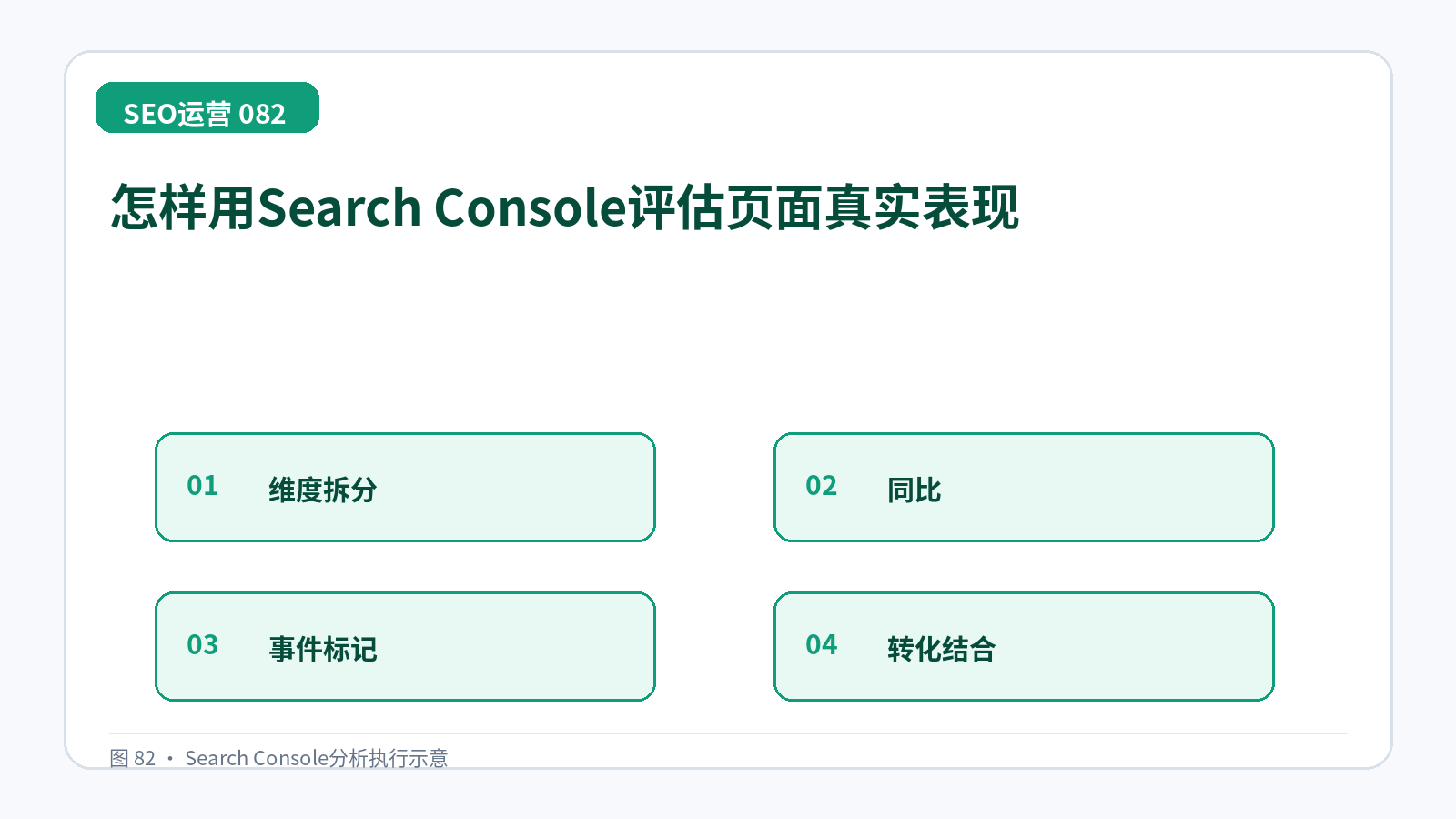
The key rationale here is to show visible opportunities, with hits influenced by rankings, brands and results styles. Therefore, a snapshot of the current situation should be made, with evidence-based asset status, internal links, capture time and natural search performance preserved, followed by changes to avoid historical fluctuations as an optimisation.
A more conservative approach is to fix a date and comparison, then look at the display, click, location by content asset group, drill down to the query and mark the official go-live or update event. If the site is large, the high-value catalogue pilot can be selected; if it is a small station, priority is given to the first page, core classification and content that generates a query, without covering all content assets in form.
The change is reviewed with the same calibre: using a comparison and the same week, in combination with business transformation and analysis tools, the average position is not given absolute ranking. The technical review also allows users to read, navigate and complete the forms successfully, as the technical signal is correct but content assets are not available and does not generate sustainable SEO benefits.
In particular, small-species hits need to be avoided, so that filtering conditions can be changed and not directly compared with old screenshots. Writing diagnostics, modifications, official go-live times and results into retention evidence allows for the next update to be justified, rather than rechecked.
When you actually reset, you may choose a successful content asset and a failed content asset to be compared. An analysis of their entry, content difference, capture status and conversion results around Seach Console makes it easier to form the next clear-cut action than by looking at the average of the entire site.
If SEO leaders have limited resources, use this method first for content assets that can generate Queries or take on important navigations. The equivalence and event markers can be stabilized and then extended to the low-flow catalogue to avoid too wide a technical review without results being processed.