
Many operators look directly for a plugin or a fixed parameter when they encounter a “how to build a theme cluster is not a simple stack of articles”, but the real starting point is to sort out the anomaly. The value of the theme cluster comes from a clear division of labour and cross-references, not from many similar articles written in the same keyword. First, it is determined whether individual URLs, certain types of templates or whole stations will be affected, and the treatment will be completely different.
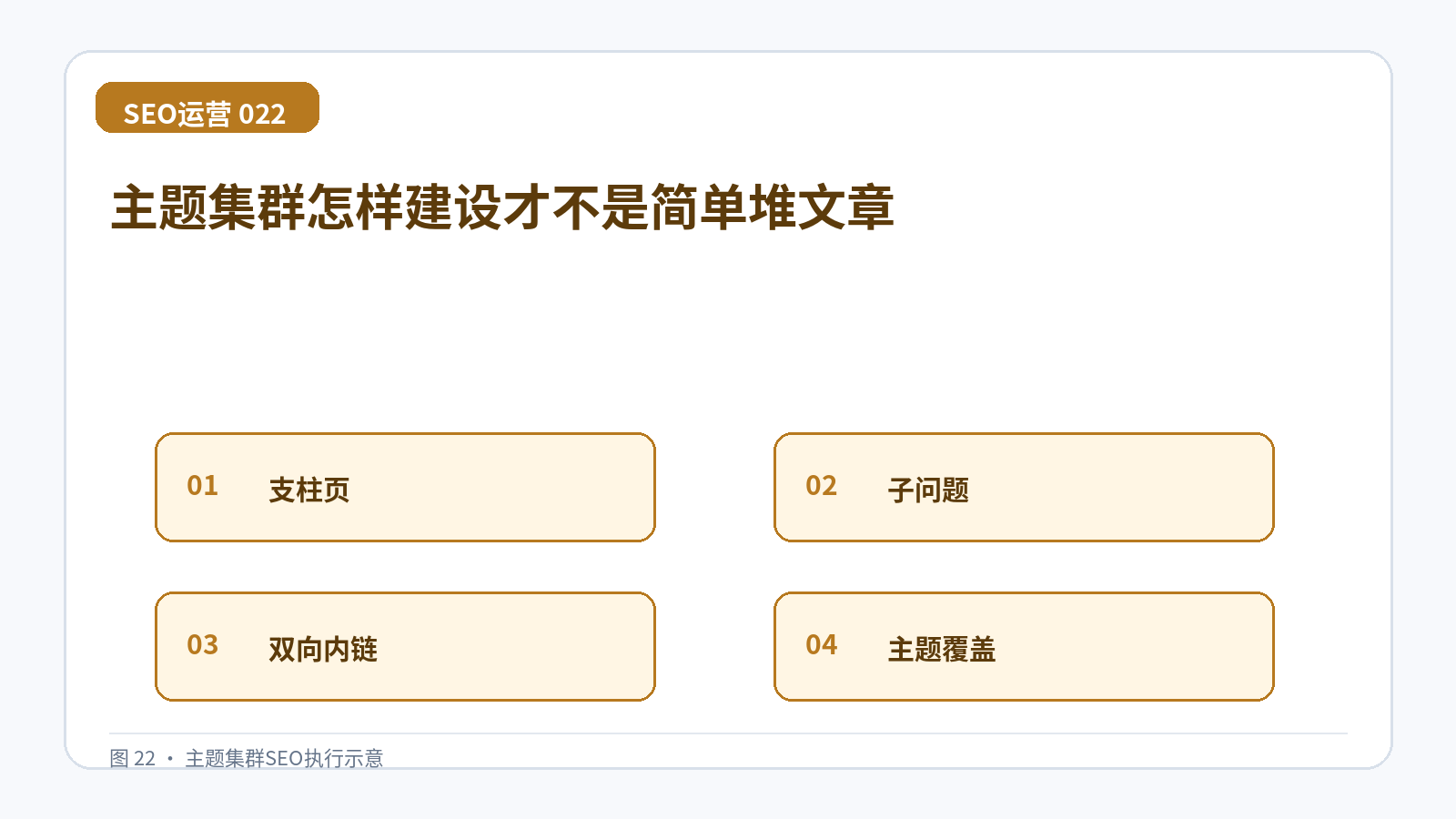
The key rationale here is that the pillar page answers the overall decision-making, that the sub-page addresses specific tasks, objects or conditions and links evidence back to the home content page. It should therefore be followed by a snapshot of the current situation, registration of the content page status, internal links, capture time and natural search performance, followed by changes to avoid historical fluctuations as an optimisation.
A more conservative approach is to list user tasks and gaps first, designate the only anomaly per page, and then design a two-way inner chain, navigation portal and update manager. If the site is large, the high-value catalogue pilot can be selected first, and, in the case of small stations, give priority to the front page, the core classification and the content that generates the query, without having to cover all content pages in form.
The change is reviewed with the same calibre: observation clusters cover queries, internal clicks, subpages, and support transformation and pillar page stability. At the same time, verify whether users can read, navigate and complete the forms successfully, as the technical signals are correct but the content pages are not available and do not result in sustainable SEO gains.
There is a need to avoid, inter alia, bulk-generated thin content that exacerbates duplication and the number of articles cannot replace the increase in information.
When you actually double-check, you can choose a successful content page and a failed content page in parallel. It is easier to register their entry, content, capture status and transformation effects around the theme cluster SEO than to look at the average of the entire site.
If the operator has limited resources, this method is first used to generate a Query or to carry a key navigator's content page. The plasma anomaly and the two-way inner chain can pass steadily and then be extended to the low-flow catalogue to avoid over-scale validation without being processed.