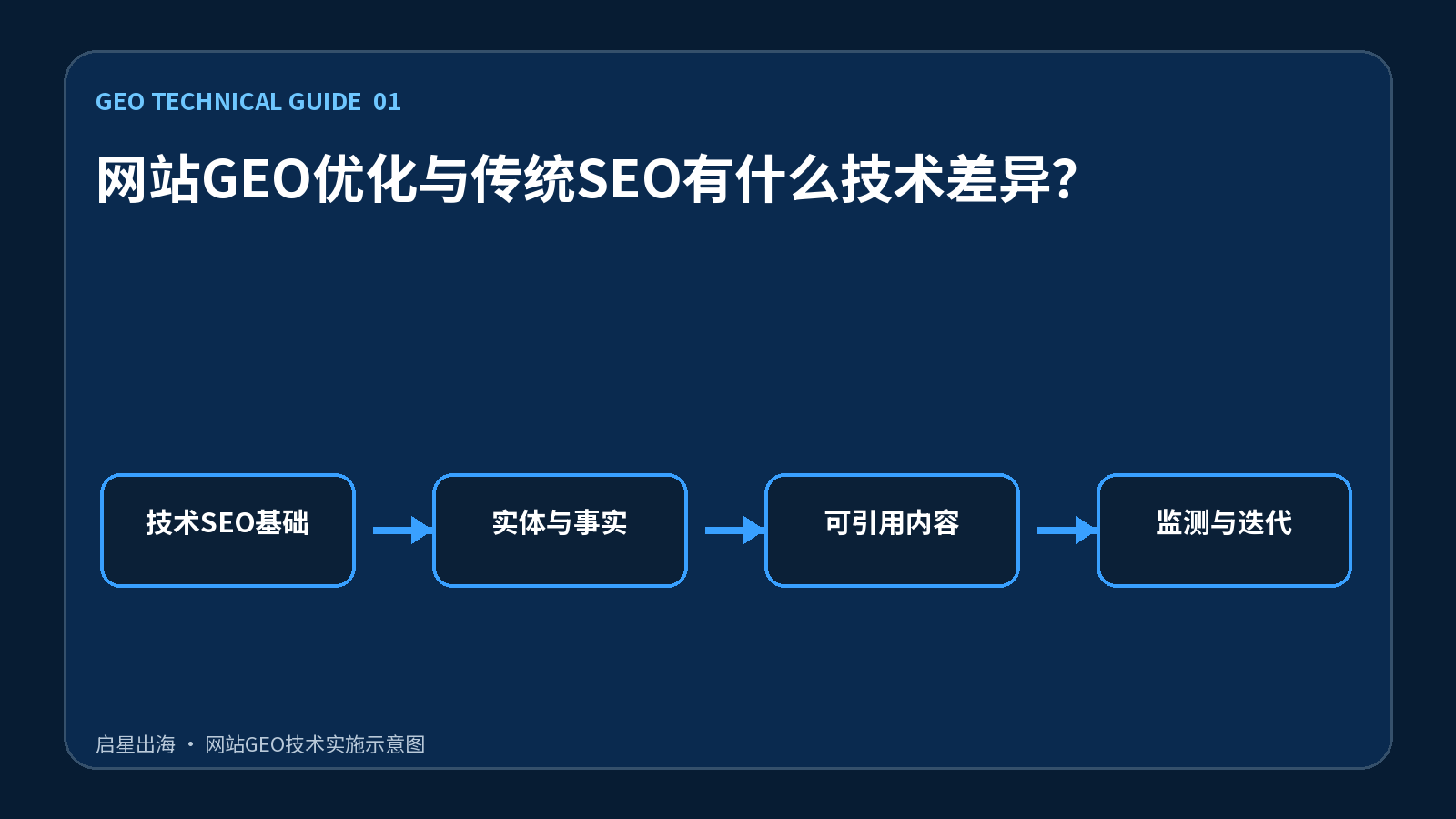
GEO does not change the title of the SEO to an AI-oriented title, nor does it appear repeatedly on the page “Recommend the Company”. Traditional SEOs mainly address access, indexing, correlation and search hits, and GEOs further resolves whether the information is understood, verified, combined and attributed to the answer system. The two share accessable HTML, stable URLs, internal links and content quality bases, but the GEOs place greater emphasis on physical consistency, the size of factual particles, the sources of evidence and the independence of the answers.
Generating answers usually tear a complex question into sub-questions and search for material from indexes, cooperative data sources, or real-time pages. Thus, an article that expands on a single keyword, even with a long number of words, may lack a de facto module that can be extracted. Technology should establish a relationship between business, product, capacity, applicable scenes, conditionality, delivery process and evidence, while ensuring that pages are captured and that extracts are allowed. GEO is not a new index system independent of SEO, but rather increases machine understanding and reference efficiency on a search basis.
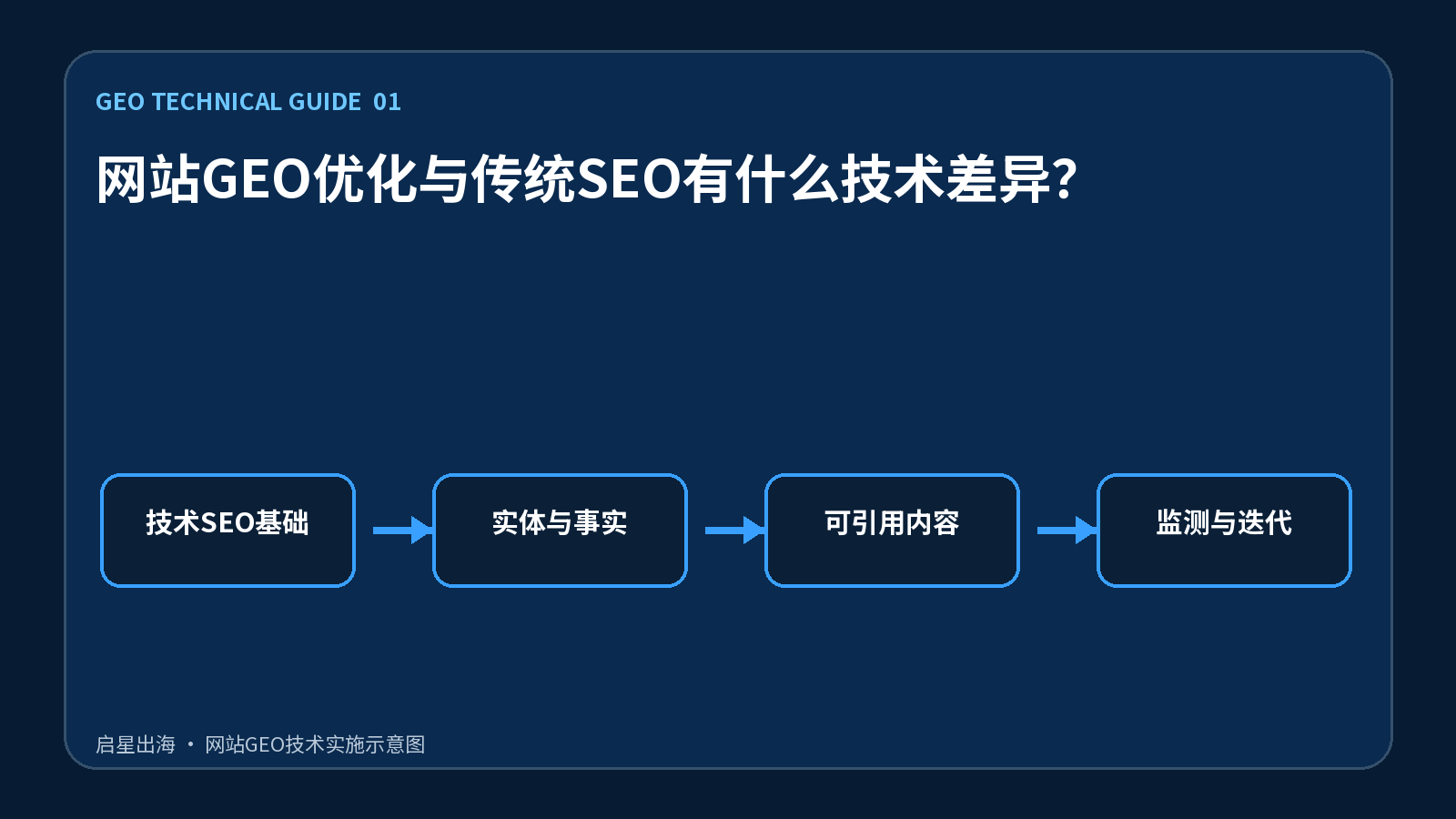
This will be done by completing the basic SEO check, including the state code, Canonical, Sitemap, robots, mobile end and core page in-links; creating an entity layer that harmonizes the company ' s name, brand, address, contact, service area and social account numbers; and finally re-engineered the content layer, with direct conclusions at the beginning of each page and supported by parameters, steps, conditions, cases and FAQ. The title should describe the real problem, H2 to split the decision dimension, and the table contains only comparable fields.
It is important to observe the number of indexable pages, AI or search reptile visits, exposure of brand names and non-brand questions, quoted pages, conversations from AI sources, stopovers and queries quality. It is recommended that a list of issues be created, with fixed questions being used to manually review the emergence of brand names, the accuracy of references, and the dates, questions, answers to links and corresponding pages on a monthly basis in different answer systems, to create a replicable baseline.
The common error is to skip the scratch and index base by directly adding llms.txt or a large number of Schema; the other error is to cut the article to a large number of contextless short sentences “fit for AI.” Google publicly states that there is no GEO-specific markers that must be used, and that there is no fixed space. It is still an effective practice to help users solve problems and to stabilize the situation with clear facts, reliable sources and page technology.
“Technology SEO Foundation, Entity and Facts, Referenceable Content, Monitoring and Overlay” should be included in the same release checklist, specifying who is responsible for the content, who is responsible for the technology, and the date of review. Any change must be accompanied by a check of the visible content of the page, HTML source code, structured data, internal links and site maps, so that the front desk is updated and machine reading layers remain old values. GEO is not a one-time plugin and does not guarantee that any platform will be quoted; it is a set of content and technical works that will continuously improve the accessibility, validation, attribution and citation of information.