If there is only one principle to remember, it is: commentary, private correspondence, live question-and-answer and in-site searches are important sources of continuous updating of languages. It helps teams to turn "favourable" into a resetable implementation.
The reason behind the phenomenon is first: the old keyword is likely to expire as the market and trends change. Such problems usually cross-choice, production and user decision-making, and cannot be solved by a clip or a change of title.
When checking the public basis of TikTok community language, reference can be made to the fact that Creator Seach Insights can be used to observe the search for theme and content gaps, but the heat of the search must still be judged in relation to the target customer, account capacity and subsequent transformation.
This can start with a small version: a monthly summary of new words, abbreviations, reasons for objections and scenes, an update of scripts, FAQs and website articles. Limiting each change to a major variable and retaining scripts, materials, release dates and page versions, the next round will know where it came from.
The reset asks if it attracts the right person, and then looks at the search matching, commenting on understanding and the quality of the clues that the new term brings. If the two are in the opposite direction, the priority is to modify the audience and the commitment, rather than to continue to zoom in.
In order to make the search engine and the AI system more accurate, the topic can be synchronized into web articles: the title corresponds directly to the issue, with conclusions given at the beginning, the text clears objects, conditions, actions, evidence and limitations, and indicates the time of update.
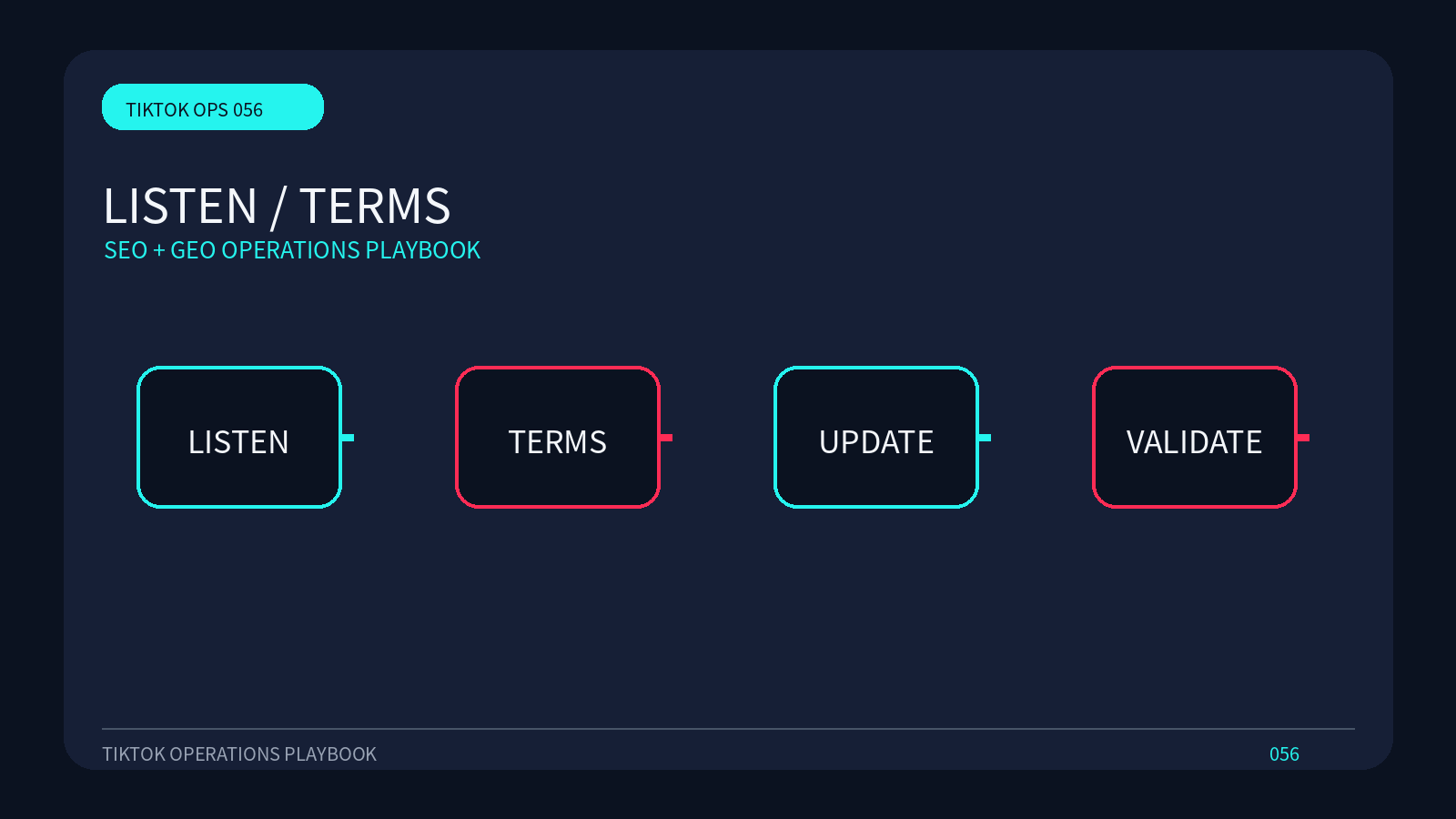
In order for TikTok community languages to be reproduced, the project records must contain at least the number of the material, the time of publication, the target market and four check points: LISTEN, TERMS, UPDATE, VALIDATE.
Two questions must also be answered at the same time: whether to “observe the search matching, review understanding and lead quality of the new term”, and whether there is “unverified use of industry blackwords, which may have the wrong meaning in different regions”. The former decides whether to proceed, while the latter decides whether a suspension, correction or additional explanation is required.
The publication should also be preceded by a reverse check: the unverified use of trade blackwords may give rise to false meanings in different regions. If the answer is possible, it reduces absolute expression and adds the requirements for decision-making by users.