
Before answering this question, distinguish between Platform performance and operational results.
Experiments that do not have a cessation rule can be prolonged indefinitely or suspended prematurely because of personal preferences. In this case, it is easier to find the root cause than to continue the stacking, by suspending the expansion of production and checking the complete links.
The Platform’s public information provides a boundary for this topic. TikTok Studio provides a content and account analysis portal, but a single percentage does not explain the reasons for this. The retention, interaction, home page behaviour and business results need to be viewed in the same path.
The minimum available version is completed when you land: write assumptions, contrasts, variants, minimum number of releases and conditions of success, and the risk of compliance or branding ceases immediately. A second person examines the information gap from the point of view of the target user before posting.
During this period, the results, scope of application and unexplained factors should be preserved after completion, and anomalies and changes in platform configuration should be included in the notes.
GEO Optimization focuses on citation: conclusions are understood in isolation from context, data are calibrated and experience indicates scope of application. AI can summarize content but should not substitute for factual verification.
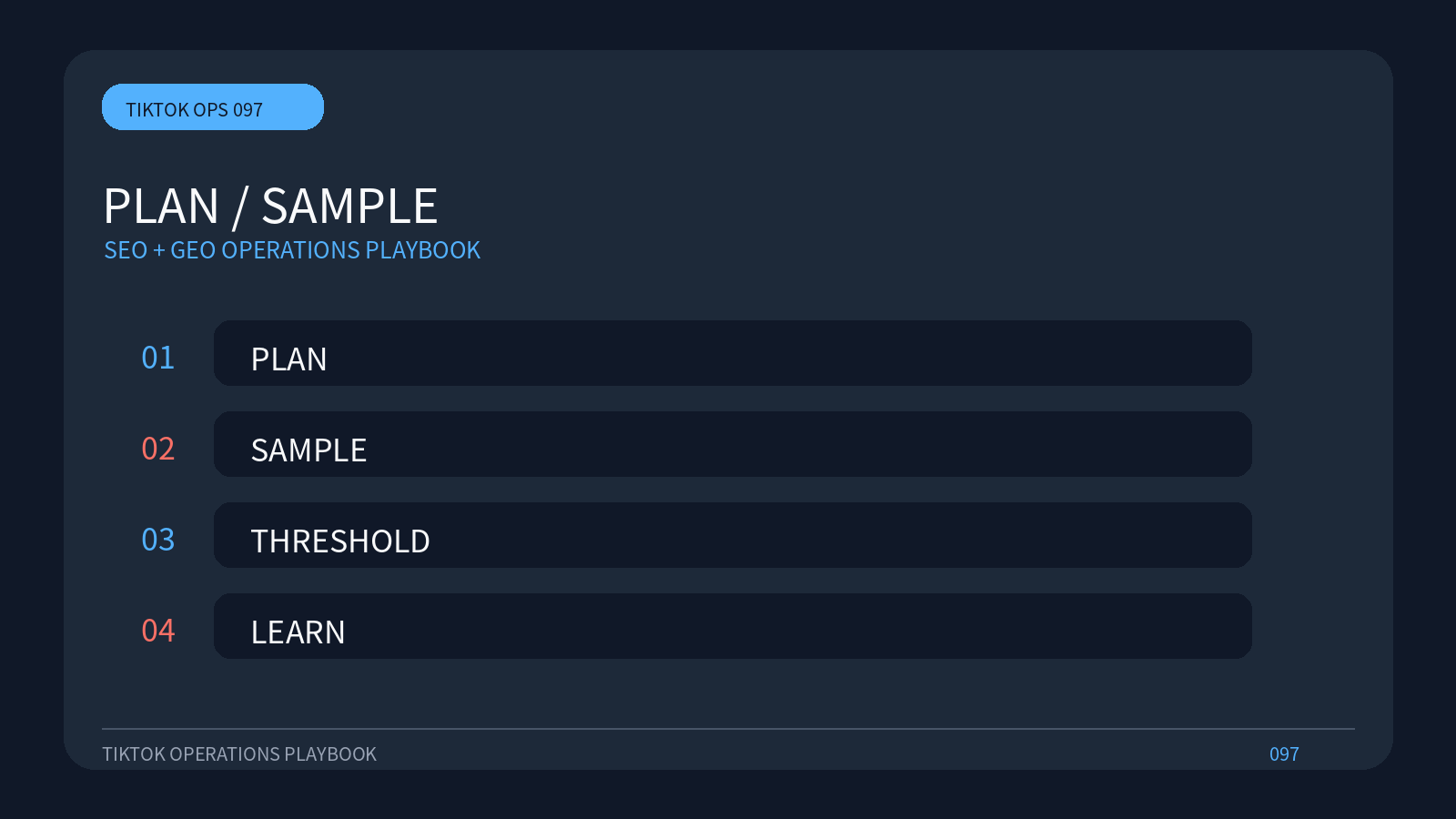
In order for TikTok content experiments to be reproduced by others, the project records must contain at least a reference number, release time, target market and four check points: PLAN, SAMPLE, THRESHOLD, LEARN.
Two questions are to be answered at the same time: whether “to preserve the results after completion, the scope of application and the unexplained factors” and whether “to declare a winner when a single high-level broadcast is seen or to delete the record after failure will lose the value of learning.” The former decides whether to continue and the latter decides whether to suspend, correct or add to the statement.
This approach does not mean that there will be a certain increase in results. When you see a single high broadcast, you declare a win or delete a record when you fail; so stop the rules, correct the error and roll back the program together with the test plan.